
“Fluid Kinship: Watershed, Foodscape, Human Tectonics (親緣流域: 水系、食野與造景力)” describes a methodology that understands watersheds as relational infrastructures, foodscapes as ecological and cultural metabolisms, and human activity as a form of geological-scale force—linking these systems across scales to reconfigure kinship as a fluid, interdependent network between humans and more-than-human environments.
Overview:
The touring exhibition Fluid Kinship: Watershed, Foodscape, Human Tectonics is preceded by a series of research initiatives developed in 2024–2025 and documented in the publication Edible Cities, Mobile Rivers by SUAVEART. Bringing together six scholars and contributors from different regions, the research explores how cultural landscapes are shaped through diverse histories, geographies, and ethnocultural contexts.
The research outcomes will be the reading reference and presented together through a touring exhibition in 2026-2027, inviting artists and cultural practitioners to engage in archival inquiry and artistic experimentation. Together, we would like to examine how grains and historical cultures intertwine, accumulate, and transform over time, while also tracing the continuity and regeneration of riverine landscapes and traditional knowledge within contemporary local communities.
The research framework encompasses Iran, India, Indonesia, the United Kingdom, Italy, and Taiwan, regions that each respond in distinct ways to “rivers” and “grains,” understood both as conditions of survival and as the spiritual and cultural core of society.
Starting in 2026, the exhibition will expand into local communities, fostering dialogue with situated forms of knowledge and lived experience. Through experimental and visual art, it unfolds as a dynamic exploration of food, culture, philosophy, ecology, history, economics, and social systems. It invites audiences to reconsider the intricate relationships between nature and everyday life—from seeds and fields, to rivers and ports, and ultimately to households and streets.
Artists and cultural practitioners are invited to respond to the exhibition’s themes through their own ways of thinking, addressing present-day challenges, lived conditions, and the possibilities of working together across territories and beyond cultural boundaries. Each work is not a static display, but an extension of research itself: evidence of the ongoing flows between individuals and society, and between human life and ecological systems.
Curatorial Framework
【Watershed】
Rivers exist within temporalities far older than humanity itself. Flowing through deep time, they have shaped the contours of the Earth and the conditions for life to emerge. Rivers are not merely accumulations of water, but dynamic fields of energy; their movements and convergences constitute a primordial force that forms species, ecologies, and the spaces in which civilizations take root. Traversing mountains, valleys, and plains, rivers carry sediment, nourish agricultural lands, and transform the potential energy of highlands into the grains of the lowlands, enabling the development of farming, settlement, and technological knowledge.
Rivers are also organic matrices of landscape, civilization, and social networks. Their vitality is not linear, but rhizomatic — branching, entangling, and continuously unfolding. Rivers have guided patterns of migration and given rise to systems such as the Khazan embankments of Goa, India, and the collective water-temple governance of the Subak system in Bali, Indonesia, revealing profound intersections between engineering, spirituality, and everyday life. Within these pulsating ecologies, rivers are not rigid boundaries, but permeable membranes through which matter, energy, and forms of relational exchange circulate between land and water, humans and the more-than-human world.
Here, we return to a fundamental question: What is water? What is a watershed?
Water is approached as both material and metaphor — existing simultaneously across scientific, geographical, cultural, and psychological dimensions. The research team investigates water’s multiple ontologies, examining its roles within physical environments, symbolic systems, and human consciousness. Through this multidimensional lens, water becomes a medium that links scientific observation with spiritual intuition.
The invited artists further explore cosmologies in which water is understood not as a “resource,” but as kin. In these worldviews, water is regarded as alive, sentient, and moral. Drawing from indigenous and vernacular epistemologies, this inquiry foregrounds water as a living presence that continually connects humans, non-human beings, and deities through ongoing relations of exchange.
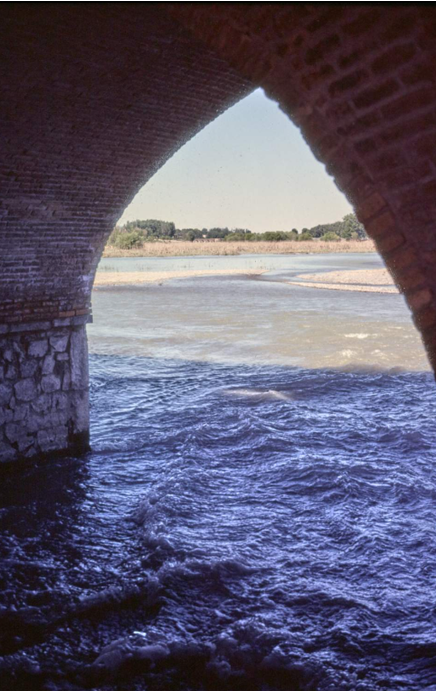
Unknown Architect, Allahverdi Khan Bridge: Underside of bridge, view downstream over Zayanda River through arch between piers, 1599-1602, Brick, 297.76 metres long, Isfahan. Royal Ontario Museum and Isfahan Urban History Project, Aga Khan Documentation Center at MIT.
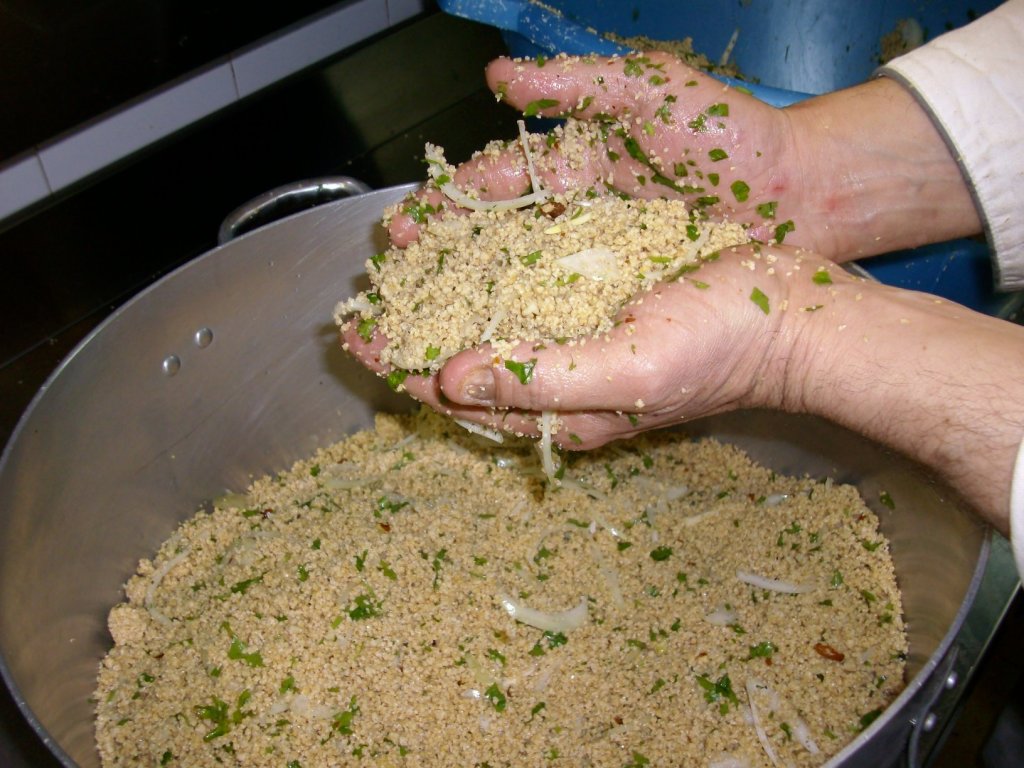
Culinary interview conducted by Martina Leone. Photography: Martina Leone
【Foodscape】
The rhythms of life have never existed in isolation. Grain is a civilizational language that transforms the kinetic energy of rivers into chemical energy; rice and wheat are not merely sources of nourishment, but crystallizations of riverine force — flowing water stored, transformed, and metabolized into the foundations of collective survival and social life. Through grain, the natural rhythms of rivers become quietly encoded into human calendars, agricultural cycles, belief systems, and ritual practices.
Grain has also profoundly shaped the evolution of civilization itself. Through sowing, irrigation, harvesting, and storage, human societies established social orders and organized the rhythms of survival through cyclical labor. Histories were written through festivals, offerings, and culinary rituals passed across generations. From river-valley settlements to port cities, from terraced landscapes to marketplaces, rivers and grains are deeply interwoven within historical trajectories, urban formations, religious ceremonies, and foodscapes, forming a fluid kinship that extends beyond the Anthropocene and remains intimately embedded within our collective lifeworlds.
This session further explores the fluid relationships embedded within food cultures, tracing how rivers mirror the movements of human migration and agricultural exchange, and how culinary traditions continuously transform through mobility, trade, and ritual. It considers how food carries local knowledge, ecological cycles, and collective memory, while examining how cooking practices and ceremonial acts become living archives of environmental adaptation and cultural resilience.
Here, eating is no longer understood merely as an act of sustenance, but as a cultural expression and a cosmological practice. Every act of planting, cooking, and sharing becomes connected to the currents of rivers, the breathing rhythms of the land, and the continuously evolving relationships between humans and the more-than-human world.

Irrigation Channel and Shrine within the Subak System, Bali. A small shrine situated beside an irrigation channel marks the intersection of hydraulic infrastructure and ritual practice. Within Subak, water management is inseparable from spiritual cosmology, local governance, and collective responsibility. 2025. Photo: Yipei Lee
【Human Tectonics】
Human Tectonics does not merely refer to the movement of geological plates, but seeks to reconsider how humanity itself has become a geological force shaping the world. Within the context of the Anthropocene, human activity has profoundly altered river courses, soil structures, climatic cycles, biological habitats, and planetary energy systems. Urban expansion, dam construction, resource extraction, agricultural production, and global logistics networks operate like forms of anthropogenic tectonic movement, continuously rewriting the conditions of landscapes and life itself. This chapter focuses on these fluid terrains shaped through the entanglements of humans, technology, capital, nature, and more-than-human beings.
To regard water as kin is to enter a cosmology in which rivers breathe, rice listens, and humans no longer stand at the center of the world, but instead participate within an ecology of co-becoming beyond the logic of the Anthropocene. Within this perspective, humanity is no longer understood as a subject positioned above nature, but rather as one node within the Earth’s interconnected systems of flow — intimately entangled with hydrology, climate, vegetation, soil, microorganisms, and mythological belief systems.
Such a perspective also proposes an ethical transformation: a shift from observing and possessing nature toward living in reciprocity with it. As the Anthropocene increasingly exposes the fractures and imbalances in our relationship with the Earth, we are compelled to relearn how to dwell within the flows that sustain life — rebuilding relational ecologies grounded in care, interdependence, offering, and mutual responsibility. This is not merely a question of environmental preservation, but of how humanity may fundamentally redefine its position within the cosmos.
This session proposes the notion of Ecologies of Co-Becoming: Beyond the Anthropocene, envisioning possible post-human and multi-species futures. Within such futures, water is no longer understood solely as a material substance, but as a presence that teaches new ethics of living. It reminds us that humans are not isolated subjects standing apart from the world, but beings continuously formed through entanglements with other lives, elements, and temporalities. The movement of rivers, the rhythms of tides, the growth of plants, and the dispersal of fungi all participate in the making of the living world. Within this ecology of co-becoming, life is no longer premised upon domination and categorization, but upon ongoing relations of exchange, perception, and coexistence.
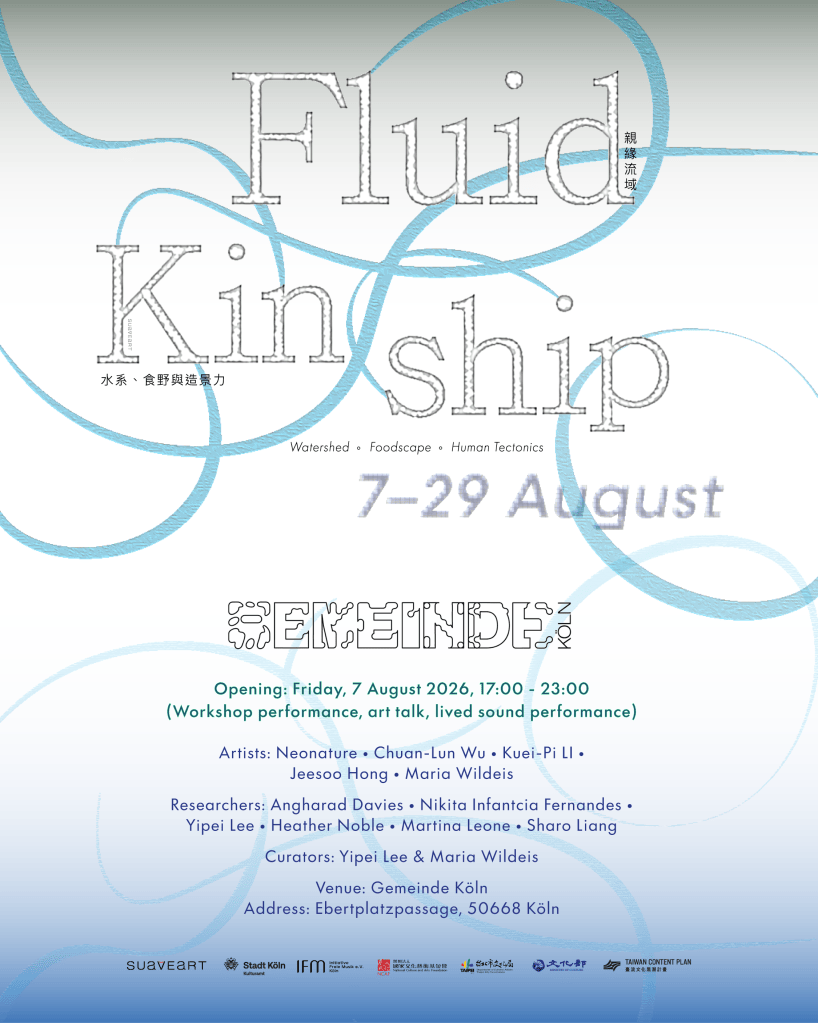
Fluid Kinship: Watershed, Foodscape, Human Tectonics
at Gemeinde, Cologne, Germany
brings together a series of experimental artistic practices that invite audiences to explore the invisible forces that connect us. Through speculative ecology, future scenarios, edible dynamics, and research-based inquiry, the exhibition reimagines relationships between humans, more-than-human worlds, and living environments.
Curated by Yipei Lee, Maria Wildeis
Featuring works by Neonature, Chuan-Lun Wu, Kuei-Pi LI, Jeesoo Hong and Maria Wildeis.
Researchers: Angharad Davies, Nikita Infantcia Fernandes, Yipei Lee, Heather Noble, Martina Leone, and Sharo Liang.
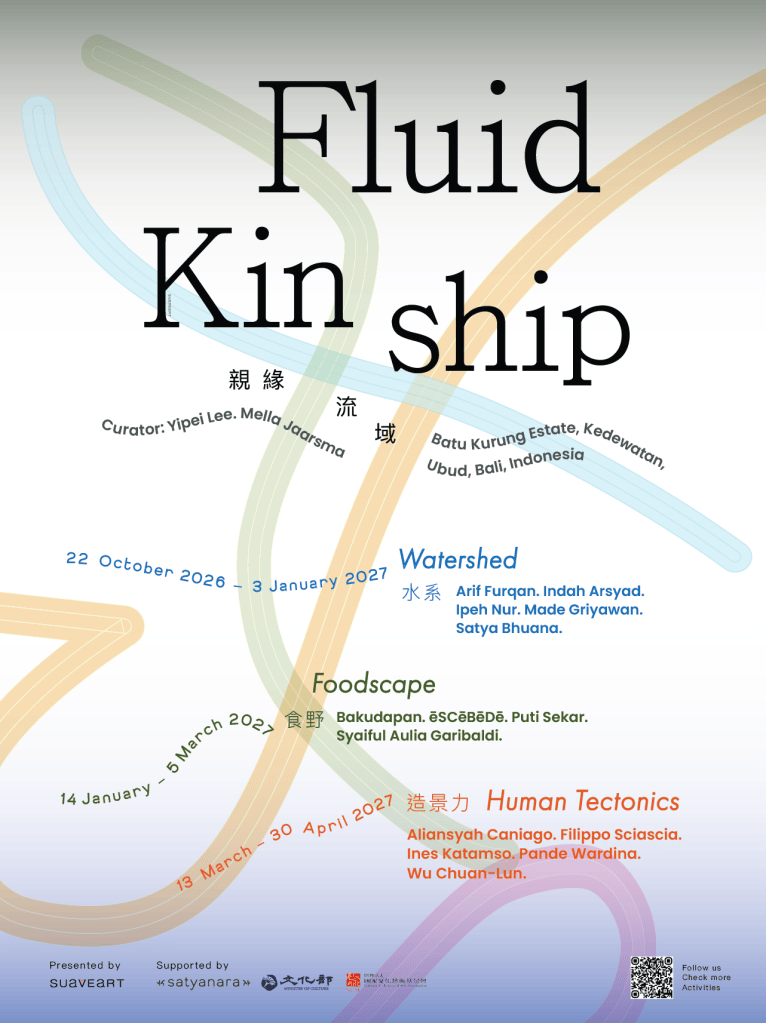
Fluid Kinship: Watershed, Foodscape, Human Tectonics
at Satyanara, Ubud, Bali, Indonesia
will invite artists to participate in three sessions, taking Subak knowledge as a starting point to explore and initiate conversations around contemporary issues in Bali and beyond.
Curated by Yipei Lee, Mella Jaarsma
Featuring works:
Session 1: Watershed|Arif Furqan, Indah Arsyad, Ipeh Nur, Made Griyawan, Satya Bhuana
Session 2: Foodscape|Syaiful Aulia Garibaldi, Collective ēSCēBēDē, Collective Bakudapan, Puti Sekar
Session 3: Aliansyah Caniago, Filippo Sciascia, Ines Katamso, Pande Wardina, Wu Chuan-Lun
Researchers: Angharad Davies, Nikita Infantcia Fernandes, Yipei Lee, Heather Noble, Martina Leone, and Sharo Liang.


