Jacob Charles 雅各布・查爾斯
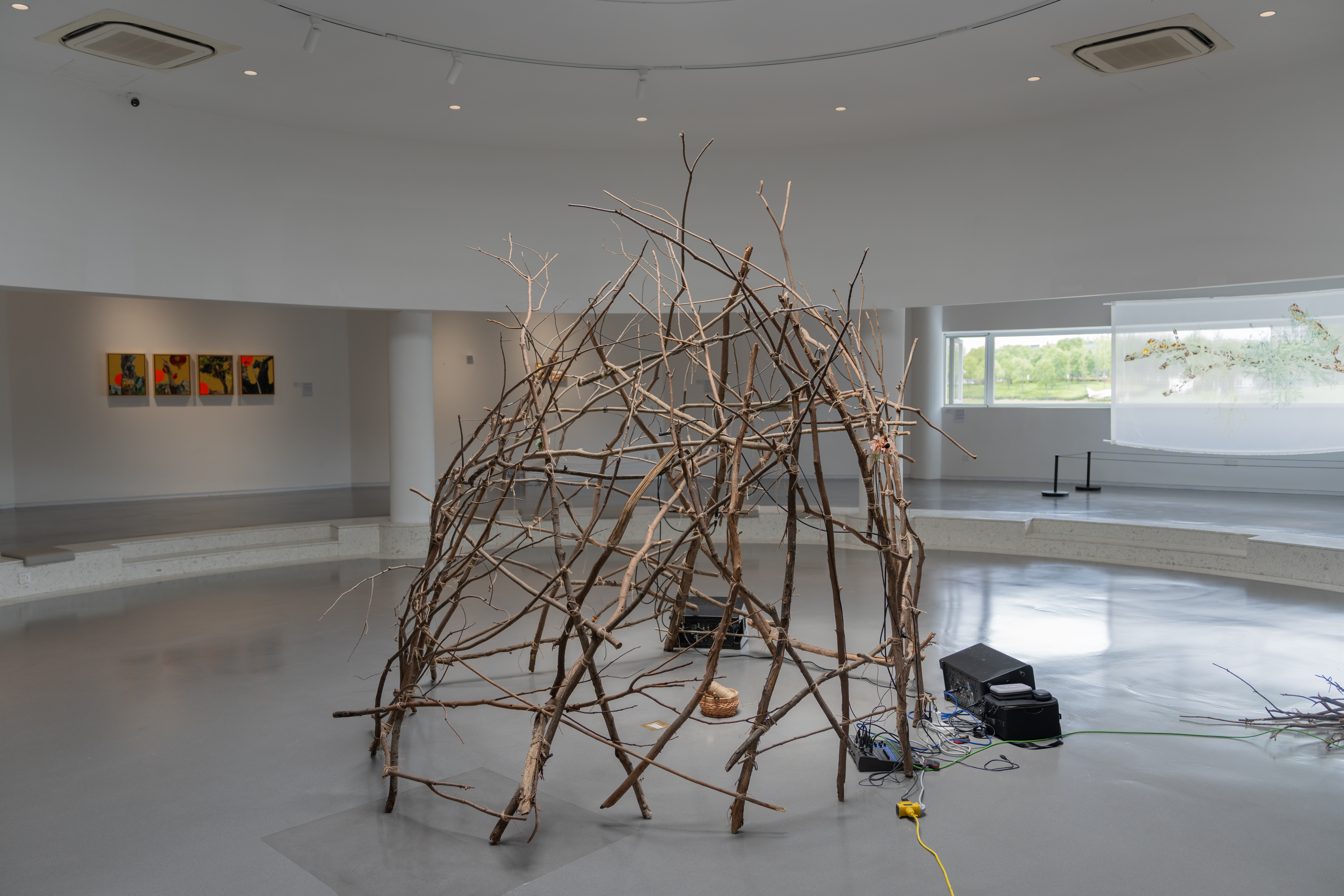
Shadow / Echo: Breathing Stone, Variable, Tree branches, piezo sensors, microphones, computer, speakers, 2026
林影迴 / 響:呼吸石, 依場地而定,
樹枝、感應器、麥克風、電腦、揚聲器, 2026
Photographer: Huang Xinyuan
Courtesy of SUAVEART
About Artwork
Shadow/Echo: Breathing Stone is part of an interactive sound sculpture series inspired by the contemplative tradition of Chinese literati scholar stones. Instead of treating the stone as a closed object for distant viewing, Jacob Charles creates a hollow framework in the form of a stone, allowing audiences to see into its interior and imagine the slow geological breathing of the stone from within.
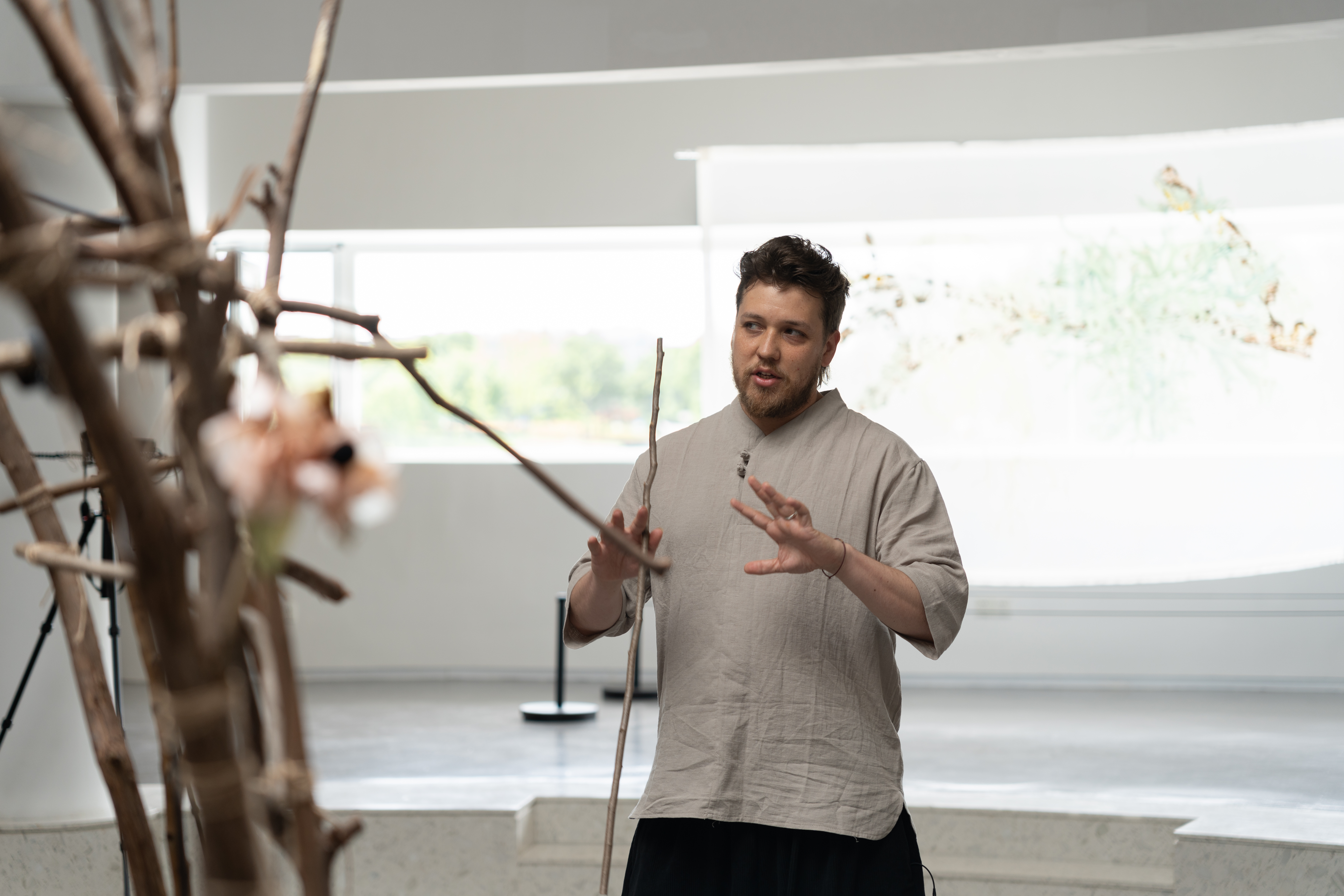
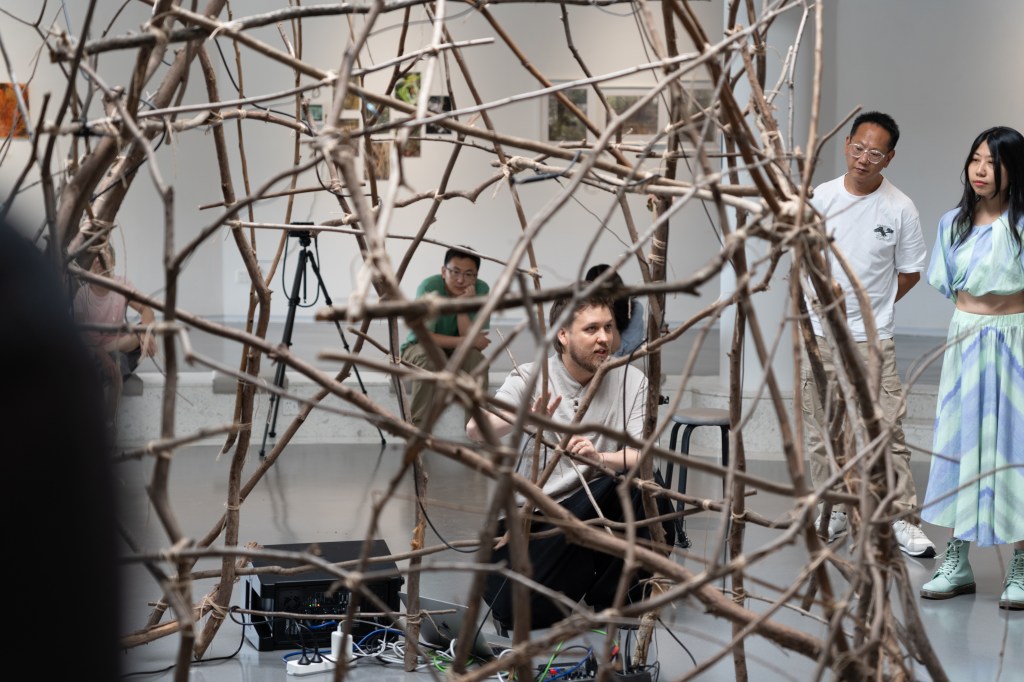
This version borrows its shape from Huineng’s Refuge Rock in Shaoguan, Guangdong and is constructed from wood gathered in Charles’s Shanghai studio garden, including metasequoia, camphor, and wintersweet. The hollow interior becomes a refuge for multimodal poet and performance artist Jill Zheng, while audience members surround the sculpture and enter the performance from all sides.
Through tactile sensors embedded in its structure and microphones hidden inside two bioplastic flowers created by Jill Zheng, the work gathers vibrations, whispers, and private thoughts from performers and visitors. These sounds are transformed into an imaginary soundscape drawn from the natural environment around the exhibition space, creating a shared field of listening between body, stone, voice, and place.
《林影迴 / 響:呼吸石》是一個互動聲音雕塑系列中的作品,其靈感來自中國文人賞石傳統中的「供石」文化。查爾斯並未將石頭視為一個供人遠觀的封閉物件,而是以「石」的形態建構出一個中空結構,使觀眾能夠進入其內部的想像空間,感知石頭緩慢而深層的地質性「呼吸」。
此版的造型借用了廣東韶關 「慧能避難石」 的形態,並以藝術家在上海工作室花園中收集的木材搭建而成,包括水杉、樟木與蠟梅等材料。中空的內部空間成為多模態詩人藝術家 Jill Zheng 的臨時棲居之所,而觀眾則圍繞著雕塑,從不同方向進入這場表演性的感知場域。
作品透過嵌入結構中的觸覺感測器,以及隱藏於Jill 所創作的兩朵生物塑膠花內部的麥克風,收集表演者與觀眾的震動、低語與私密思緒。這些聲音隨後被轉化為源自於展覽現場自然環境的想像聲景,在身體、石頭、聲音與場所之間建構出一個共享的聆聽空間。
Jacob Charles is a qin performer, composer, and intermedia artist whose work treats sound as a living relationship between body, landscape, and material. Rooted in the ancient literati ideal of self-cultivation across music, painting, poetry, and thought, his practice expands the guqin through technically rigorous improvisation and innovative techniques, bringing the instrument into dialogue with field recording, handmade natural inks, landscape painting, interactive installation, and collaborative performance.
His works often unfold as resonant environments where gesture, breath, touch, and vibration become structural forces. Through qin performance, sound sculpture, seismic sensors, hydrophones, and environmental listening, Charles explores how listening can connect human presence with stone, water, wood, and place.
He studied guqin with Zhao Xiaoxia and composition with Ye Xiaogang at the Central Conservatory of Music in Beijing, where he later taught American Music and Literature. He is the co-founder of KONGQU, a structured improvisation troupe that brings artists across disciplines together to create performances where structure and improvisation hold performers and audiences within the powerful fragility of a shared moment.
雅各布・查爾斯是一位古琴演奏家、作曲家與跨媒材藝術家,其創作將聲音視為身體、自然景觀與物質之間持續生成的生命關係。根植於中國古代文人關於「琴、書、畫、詩、思」相互修養的傳統精神,他的實踐在保留古琴嚴謹技法與即興性的基礎上,不斷拓展這一樂器的表達邊界,使其與田野錄音、天然手工墨料、山水繪畫、互動裝置及協作表演形成跨媒介對話。
他的作品常以一種共振性的感知場域展開,在其中,身體動作、呼吸、觸覺與振動成為構成作品的重要結構。透過古琴演奏、聲音雕塑、地震感測器、水聽器以及環境聆聽等方式,探索聆聽如何將人的存在與石頭、水流、木材及地方精神重新連結。
他曾師從趙曉霞學習古琴,並於北京中央音樂學院師從小綱學習作曲,後於該校教授美國音樂與文學課程。他同時也是結構性即興團體 KONGQU 的共同創辦人。該團體匯聚不同領域的藝術家,透過結構與即興並置的協作方式,創造一種使表演者與觀眾共同置身於脆弱而強烈的當下經驗中的現場實踐。
Exhibition|Rhizomatic Echoes 林音・根韵
6 June – 12 July, 2026

