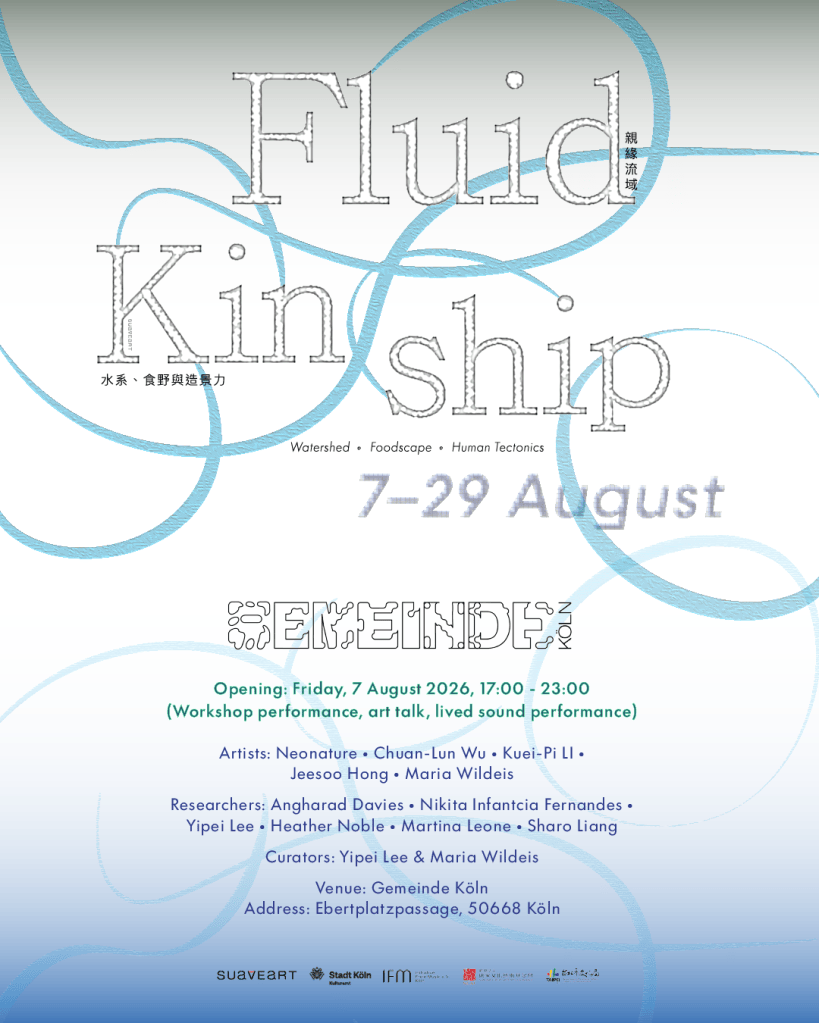
Opening Events
Workshop performance, art talk, lived sound performance
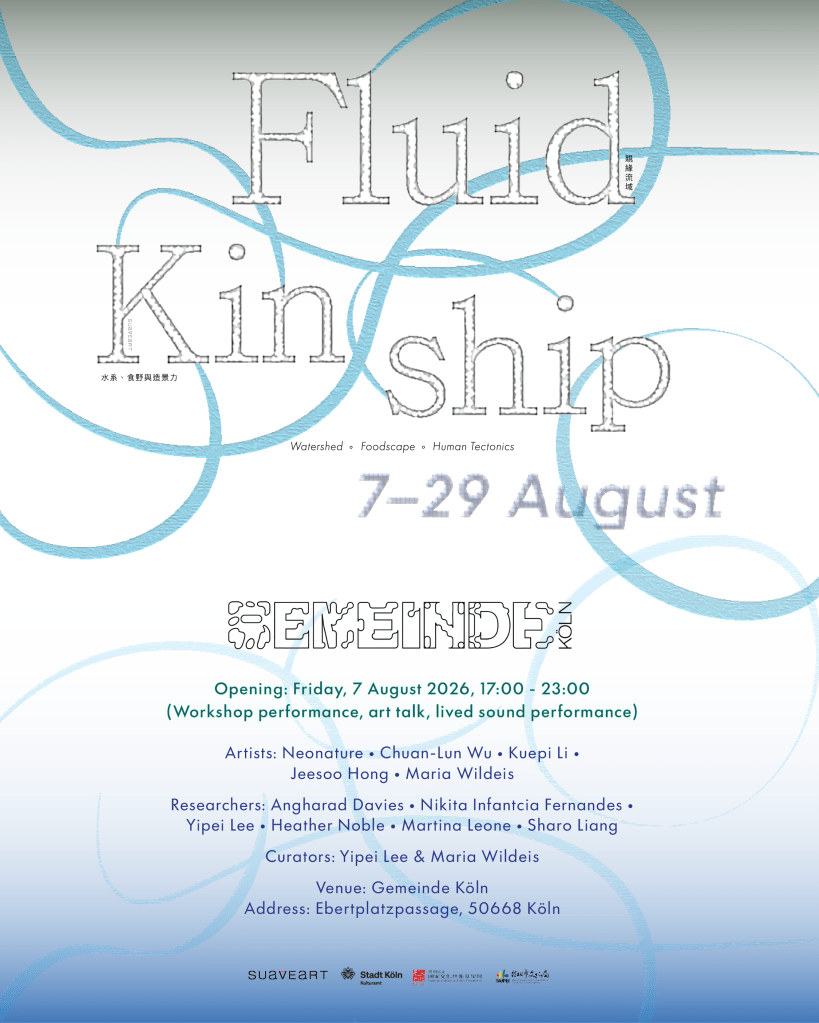
Friday, 7 August 2026, 17:00 – 23:00
Exhibition
7–29 August 2026
Venue
Gemeinde, Cologne, Germany
Artists
Neonature • Chuan-Lun Wu • Kuei-Pi LI • Jeesoo Hong • Maria Wildeis
Researchers
Angharad Davies • Nikita Infantcia Fernandes • Yipei Lee • Heather Noble • Martina Leone • Sharo Liang
Curators
Yipei Lee & Maria Wildeis
Organized by SUAVEART and Gemeinde Cologne
Supported by Stadt Köln, NCAF, and the Department of Cultural Affairs, Taipei City Government, Initiative Freie Musik e.V. Köln
21 July, 2026
As climate change accelerates, ecosystems continue to unravel, and geopolitical tensions expose the growing fragility of global infrastructures, Fluid Kinship: Watershed, Foodscape, Human Tectonics asks a deceptively simple yet profound question:
What if the future of civilization lies not only in technological innovation, but in returning to the river?
Opening in Cologne on 7 August 2026, the exhibition inaugurates an evolving international platform for artistic research and translocal collaboration across Europe and Asia. Rather than presenting ecology as a subject to be represented, Fluid Kinship approaches water, grain, landscapes, and human communities as active participants in shaping one another. Through contemporary art, scientific inquiry, and long-term field research, the project proposes that our relationship with the planet is not one of stewardship alone, but of kinship.
Developed by SUAVEART, the project unfolds through invitation and collaboration rather than a predetermined itinerary. Beginning in Cologne, future presentations will continue to emerge with partner institutions, artists, researchers, and communities across different regions. Each host contributes its own ecological knowledge, cultural histories, and artistic practices, allowing the project to evolve in response to local contexts instead of traveling as a fixed exhibition.
The project draws inspiration from philosopher Karen Barad’s concept of Agential Realism, the exhibition background considers agency as something produced through relationships rather than possessed by individuals alone. Rivers, grains, soil, infrastructures, technologies, and living bodies are understood as interconnected forces that collectively shape meaning. Visitors are therefore invited not simply to observe artworks, but to enter dynamic systems where meaning is produced collectively through material encounters.
For curator Yipei Lee, the exhibition begins with a simple yet profound observation:
“The rhythm of life has never been autonomous. Grain is the language through which rivers become civilization. Every harvest carries the movement, the memory of water, every ritual remembers a watershed, and every landscape bears witness to countless relationships between human and more-than-human worlds.”
Cologne marks the first chapter of the project. Shaped by the Rhine River and recognized as one of Europe’s leading centers for contemporary art, the city provides a context for exploring water infrastructures, migration, ecological memory, and the relationship between environmental change and cultural exchange.
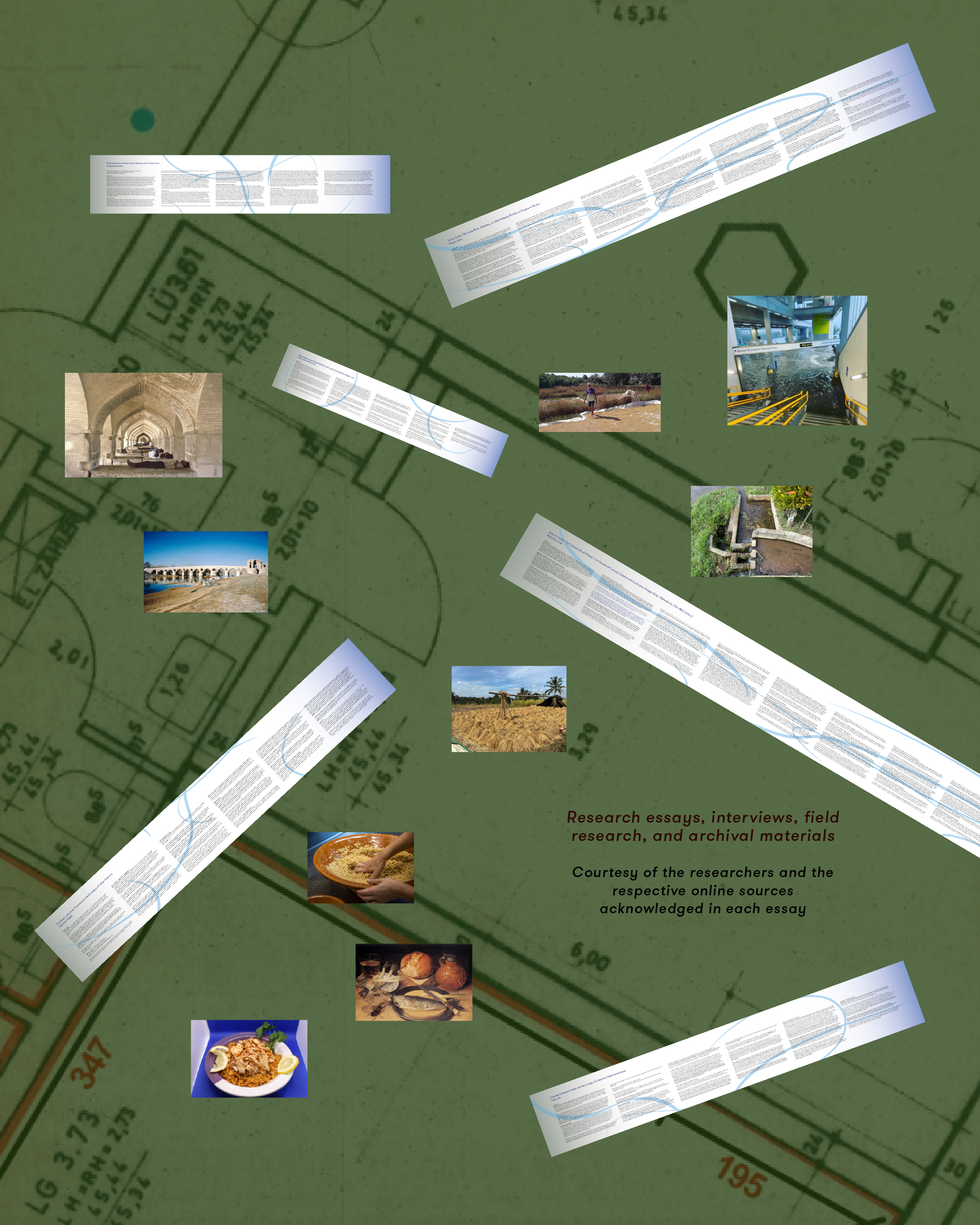
The exhibition brings together artists whose practices intersect contemporary art, environmental research, and speculative futures. New artworks by Wu Chuan-Lun and Kuei-Pi LI, together with a site-specific workshop performance by Jeesoo Hong, are presented alongside VR works by Neonature and a live sound performance by Maria Wildeis at the Opening Event. The project is further enriched by international researches featuring the work of Angharad Davies, Nikita Infantcia Fernandes, Yipei Lee, Heather Noble, Martina Leone, and Sharo Liang, whose investigations into rivers, food systems, urban ecologies, and cultural memory provide conceptual foundations for the exhibition.
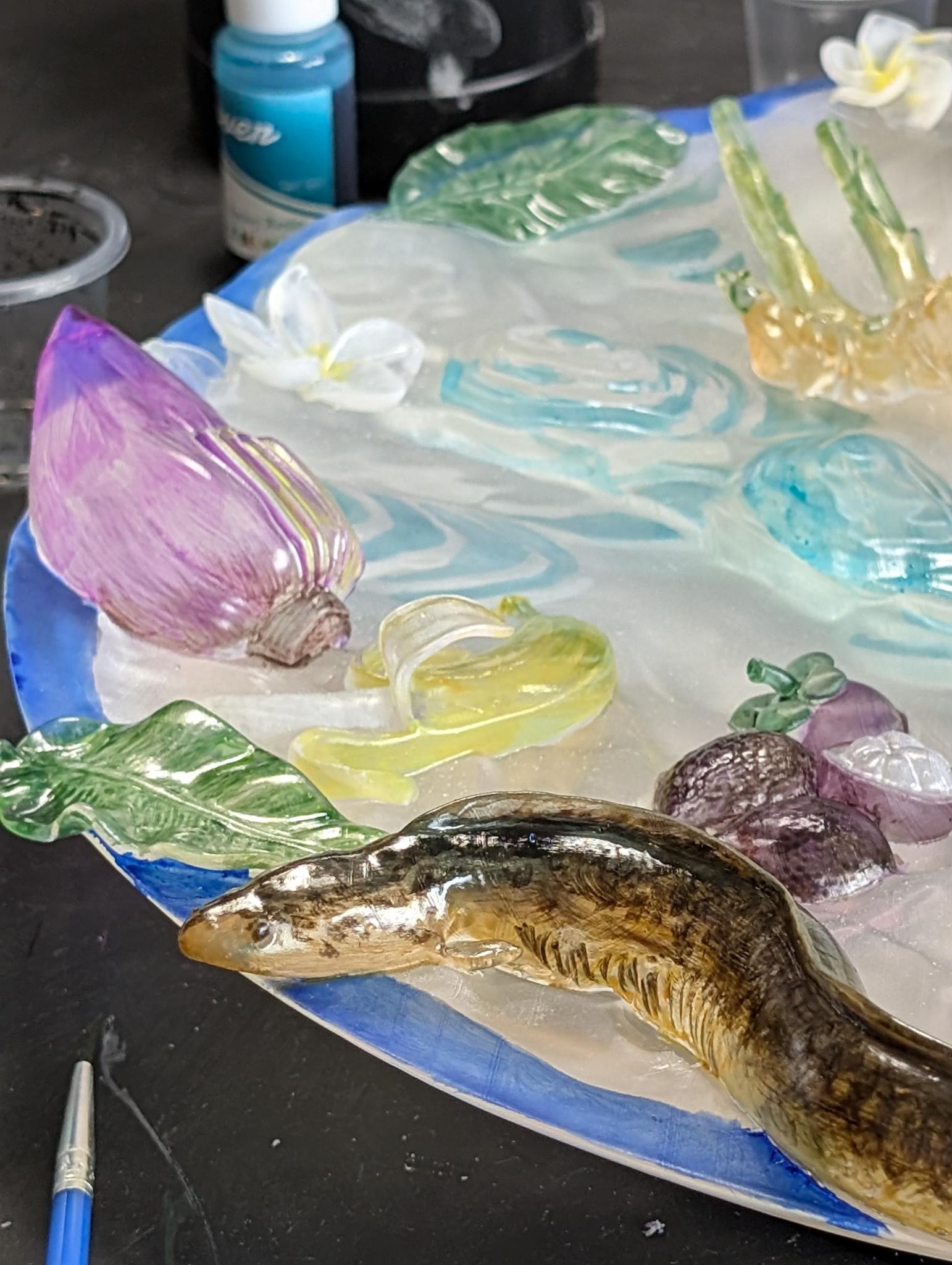
Highlights include Neonature’s Sponge City, a multimedia VR installation imagining a near-future metropolis sustained through the repair of broken hydrological cycles; Kuei-Pi LI’s Cloud is nothing, Thirst is everything, an embodied exploration of the invisible water consumption underpinning cloud computing and large language models; Chuan-Lun Wu’s Foodscape, a series of 3D-printed vessels inspired by Renaissance Palissy ware that brings together diverse Asian agricultural landscapes to question the artificialization and datafication of nature, alongside the resource-based management of water and food systems; and Edible Sound Sculptures by Jeesoo Hong, a participatory performance that turns the textures and sounds of eating into a collective act of composition.
Rather than proposing solutions to the ecological crisis, Fluid Kinship invites audiences to reconsider how relationships between humans and more-than-human worlds continue to emerge through reciprocity, care, and shared responsibility. As the project evolves across different cities and through new partnerships, it approaches curating as an ecological practice—not as the display of knowledge, but as the cultivation of relationships and the expansion of perspectives; not as the replication of fixed outcomes, but as an ongoing process of nurturing new dialogues, collaborations, and shared learning in each place it inhabits.
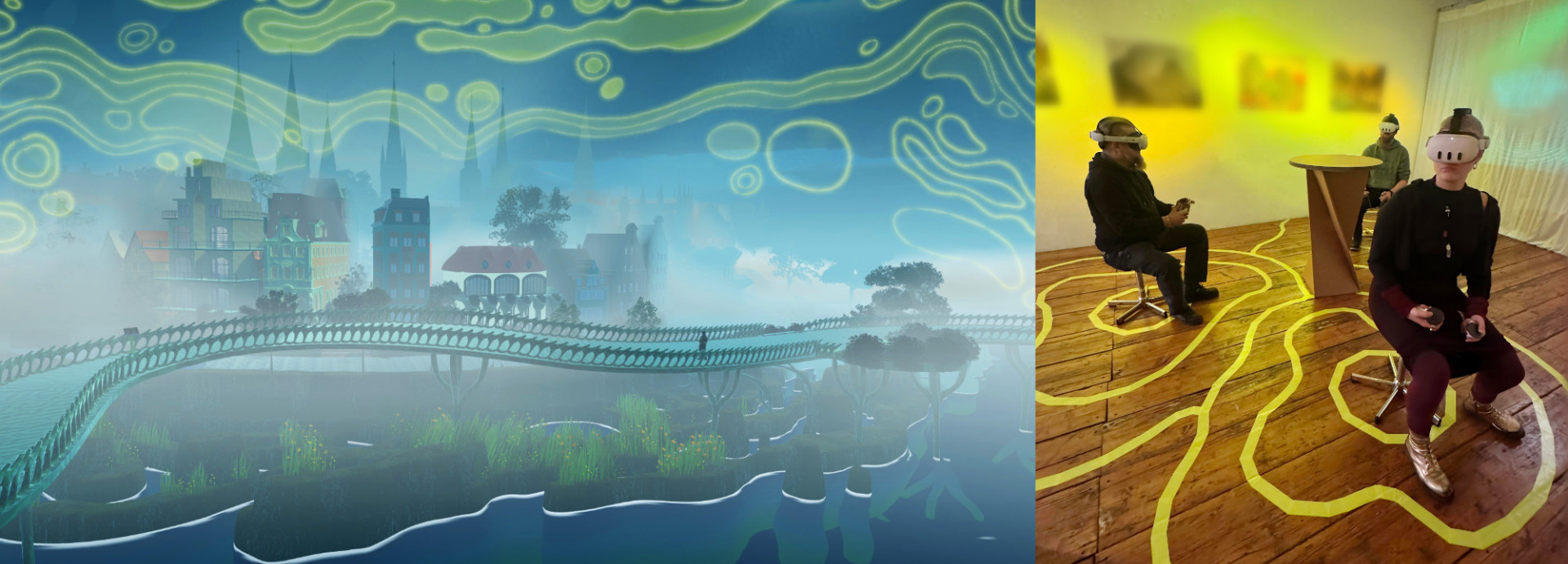
▲ Neonature|Sponge City; Dimensions Variable; 4K Video Projection, Meta Quest 3; 2024|Courtesy of the artist
◀︎ Wu Chuan-Lun|Landscaplate (working title) and its process; 2026|Courtesy of the artist
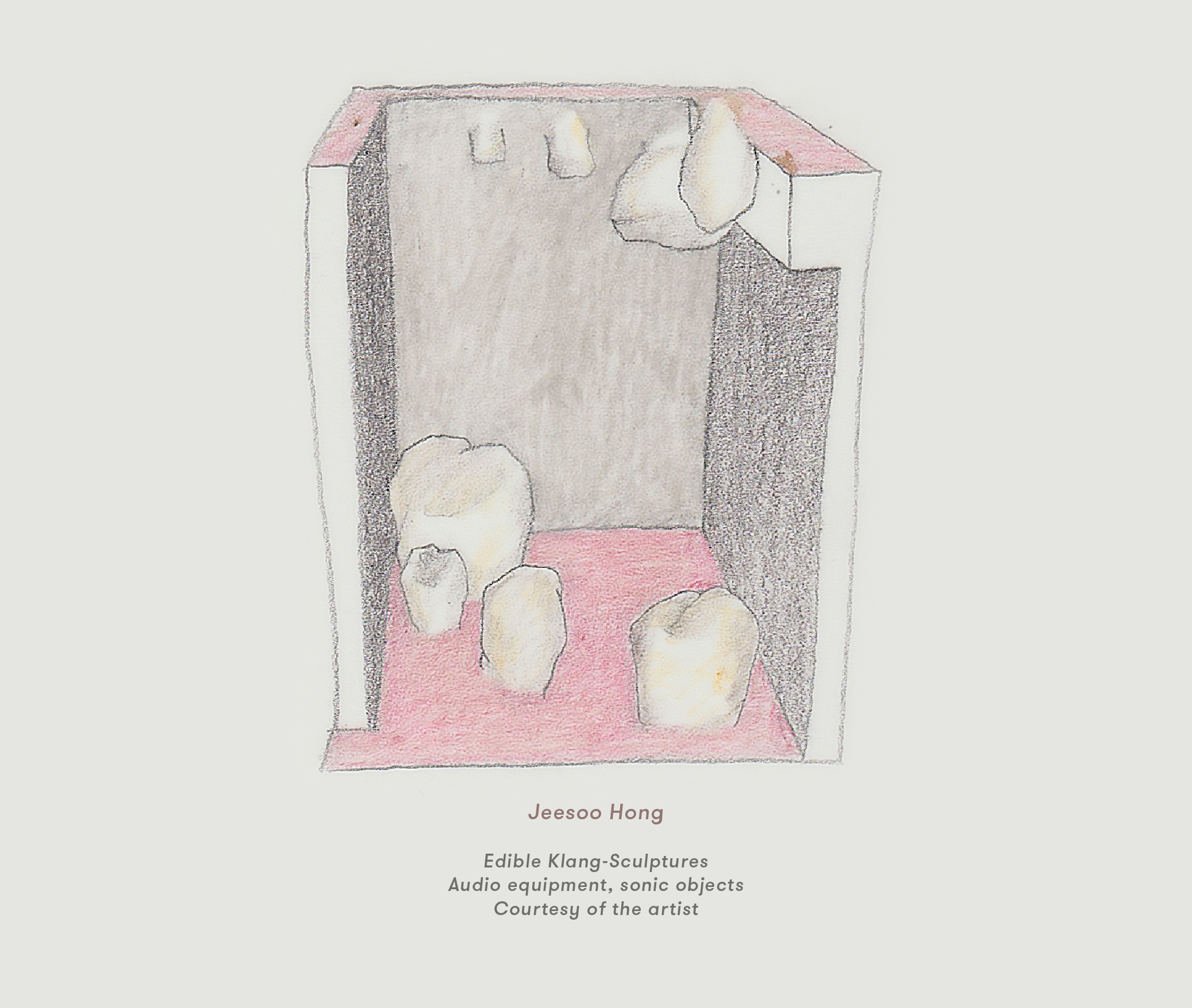
▲ Jeesoo Hong|Edible Sound-Sculptures; Audio equipment, sonic objects|Courtesy of the artist
◀︎ Research essays, interviews, field research, and archival materials|Courtesy of the researchers and the respective online sources acknowledged in each essay
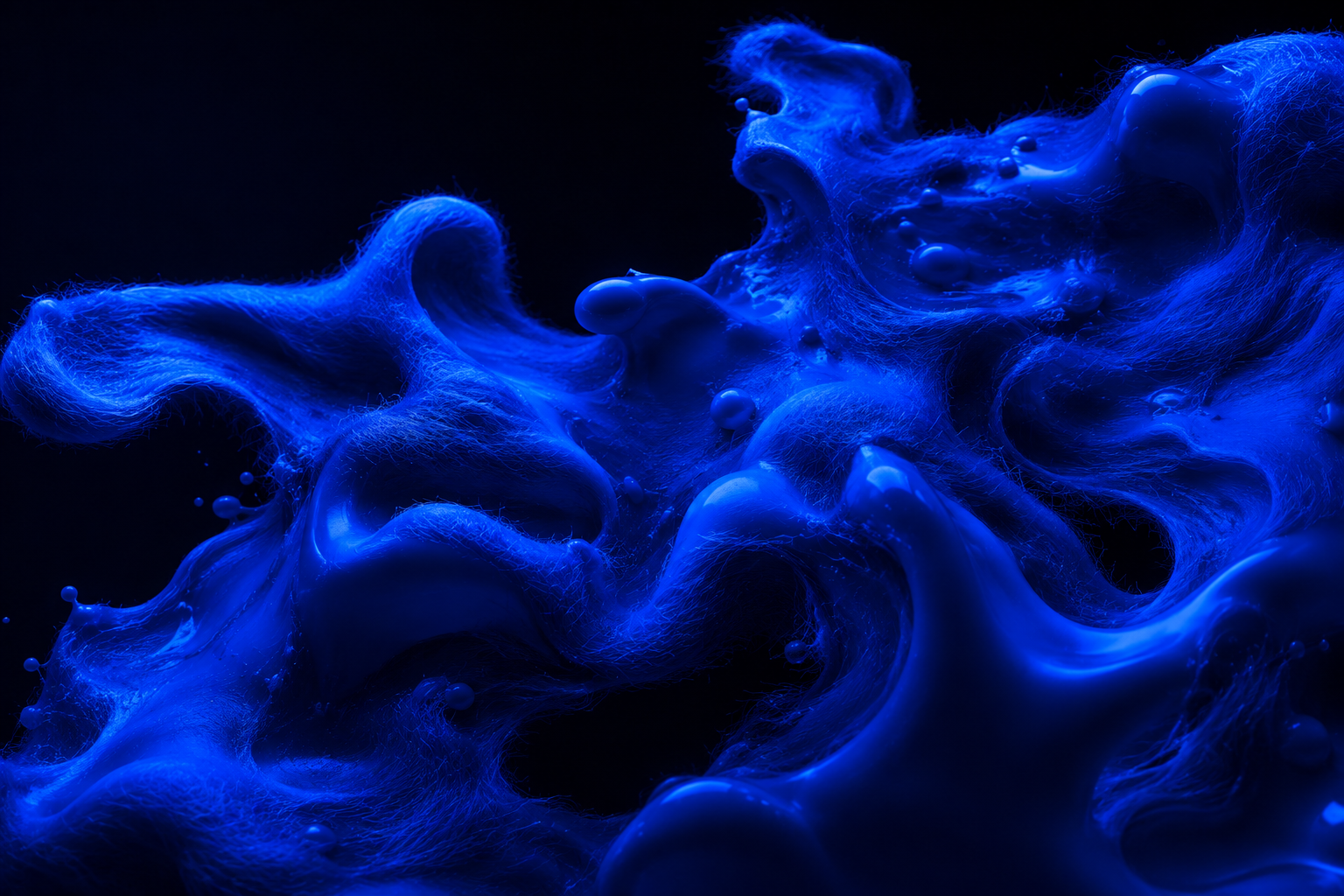
▲ Kuei-Pi LI|Cloud is nothing, Thirst is everything; Dimensions variable; Readymade|Courtesy of the artist
About SUAVEART
SUAVEART is a research-based curatorial institution exploring environmental issues, nonhuman perspectives, and island ecologies through the intersections of art, science, and everyday life. Emerging from long-term cultural exchanges initiated in Southeast Asia in 2008 and formally established in Taiwan in 2015, SUAVEART develops transnational collaborations through exhibitions, research, artist residencies, publications, workshops, and public forums. The organization is the member of international initiatives including Europa Nostra, the Climate Heritage Network, and the Preserving Legacies Network, fostering global dialogue on climate resilience, ecological futures, and cultural heritage. (https://suaveart.org/)
About Gemeinde
The place’s particular concern is to present art not only through the format of the showroom. Exhibiting is also linked to colonialism, where objects isolated from their environment were displayed as trophies in an exclusive building. The space seeks for alternative ways and focuses on an art that, as a mediator of knowledge, opens up new perspectives on our society and can be practiced as a shared ritual. Gemeinde Köln is interested in getting to know the motivation and individual topics of the people invited.
The art space is located at Ebertplatz in central Cologne / Köln, North-Rhine-Westfalia in an underground passage, close to a metro entrance. The passage is part of the biggest public space in the city, with a fountain (kinetic sculpture) in the middle and a bar. (https://www.gemeinde-koeln.org/)
2026 年 7 月 21 日
開幕活動
工作坊展演、藝術家座談、現場聲音演出
2026 年 8 月 7 日(五)17:00–23:00
展覽日期
2026 年 8 月 7 日-29 日
展覽地點
德國科隆 Gemeinde
藝術家
Neonature • 吳權倫 • 李奎壁 • Jeesoo Hong • Maria Wildeis
研究者
Angharad Davies • Nikita Infantcia Fernandes • 李依佩 • Heather Noble • Martina Leone • 梁棨筑
策展人
李依佩 & Maria Wildeis
主辦單位|細着藝術 SUAVEART、Gemeinde Cologne
支持單位|科隆市政府、國藝會、臺北市政府文化局、科隆自由音樂倡議協會
當氣候變遷加劇、生態系統持續崩解,地緣政治的不穩定也逐步暴露全球基礎設施的脆弱性,《親緣流域: 水系、食野與造景力》提出了一個看似簡單卻根本性的提問:如果文明的未來,不全是依賴科技,而是重新回歸到河流,會是什麼樣子呢?
展覽將於 2026 年 8 月 7 日下午五點於德國科隆藝術空間 Gemeinde 開幕,並以此為起點,展開一項橫跨歐洲亞洲、持續發展中的國際藝術研究與跨地域合作。
不同於將生態視為被觀看或再現的對象,《親緣流域:水系、食野與造景力》將水、穀物、地景與人類社群視為彼此交織、共同塑造世界的行動者。透過當代藝術、科學研究與長期田野調查,計畫重新思考人類與地球的關係——這不只是管理與保護的課題,更是一種共享生命、彼此依存的親緣實踐 (kinship)。
本計畫由細着藝術發起,前期與多位跨國研究者共同展開研究,並非依循既定的巡迴展模式,而是在持續的邀請、合作與對話中不斷生成。科隆作為計畫的第一站,未來將持續與不同地區的藝術家、策展人、研究者、文化機構及地方社群,共同發展回應在地脈絡的藝術實踐;將帶入自身的生態知識、歷史經驗與文化實踐,使計畫在不同地域中持續吸納新的視角與方法,並於地方經驗與國際交流之間建立新的對話,而非移植一個固定完成的展覽。
本計畫受到哲學家凱倫・巴拉德 (Karen Barad)「能動實在論 (Agential Realism)」的啟發,將世界理解為一個由各種生命、物質與基礎設施持續交互生成的關係網絡。河流、穀物、土壤、科技、基礎設施與人類並非彼此分離的存在,而是在相互作用中共同構成世界的意義。因此,《親緣流域》的巡迴並非單純的展示移動,而是一場持續生成的生態實踐:每一次與地方社群、文化機構及研究者的相遇,都將重新塑造展覽的內容與方向。
策展人李依佩表示:
「生命的節奏從來不是孤立存在的。河流是孕育地景、文明與社會網絡的生命母體;穀物則是一種將河流轉化為文明能量的語言。它們共同將自然的節律編織進人類的曆法、信仰與生活,也在漫長的時間中塑造文明的發展軌跡。每一道地景,都記錄著人類與不止於人類世界之間無數交織、共生且持續生成的關係。」
科隆作為本計畫的第一站,具有特殊的地理與文化意義。萊茵河塑造了這座城市的發展,而科隆亦是歐洲重要的當代藝術重鎮,因此成為探討水利基礎設施、人口遷徙、生態記憶,以及環境變遷與文化交流之間關係的重要場域。
展覽匯聚多位跨足當代藝術、環境研究與未來推測的藝術家,包括台灣藝術家吳權倫、李奎壁最新創作,以及韓國藝術家洪知秀 (Jeesoo Hong) 為展覽限地發展的工作坊展演;開幕活動亦將呈現德國雙人組藝術家 Neonature 的 VR 作品,以及德國藝術家 Maria Wildeis 的現場聲響演出。此外,來自英國的 Angharad Davies 和 Heather Noble、印度的 Nikita Infantcia Fernandes、義大利的 Martina Leone 與台灣的李依佩和梁棨筑六位國際研究者的研究成果,也共同構成展覽的重要脈絡基礎,涵蓋河流、糧食系統、都市生態與文化記憶等議題。
本次展覽亮點包括:Neonature 的《海綿城市》,一件多媒體 VR 裝置,描繪近未來城市如何透過修復破碎的水循環系統延續生存,重新想像人類與水文環境的共生關係;李奎壁的《雲並不重要,渴望才是一切》,以沉浸式體驗將雲端運算、大型語言模型等數位基礎設施背後龐大卻難以察覺的水資源消耗轉化為公眾可親身感知的經驗;吳權倫的《食域》,受文藝復興時期帕利西陶盤 (Palissy ware) 啟發,以 3D 列印器皿濃縮亞洲多樣的農業景觀於同一容器之中,反思自然如何被人工化、資料化,水與糧食景觀又如何逐漸成為可被量化、資源化與並置治理的對象;以及洪知秀的《可食聲響雕塑》參與式展演,邀請觀眾透過食物的質地、咀嚼與發聲,共同將進食轉化為一場集體創作的聲音實踐。
《親緣流域》並不試圖為生態危機提出單一解方,而是邀請觀眾重新思考:人類與不止於人類世界之間的關係,是如何透過互惠、照護與共同承擔而持續生成。隨著計畫在不同城市與合作夥伴之間演化,它也將策展視為一種生態實踐——不是知識的展示,而是關係的建立與視野的開展;不是既定成果的複製,而是在不同地方持續孕育新的對話、合作與共同學習。
關於細着藝術
細着藝術 (SUAVEART) 是一個以研究為基礎的策展單位,透過藝術、科學與日常生活的交會,探討生態、非人視角與島嶼環境等議題。其發展源於 2008 年台灣與東南亞地區文化交流的啟發,並於 2015 年正式於臺灣成立。細着藝術持續透過展覽、研究、藝術家駐村、出版、工作坊及公共論壇等多元形式,建立跨國合作網絡,促進跨域對話。目前亦為 Europa Nostra、Climate Heritage Network 與 Preserving Legacies Network 等國際組織成員,致力於推動文資、氣候韌性與生態未來之間的知識交流。
關於 Gemeinde
位於德國科隆的藝術空間 Gemeinde 關注的不僅是藝術作品的展示,更試圖重新思考展演本身的形式。傳統展示制度往往與殖民歷史密不可分,將物件自其原有環境中抽離,作為可供觀看的收藏品陳列於封閉空間之內。Gemeinde 因此積極尋找替代性的展示方式,關注藝術如何作為知識的媒介,開啟理解社會的新視角,並成為一種可由群體共同實踐的儀式。
空間亦重視與每一位受邀創作者建立深入交流,理解其創作動機與所關注的議題,並據此發展合作形式。
Gemeinde Köln 位於德國北萊茵—西伐利亞邦科隆市中心的 Ebertplatz 地下通道,緊鄰地鐵出入口。該地下通道連接著科隆市最大的公共廣場之一,中央設有大型動態雕塑噴泉與酒吧,是市民日常聚集與交流的重要公共空間。

