Short Intro of CURATOR
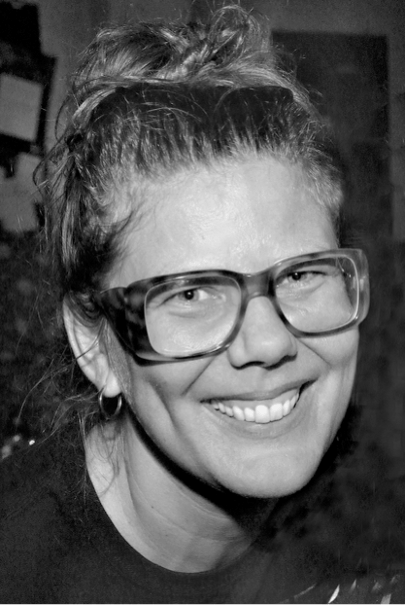
Sasha Dees is a world citizen and connector living for the arts. She is the founder of SDPM, a production company with a focus on international, inclusive and experimental innovative projects across disciplines. Relevant recent projects include her curating the exhibitions MAMMON at the Fine Arts Museum in Split, Croatia (2018) and NEXUS at the Museum for Contemporary Art in Taipei, Taiwan (2023) both with catalogs.
She published Entangled Species, Conversations on Contemporary Art in the Caribbean (2021), after a 2 year research period in the Caribbean (2017-2019) and is a contributing writer for art-magazine Trendbeheer, including a 15+ article series on the art community in Taiwan (2023). She currently works with CHOU Tung-Yen (Very Theatre) as his international consultant, presenting his XR-work (Traversing the Mist, Free UR Head) in the international field/market (2023, ongoing) and serves on various funding committees such as Mondriaanfonds. More info: www.sashadees.com
Curatorial Expertise & Interests
Curator/writer Sasha Dees is a world citizen and connector living for the arts. She facilitates international network and capacity building for emerging creators and professionals; discourse around current urgent topics decolonization, ecology & technology and global equality; and platforms for authentic voices and new perspectives.

In her new book Entangled Species. Conversations on Contemporary Art in the Caribbean, Sasha Dees takes us on a personal journey, showcasing the depth and variety of artists and art communities in the Caribbean.
Entangled Species. Conversations on Contemporary Art in the Caribbean, written by Sasha Dees (the Netherlands) is the result of a fifteen-month research project. After having spent two decades working and traveling in the region, Sasha visited 16 countries in the Caribbean (including Barbados, Curacao, the Dominican Republic, Haiti, and the Virgin Islands) from November 2017 to May 2019. She interviewed over 800 artists and art professionals. Some she knew previously, many she met as she researched and traveled.
Part travel book and 100% toolkit, Entangled Species is filled with engaging anecdotes and extended conversations with artists and art professionals. As passengers on Sasha’s journey, we learn about this world as she explores and documents it.
The opening chapter gives the reader a general introduction to the Caribbean region. Subsequent chapters discuss the infrastructure of the arts and the art marketplace: Education; The economy of art; Galleries; Museums; Biennales; Funding and Project Spaces and Residencies. With each chapter comes a contact list of artists and institutions. Additionally, there is a list of relevant publications, a 50-page selection of artworks by contemporary artists from the region, and a glossary of (art) terms used in the book.
【From Coffee to Curating: A Day with a Curator】
I grew up in a changing society in the Netherlands where a growing population in Dutch Europe in part has roots in the Dutch Caribbean and former colonies. In school I had friends whose par-ents raised their children consciously with both cultural references and heritage. It is how I unconsciously in a very natural way was exposed to different cultural references, language, food, music, dance, books, behavior, attitude, movement, traditions, and rituals. This was not only adding but sometimes also questioning my upbringing at home.When I grew older, how we are being pro-filed by society, unjust and unequal difference in offered opportunities and treatment became noticeable. I also became aware that however everybody has choices we certainly don’t get the same options and opportunities to choose from.
Over the years I immersed myself through friends, and later work, in the context of the Dutch Caribbean, and other former colonies. Having built decennia long close friendships and work relationships becoming increasingly aware of the world historical entanglements and failure to create equality – or even equality of opportunity. Not locally for all Dutch citizens, neither worldwide for all countries.
As quoted in my publication Entangled Species, Ethiopian-American political scientist professor Adom Getachew wrote ‘If colonialism made the modern world, decolonization cannot be complete until the world and that includes Europe is remade’.
At the Core of NEXUS is connecting past with present presenting various artworks (perspectives) from artists throughout the Caribbean speaking directly to audiences in Taiwan curated by me acknowledging my Dutch heritage being a colonizer and awareness of its present continuous impact and influence.
With NEXUS I was aiming to facilitate broadening the decolonial discourse, making a deliberate geopolitical connection between the Caribbean region, having been long colonized by European governments like the Netherlands and Taiwan, first colonized by the Netherlands (followed by Qing Dynasty, Japanese Empire, and lastly taken from Japan and ‘given’ to Chinese Nationalists by way of the US government).
Taiwan not unlike countries in the Caribbean region after being colonized, has been struggling to get their sovereignty acknowledged. I was interested to inspire conversations on these different experiences, perspectives and instigate dialogue on constructive and current ways to reflect on historical memory, heritage and legacy its impact and influence and collectively rethink power structures in our present lives and for the future.
The artists in NEXUS (see above) worked in close collaboration with me in selecting the works and narrative(s) to present in Taiwan. Resisting, respond to and reimagine a curatorial frame is something I not only welcome but is a condition, it is important to me, to be critiqued, questioned, learn and adjust as a curator to present works in the best way possible to what it represents and speaks to (including to how it can be installed) and through that give the audience the best possible experience getting to know the artists. All used text and visuals in printed matters and catalog about the works was done in close constant discussion with the artists with their final approval.
Furthermore MoCA Taipei director Loh and her staff were very open and genuinely interested making space and giving opportunities to get to know the artists perspectives rather than me interpreting their vision, works and practice. Thus we added to the museums usual video of the curators intent, with videos of all participating artists speaking in person about the presented work in context, their view on its relevance for Taiwan and how it fits in their larger practice (all live on digitally on the museum’s video channel).
Within the museums podcast series, a multi-episode series on specific topics was produced to facilitate a dialogue between professionals in Taiwan and the Caribbean. A thoughtful educational package was made on Caribbean flora and fauna for children. Furthermore streamed moderated discussions for museum audience with the artists were organized over the time of the exhibition.
Where an island is confined, contained and isolated with unique local ‘story’ (perspective), placed in a curatorial framework of the ‘archipelago’ connects and transcends, facilitating (re)imagination. Using the framework of ‘archipelago’ was my way to offer audience in Taiwan, being its own island within an archipelago, a natural entrance point to an otherwise mostly unknown territory (the Caribbean) and larger colonial discourse.
For the participating artists using ‘archipelago’ still left room to represent an island, a local perspective (Emanuelson/St. Maarten, and Denis/Haiti) while at the same time gave space to stories of entanglement (Cozier/transnational labor, and Galissa/Lasalle/sovereignty and migration) and (re)imagination (Huggins and Warner / claiming the now and future over past).
As a curator, you are always limited by the layout, the techniques available and how your exhibition relates to other exhibitions and activities in the museum. In NEXUS the use of the archipelago framework shaped the conceptual and spatial design, the sense of fluidity, and supported the public experience.
It was important to realize that MoCA Taipei visitors would often be unfamiliar with the Caribbean and the artists. So it was especially important which work the visitors would experience first. This work, where it was placed and how it would be installed, had to immediately attract the attention of visitors who entered. The expressiveness of this work had to appeal to visitors in such a way that they wanted nothing more than to ‘engage in conversation’ and immerse themselves in the exhibition and the works presented.
Hidden or in plain sight alike. The philosophical thread in my practice is my conviction that we as humans are inextricably entangled with each other in a larger ecosystem. We have individual and collective responsibility in the now and for the future for that entire transcending ecosystem we are a small part of.
In Dutch, we say, ‘unknown makes unloved’. I think it is important to provide a platform for a wide range of perspectives reaching as many people as possible. To gain knowledge, share, connect, understand, respect, and create space for diversity. To elevate the human condition and contribute (and give up) constructively to an equal existence and future for all that is part of the ecosystem, and to take care of everything that is part of it.
For me, an exhibition is successful if it touches and appeals to visitors, and has impact, intended or not. That the encounter stays with the visitor, and might want to know more about it, refers to it in conversations, broadens the visitors view and frame of reference. A good curator to me thus facilitates an exhibition, which manages to do the above for its visitor(s).
Elements such as fundraising, institutional support, public programs, transnational cooperation all influence HOW you can realize an exhibition. All Curators set their own conditions within which they can and want to work. Ultimately, these are personal considerations people make. For me it’s about connection, it always starts with a person followed by is there a meaningful topic, for whom, where (location), and is there a challenge for myself. All this is decisive before I even start thinking about HOW something can be realized and what it takes.
I am indeed always ‘on’. I have a natural curiosity, and I like to wander, and wonder. I like to work in the space where small gestures and actions are meaningful: A cornerstone for a building, re-moving a barrier, opening a door, contributing constructively to experimentation, innovation or change.
And yes, as a ‘passer-by’, I sometimes don’t see or experience the growth, a given end result, or get benefits from my contribution. That is ok as I don’t give any value to ownership (holding). My urgency, drive, knowledge and skills lie in planting seeds. Beyond that, I stubbornly trust in the transcendent ecosystem we are jointly responsible for and within we take care of ‘it’ and each other, which might have disappointed me at times, but has never failed me.
I try to find balance by being aware of both personal limitations and ethical evolution. I relate to the world and the context as I experience it from my frame of reference and perspective at the moment of… I take the time to observe the community and context in which I find myself. In a way that I am (hopefully) not too disturbing to the environment, while staying true to myself.
Traveling has led to what I saw as the core of myself continuing to shrink over the years. My ability to adapt to differences and the unknown has grown, and it has allowed me to grow as a person, and boundaries stretched. Navigating ‘the unknown’ to respectfully exist can be a mutual ‘enriching’ experience without the persistence for domination and/or appropriation.
I think that in ten years’ time, the core of curation, elevating the human condition, will be the same. Letting go of the idea that humans can control the ecosystem remains a struggle of all times. Preservation of Art, education and science is necessary to keep stimulating the human ability to imagine and wonder needed to (re)think new ways of living.
【Additional exhibition photos】
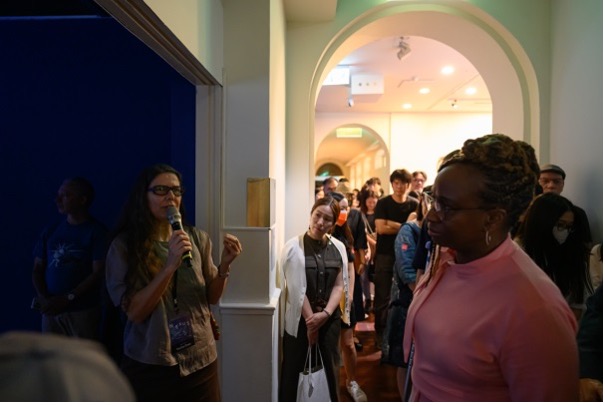
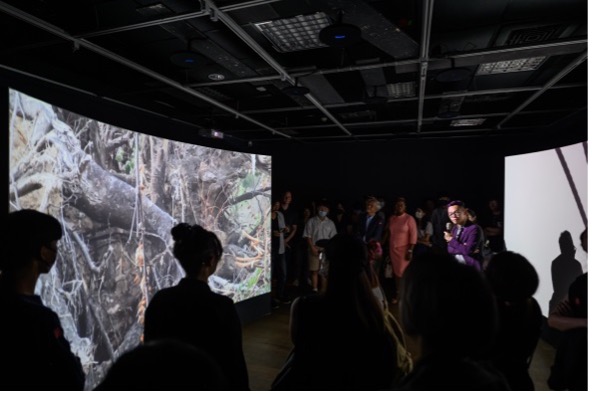
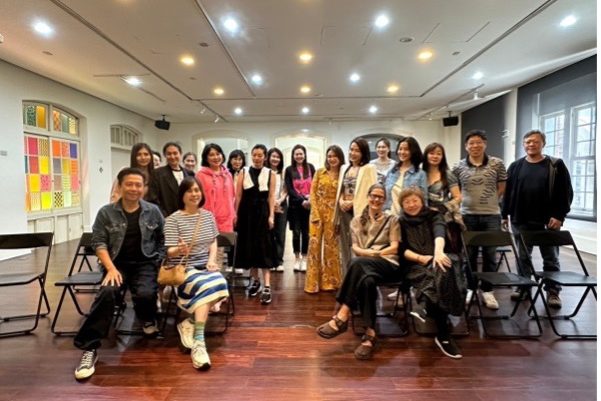
Opening NEXUS at MOCA Taipei; MoCA Taipei collectors tour with director Loh; Taiwan, May 2023|Courtesy of Sasha Dees
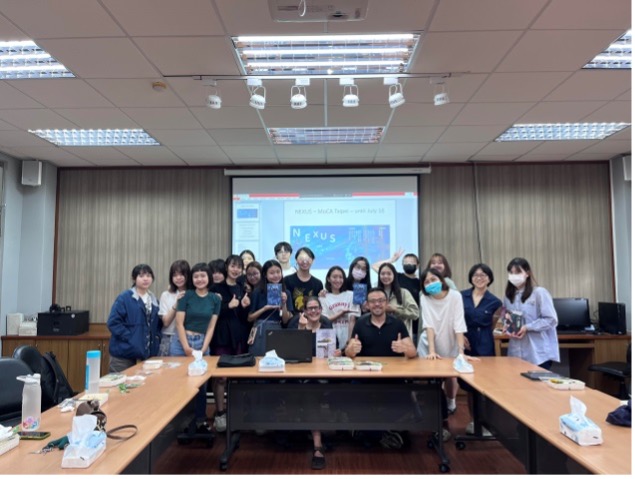
Presentation at NSYSU (Koahsiung, Taiwan) for Professor Walther Hsu class; May 2023|Courtesy of Sasha Dees
Interviewer: Jin-man Pei
Editor: Yipei Lee
Special thanks: Sasha Dees
Photo credit: Sasha Dees
From Coffee to Curating: A Day with a Curator is a series of dialogues with curators who are deeply engaged in the art of curation, knowledge exchange, and cultural storytelling. Through this column, we’re pulling curators out from behind the scenes and into the spotlight. In these fun, candid interviews, we invite you into their world—from early morning coffee rituals to late-night brainstorming sessions. Discover the sparks of inspiration, unexpected creative turns, and everyday hustle that shape the exhibitions we see and feel. It’s about the people behind the practice, and the passions that keep them going.

