Curatorial Statement (English)
By Yipei Lee and Mella Jaarsma
Fluid Kinship: Watershed, Foodscape, Human Tectonics is a touring exhibition rooted in Edible Cities, Mobile Rivers, a research project developed at SUAVEART in 2024–2025. Together with six researchers across regions, it explores how water, grain, and cultural landscapes reveal relationships between ecology, society, and knowledge.
At the heart of the project is a simple proposition: water is not merely a resource to be managed, but a force around which human societies have organized themselves. If we look back at pre-historic times, attempts to control water supplies shaped how crops were planted and harvested, giving rise to settlements and powerful civilizations.
For thousands of years, water has enabled humanity to grow crops, build great civilizations, spread cultures, and engage in trade. Yet it is also one of the most powerful forces capable of leveling human achievements. Science and technology often help us minimize the dangers, but even today, humanity remains essentially at the mercy of this capricious element: water.
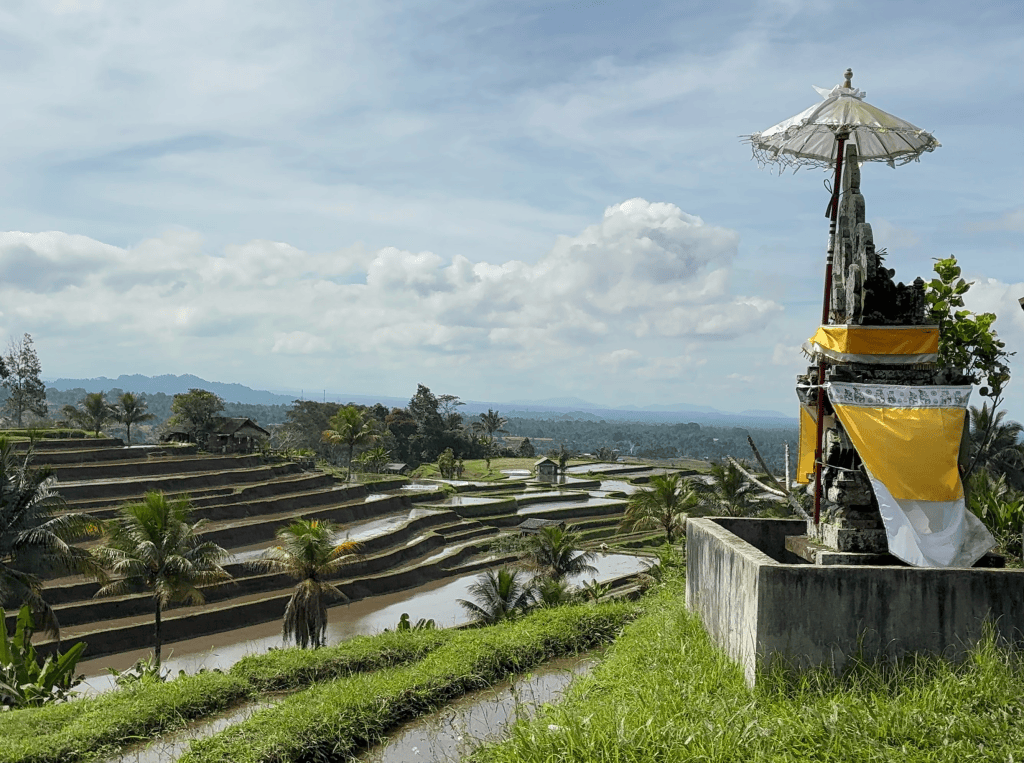
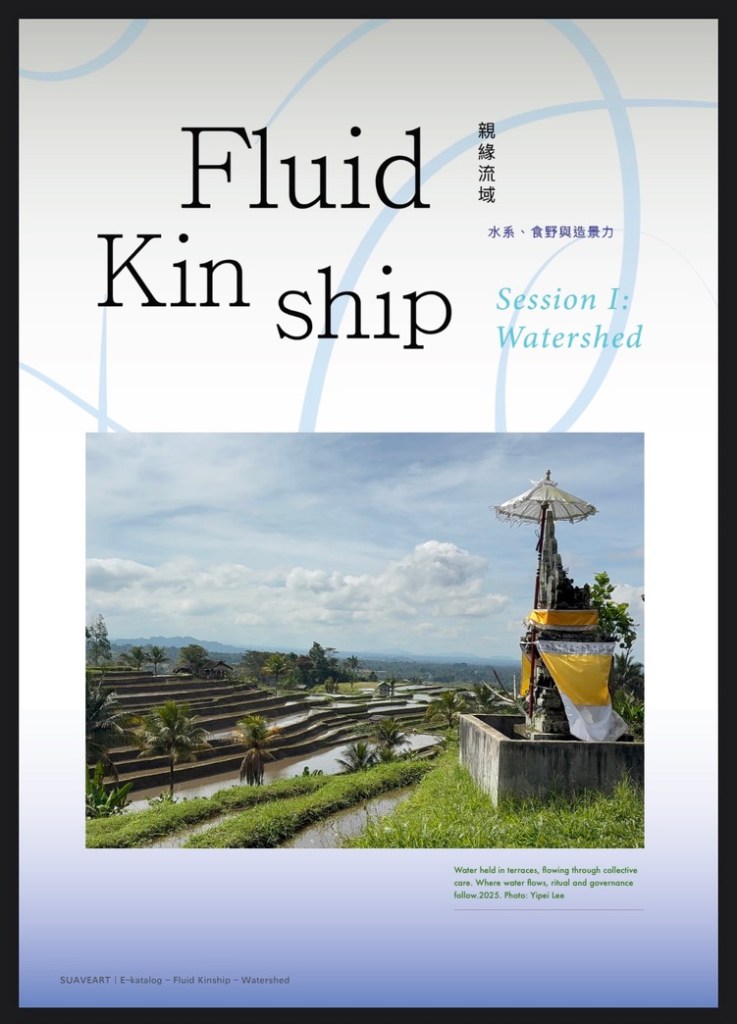
These different experiences lead to the Indonesian chapter of Fluid Kinship and Bali’s Subak—a living system in which irrigation, rice cultivation, communal cooperation, ritual, and ecological governance are inseparable. Water is not simply a resource allocated according to individual need, but a shared force connecting farmers, land, rice, community, and the sacred.
Subak offers another way of thinking about sustainability: not simply how to obtain more water, but how to share it; not how to dominate nature, but how to organize collective life around ecological limits. Yet this relationship is increasingly under pressure from tourism, urbanization, land conversion, and changing patterns of water use.
Through artistic research and fieldwork, Fluid Kinship approaches watersheds as dynamic, interconnected systems. It asks what might change if water is understood not as an object of management, but as kin: a living presence—one that connects humans, more-than-human beings, places, cultures, and practices of knowing.
WATER IS…
Water and rice are not merely elements of nature; they are also two symbols that we encounter from an early age through everyday life and education in Taiwan. We are often reminded to be flexible like water, and to remain humble like a rice stalk bending under the weight of its full grains.
My grandfather was a farmer living in the coastal area of Yunlin County, Taiwan. For decades, he faced typhoons, seawater intrusion, soil salinization, and land subsidence caused by excessive groundwater extraction. The relationship between climate, land, and water was constantly shifting, making the care and cultivation of crops increasingly difficult. As he would often say, “We depend on the sky for our livelihood.”
Growing up in Asia, rice is also part of our shared memory. Traditional family customs and religious beliefs have given rise to rituals centered around rice, as well as folk songs associated with agricultural practices. Rice is more than food; it is woven into our daily rhythms, seasonal cycles, family relationships, and collective memory. (Yipei Lee)
I grew up in the Netherlands, where children learn to swim from the age of four, both for safety and because waterways surround and shape many of our communities. I was born at sea level, in one of the first polders of the IJsselmeer. Surrounded by a dike, the water was pumped out, transforming what was once water into reclaimed land and eventually into fertile farmland.
Land, water, and wind are the elements that have shaped the landscape I grew up in, but also the way I understand my relationship with nature. They are constantly in dialogue: water gives and takes, land is reclaimed and cultivated, and wind moves freely across the open landscape.
If we look back at pre-historic times, attempts to control water supplies shaped how crops were planted and harvested, giving rise to settlements and powerful civilizations.
For thousands of years, water has enabled humanity to grow crops, build great civilizations, spread cultures, and engage in trade. Yet it is also one of the most powerful forces capable of leveling human achievements. Science and technology often help us minimize the dangers, but even today, humanity remains essentially at the mercy of this capricious element: water.
A question that would have been almost unimaginable to our ancestors: How much clean water should we devote to building the technologies of the future when the same water is needed for drinking, agriculture, ecosystems, and everyday life? (Mella Jaarsma)
SUBAK IS …
One of the world’s most remarkable examples of traditional water management, already built in the 9th century, can be found in Bali. Water from 150 rivers and streams, as well as numerous mountain springs and volcanic crater lakes gets distributed fairly across watersheds and enables farmers to cultivate rice throughout the year. But the Subak is far more than an irrigation system. It is a system of cooperation, with between 50 and 400 farmers per Subak, working in a spiritual relationship with land and water.
Farmers do not simply receive water according to individual needs. They participate in a communal system governed through traditional institutions and water temples. Decisions about planting and harvesting are coordinated, while ceremonies and rituals follow the lunar Balinese Saka calendar.
At the centre of this spiritual landscape are the water temples, including Pura Ulun Siwi, regarded as a rice temple and a mother temple associated with the smaller, roofless shrines known as Bedugul, which are scattered throughout the Subak landscape.
Here, engineering and spirituality are inseparable.
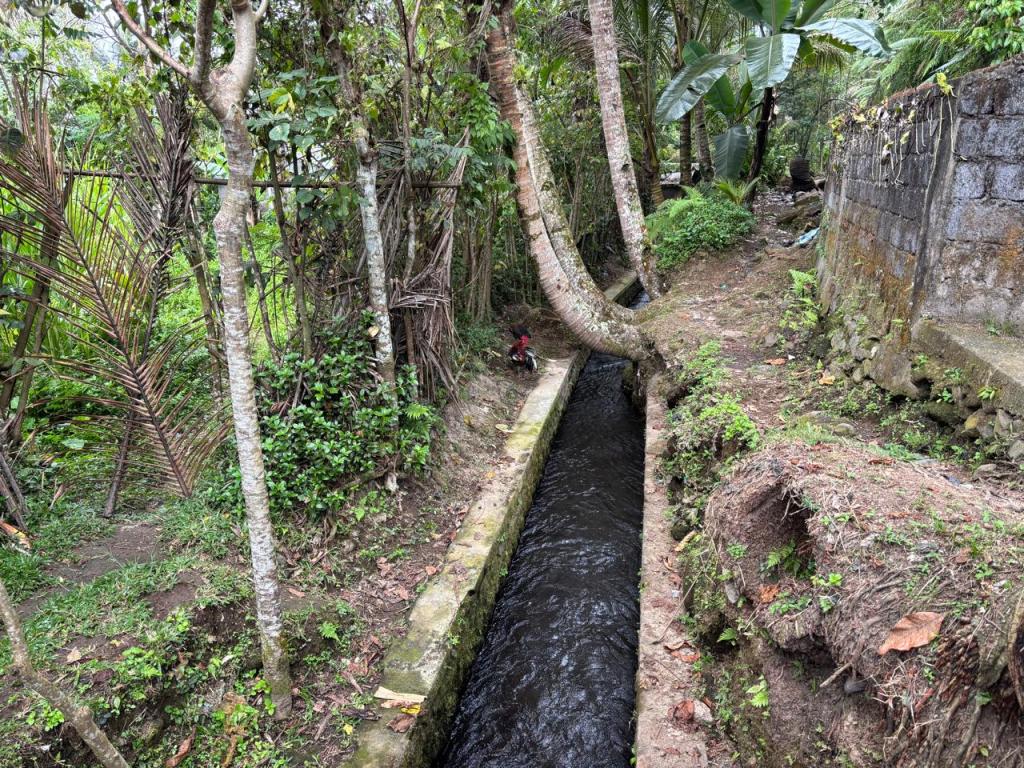
The canals and terraces may appear to be works of practical engineering, but behind them lies a deeper idea: water is not merely a resource to be extracted and consumed. It is something that connects people, agriculture, nature, and the sacred. For centuries, this philosophy helped sustain Bali’s extraordinarily fertile agricultural landscape.
The Subak therefore offers more than an extraordinary example of ancient water management. It offers a lesson for the future. Its fundamental principle is not simply how to obtain more water, but how to share it. Not how to dominate nature, but how to organize human society around the limits imposed by nature. Yet this centuries-old relationship is now under pressure.
Agricultural land is being converted for other uses. Tourism and urbanization are increasing demand for water, or the villas and hotels built on farmland close down water streams.
Economic pressures are changing traditional farming practices, while the cultural and spiritual communities that have sustained the Subak face their own challenges.
The question facing Bali is therefore part of a much larger (global) story.
Together, we travelled around Bali, meeting and talking with farmers, cultural leaders, and researchers. Along the way, we gathered stories and perspectives that offer a glimpse into some of the current challenges around Subak and water management.
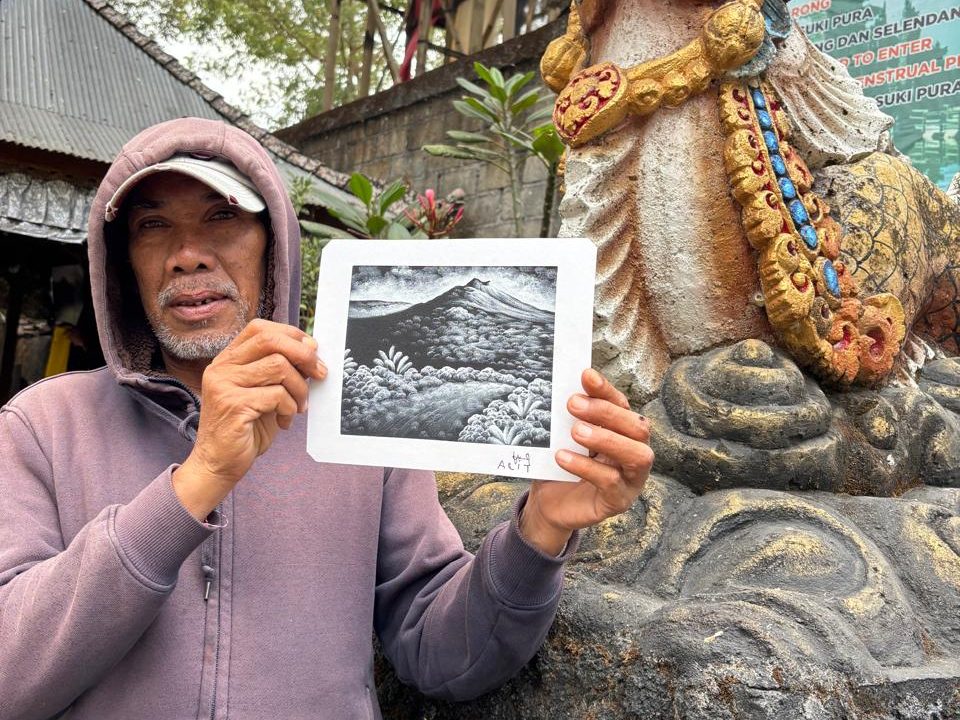
Dr. Ir. I Wayan Alit Artha Wiguna: “We have to find ways for Subak to function in modern times without losing its traditional values. We cannot allow the cultural values of Subak to be lost, even as we go through so many changes. Although Subak has been recognized by UNESCO as a World Heritage site, its future must also take into account the economic realities of today; the adoption of new technologies, such as drones and tractors, as well as considerations around emissions and carbon. If we fail to do this, the Subak system may eventually disappear.” (Interview, 10 March 2026)
I Ngurah Suryawan writes in his book Tri Hita Bencana – The Political Economy of the Greed of Contemporary Balinese People (p. 7, Pustaka Larasan, 2026) that. Tri Hita Karana or Balinese Hindu philosophy based on the three causes of wellbeing: in harmony with the Divine, among people and nature/environment has turned into Tri Hita Bencana’ or Three Causes of Disaster. I Ngurah Suryawan: ”Several of its material references; Bali’s forests, land, and nature, have been replaced by tourism accommodations and have been destroyed and left in ruins, although some still remain. Its intellectual and spiritual references may perhaps be searched for by the clever as a justification as well as a consolation. But it is difficult to deny that the ideal knowledge of harmony and peace in the ordering of Balinese human life has been destroyed and has lost its power.”
Ketut Budiarsa, a farmer working in a rice field near Denpasar, sees Subak as a source of strength and a form of resistance against the rapid urbanization of Bali. For him, Subak is not only about managing water and rice cultivation, but also about protecting agricultural land and the community that depends on it. His Subak community has been protesting against government decisions to issue building permits on agricultural land, which they see as a threat to the future of farming. (Interview, 13 March 2026)
I Made Gendra, a farmer in Jatiluwih who grows organic red and white rice, told us that his son does not want to continue working in the fields. As a result, he has been forced to hire workers from other areas to help with planting and harvesting.
For Gendra, this is part of a wider challenge facing farming communities in Bali: as younger generations move away from agriculture, the traditional networks that sustain Subak are becoming more difficult to maintain. This shift can create tensions within the Subak system and, over time, unavoidable cracks in the community. (Interview 11 March 2026)
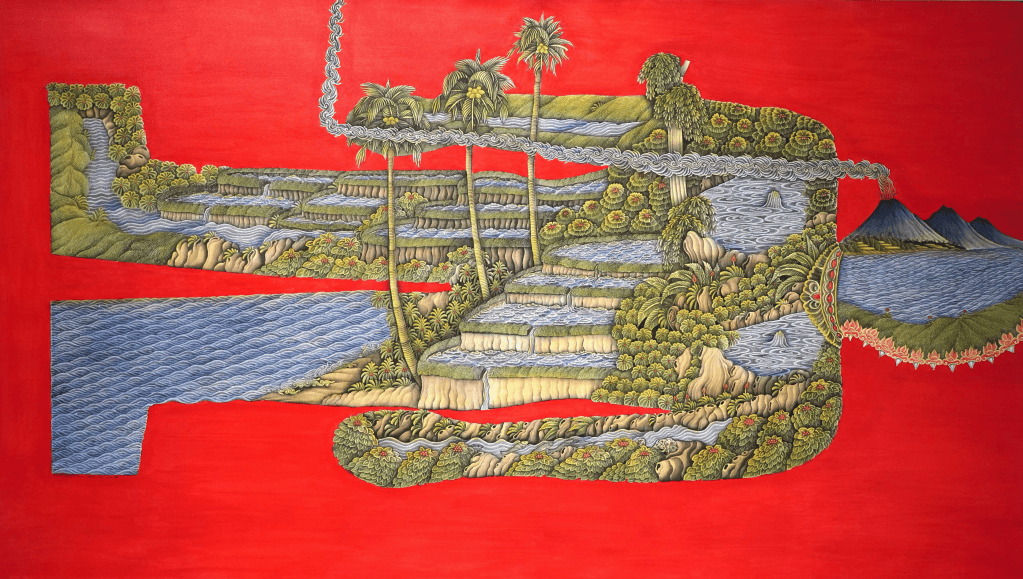
I Made Griyawan|Reflection, Acrylic on canvas, 150 x 80 cm, 2026
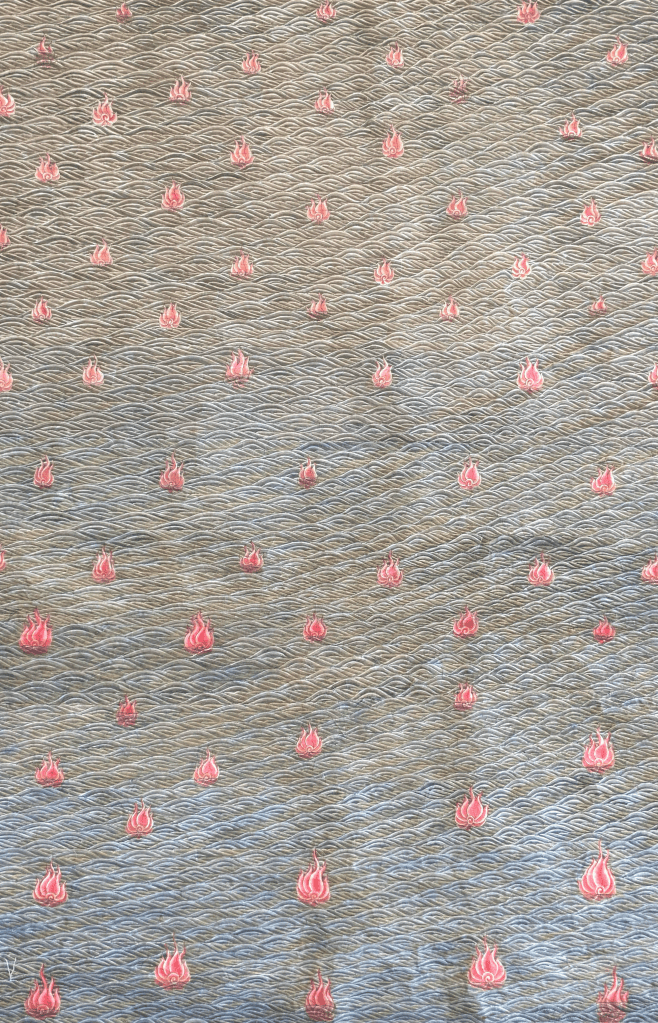
I Made Griyawan|Segara Gni, Acrylic on canvas, 111 x 75 cm, 2026
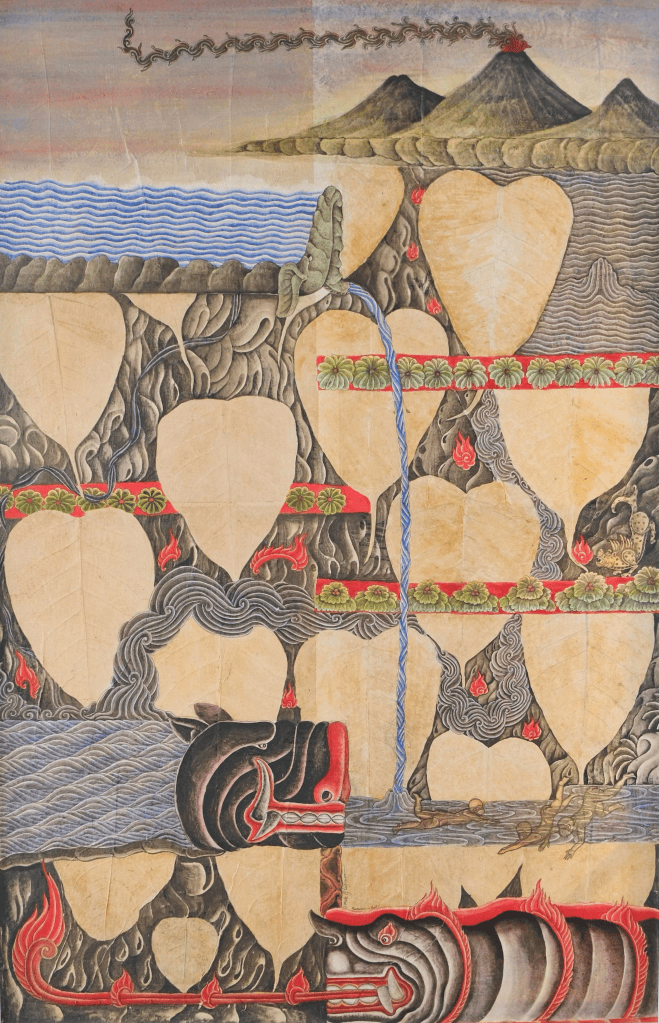
I Made Griyawan|Perjalanan Air (The Journey of Water), Natural pigments and acrylic on mixed media, 100 x 65 cm, 2023
I explore how traditional knowledge can nurture a renewed awareness of our interconnectedness with the natural world. At the heart of these works is the understanding that the self is not separate from nature, but exists as a reflection and extension of it. The human body can be understood as a microcosm of the larger universe, in which what takes place within t
he body resonates with processes occurring in the natural environment.
From this perspective, Balinese cultural values that emphasize balance between humans, nature, and the cosmos offer a way of reconsidering our contemporary relationship with the environment. Recurring floods during the rainy season, for instance, can be read as one manifestation of an increasingly disrupted relationship between human activity and natural systems. The covering and disappearance of irrigation channels, together with land conversion and other forms of environmental transformation, interrupt the natural movement of water and disturb the ecological relationships that have long shaped the landscape.
Through these works, I seek to reconnect with an understanding of nature in which humans are not positioned outside or above the environment, but as an integral part of its continuous cycles. Water, earth, fire, and life are not separate elements, but interconnected forces through which both human and non-human worlds are sustained. By bringing traditional knowledge into dialogue with contemporary environmental conditions, the works invite a reconsideration of how we inhabit, transform, and care for the landscapes of which we are inherently a part.
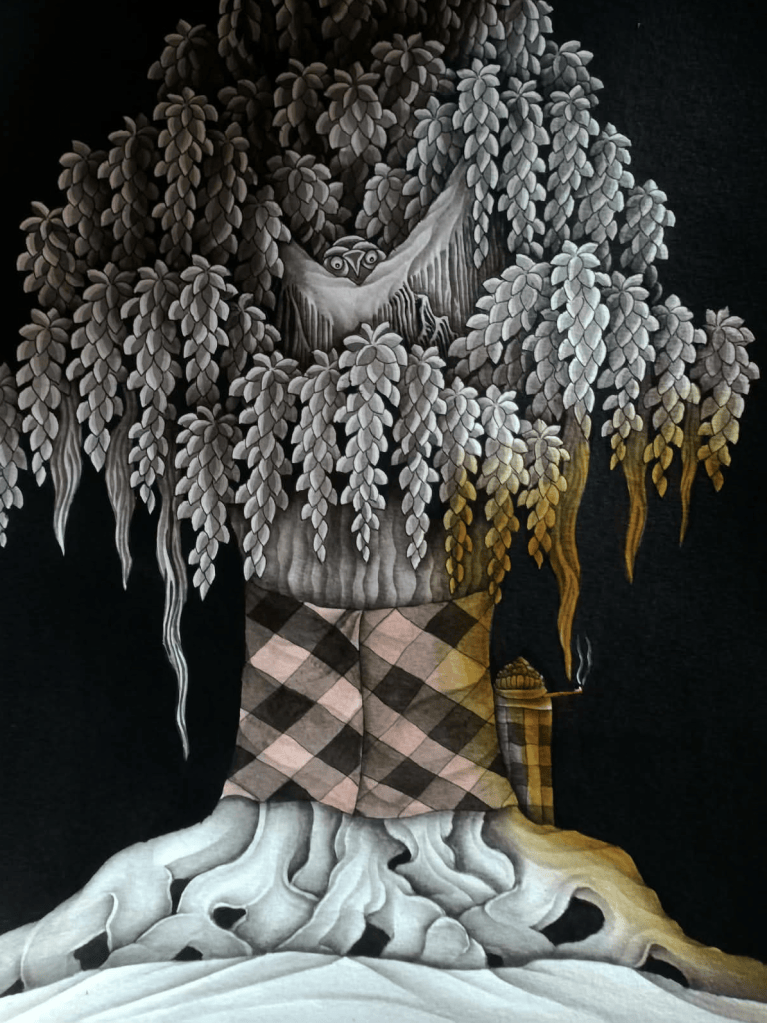
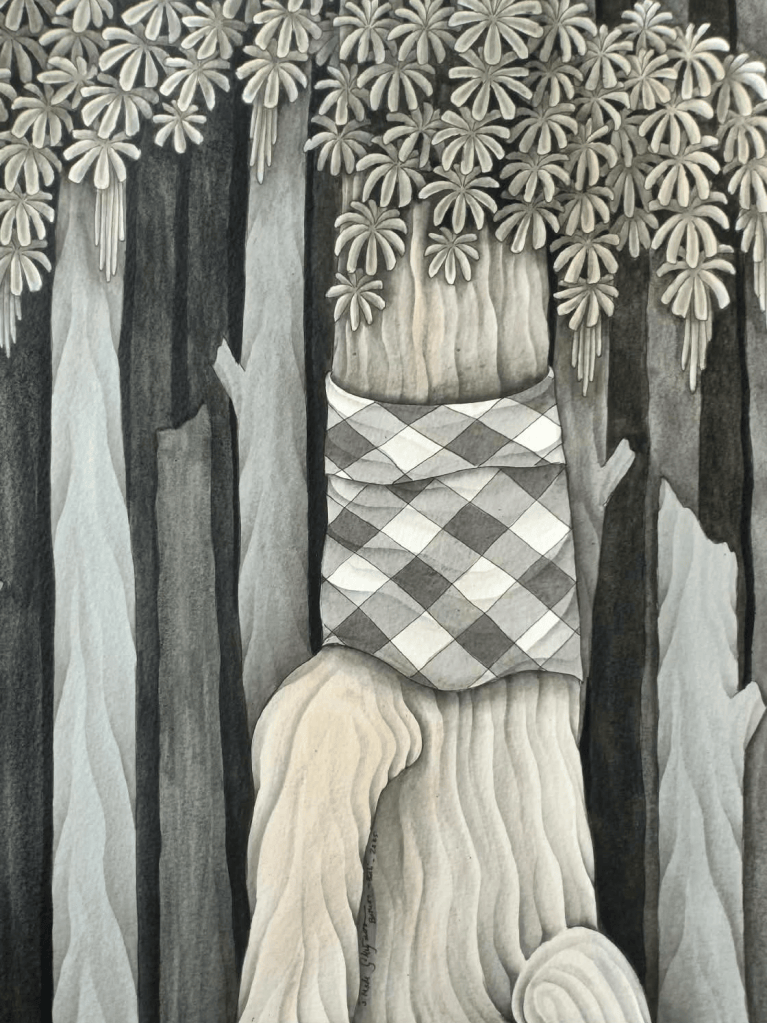
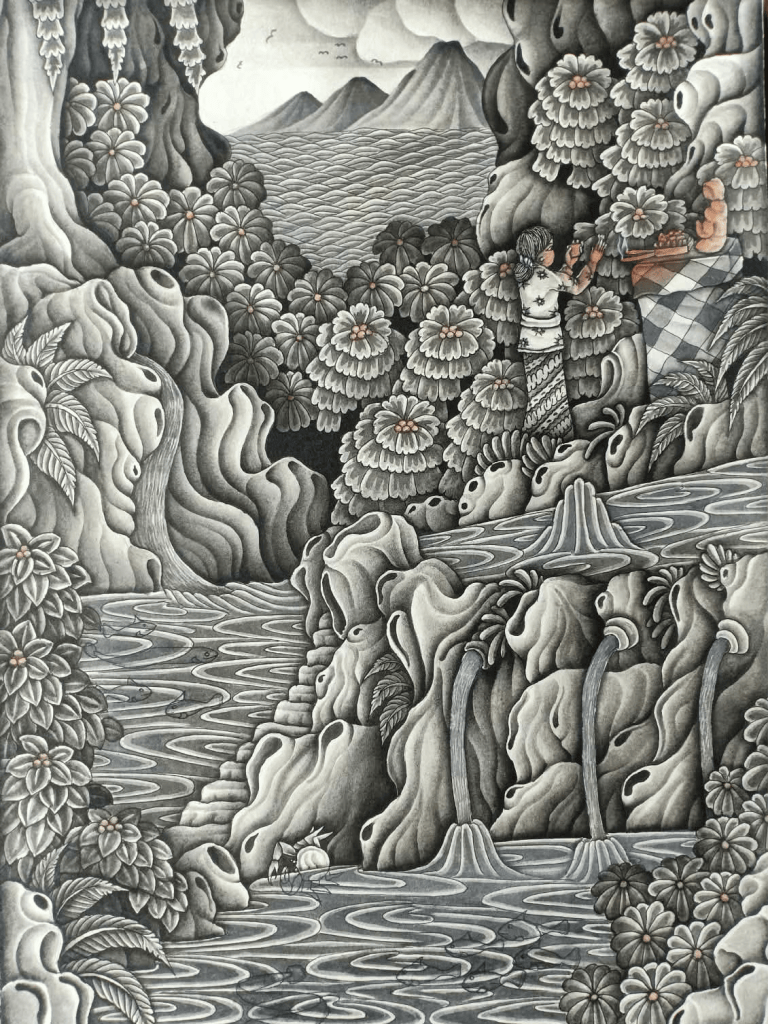
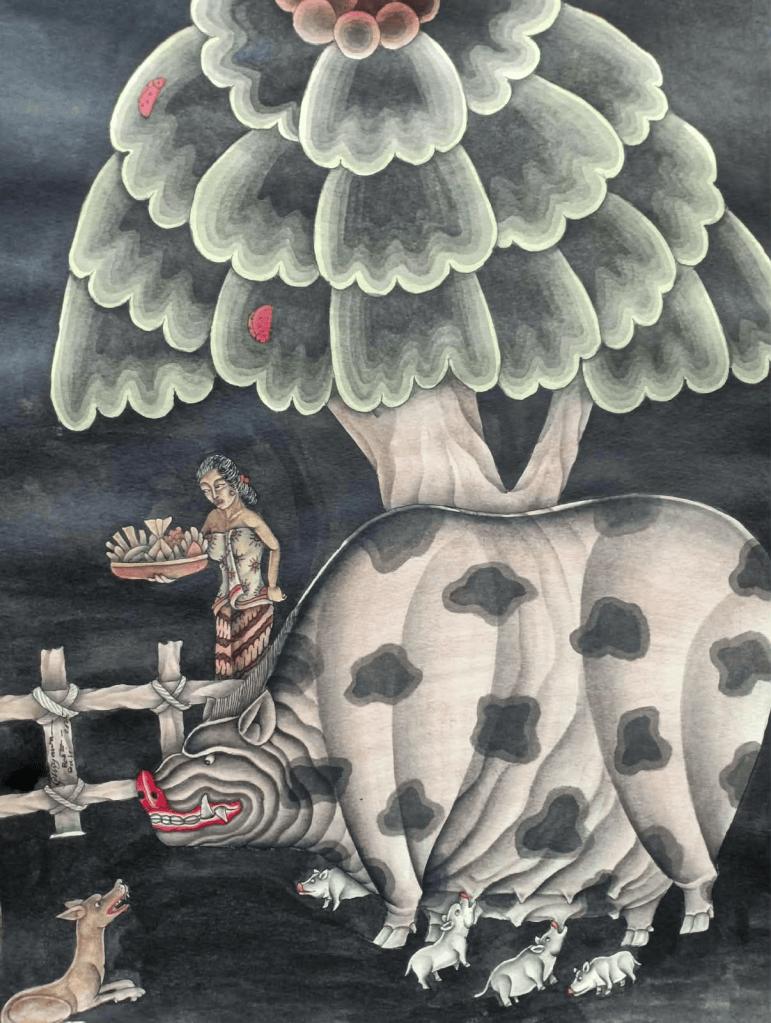
I Made Griyawan|Menjaga Pohon (Caring for Trees), Menjaga Sumber Mata Air (Protecting Water Sources), Tumpek Kandang (Menghormati Binatang) (Honouring Animals), Japanese Charcoal on paper, 39 x 29 cm, 2025
Drawing on traditional Balinese cultural practices and rituals, this group of works explores the practices of protecting water sources, honouring animals, and caring for trees. Through these cultural traditions, the works seek to rekindle an awareness of the profound connections between humans and the natural world, as well as their interconnectedness with the wider universe.
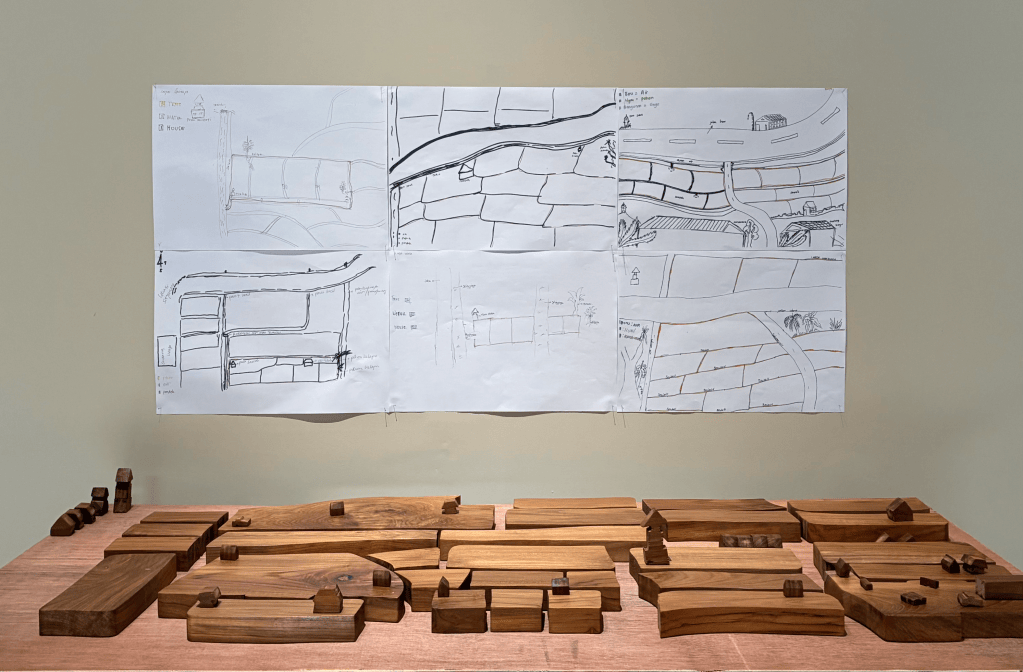
Subak farmers
(From Subak Banjar Bunutan and Banjar Satung)
The Shared Flow
Acrylic, tracing paper, color pen, mixed media and wood
Variable dimensions
2026
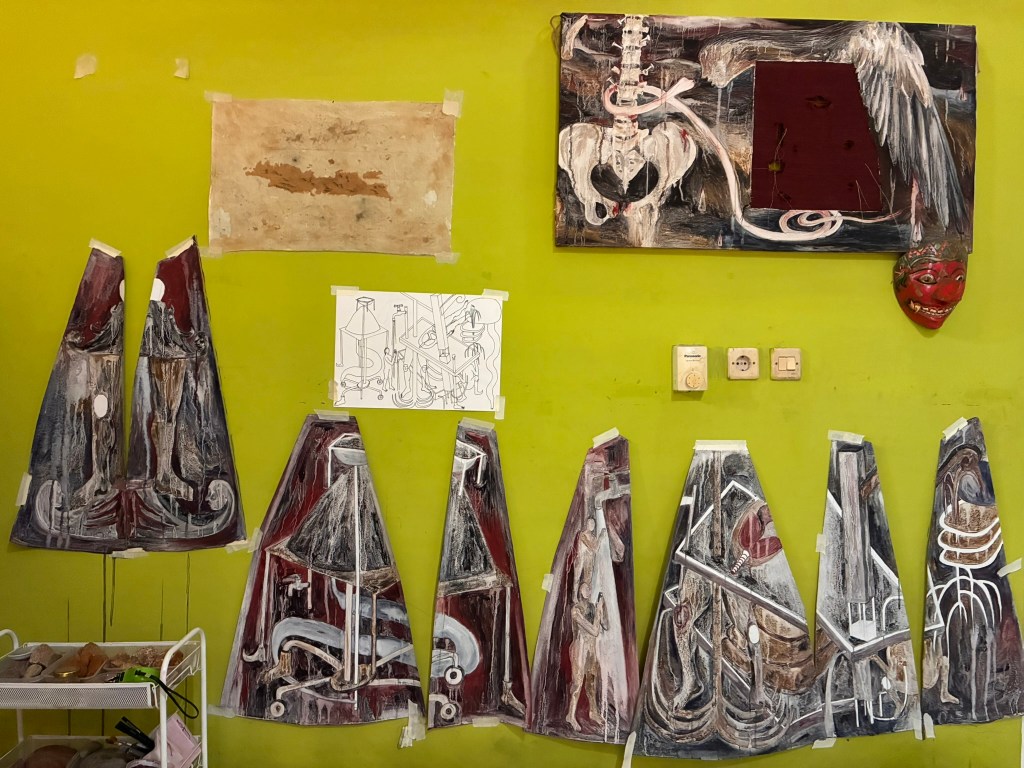
On Nyepi Sawah, Subak farmers participated in a workshop exploring the relationship between land and water. Together, they traced the origins and pathways of water and considered how it connects rice fields with everyday life. Through sharing their farming experiences, participants mapped the stages of rice cultivation, from planting and growing to harvesting, and discussed how agricultural practices adapt to seasonal changes and fluctuations in water availability during the rainy and dry seasons. Each cultivation cycle is also accompanied by at least six agricultural rituals, reflecting the close relationship between agricultural production, spiritual beliefs, and the rhythms of nature.
Afterword: Yipei Lee transformed the participants’ shared knowledge and drawings into a landscape model reflecting the interconnectedness of water, land, agriculture, and collective life within the Subak system.
Ipeh Nur
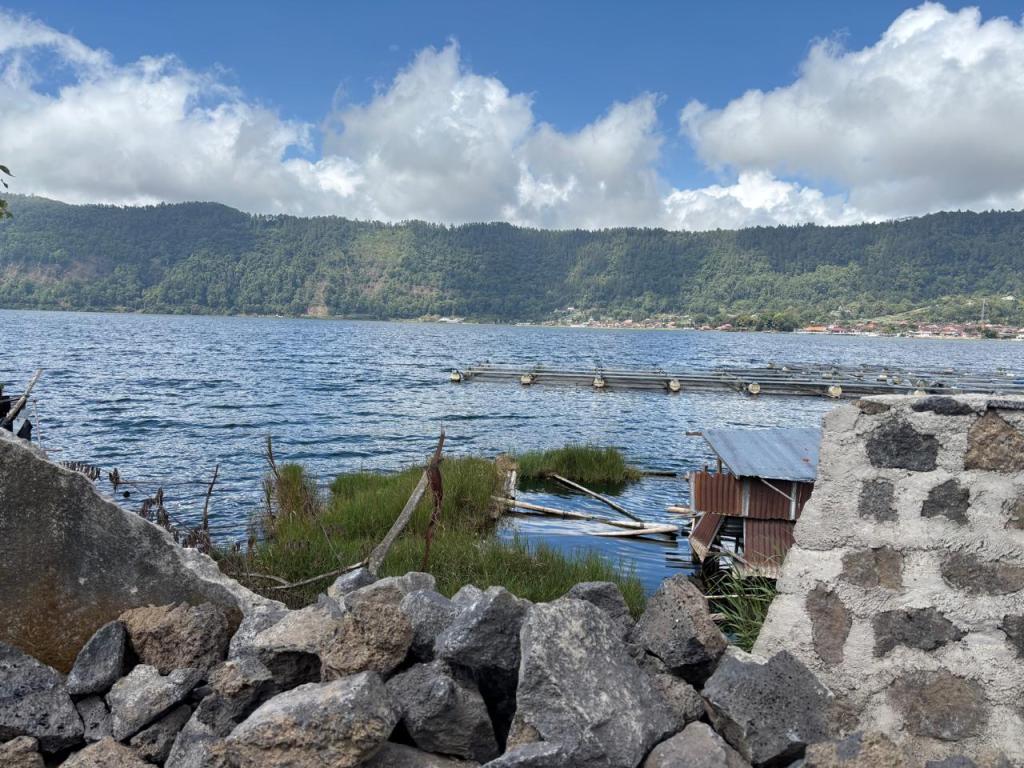
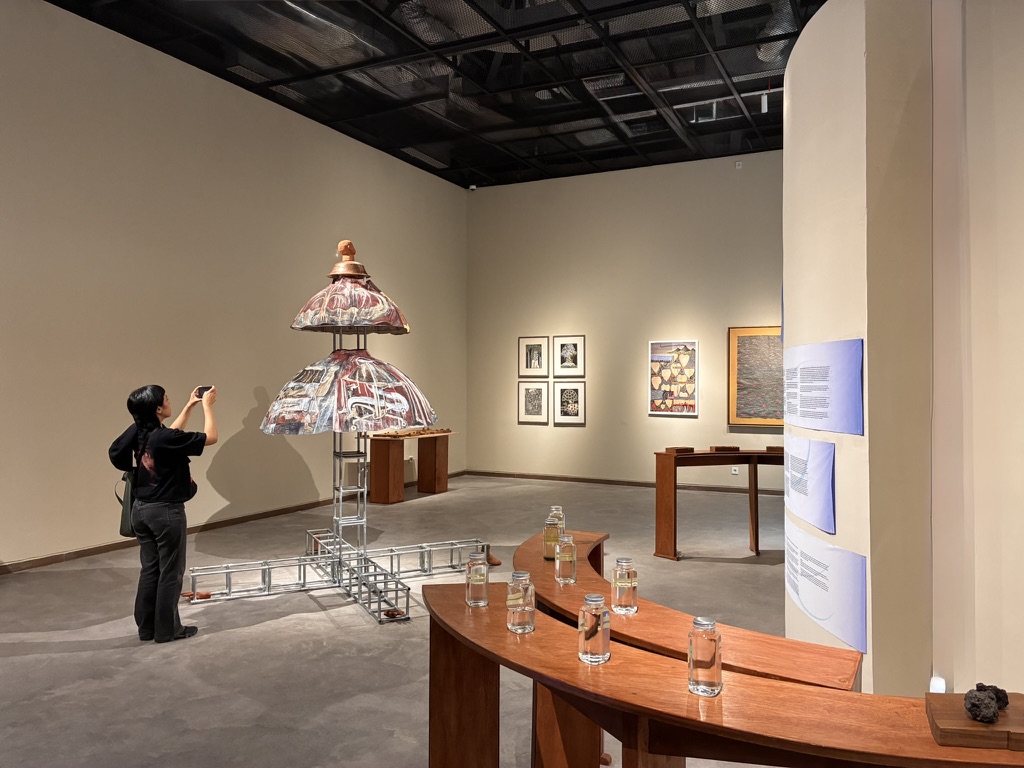
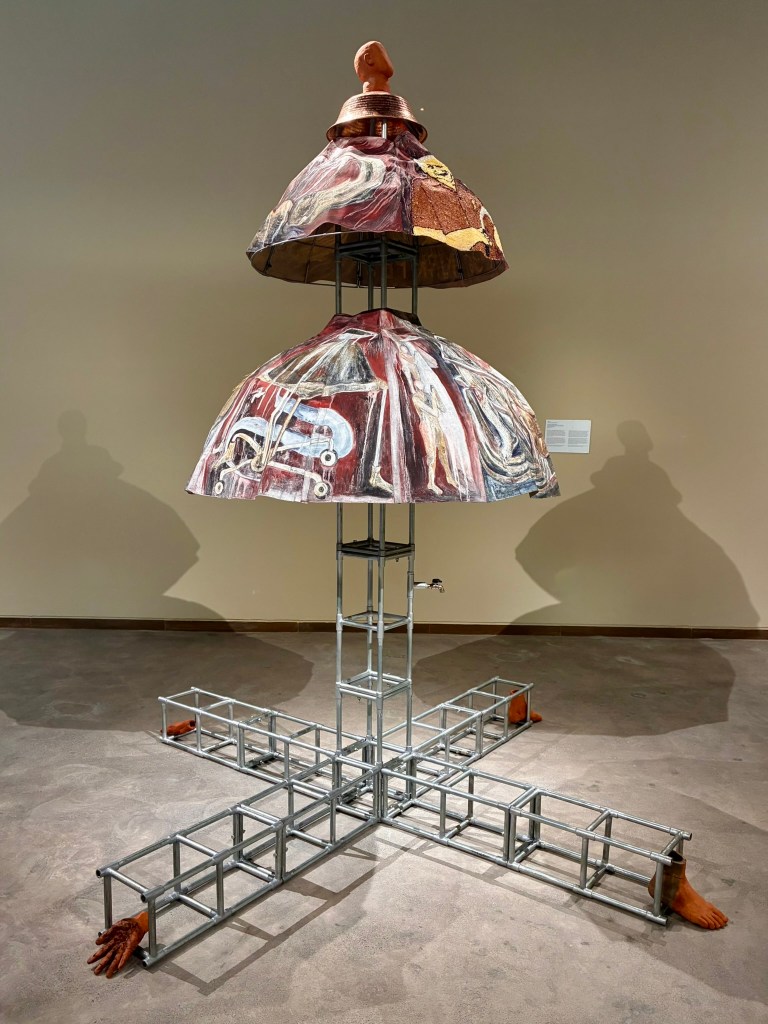
Pura Bencana (Disaster Temple)
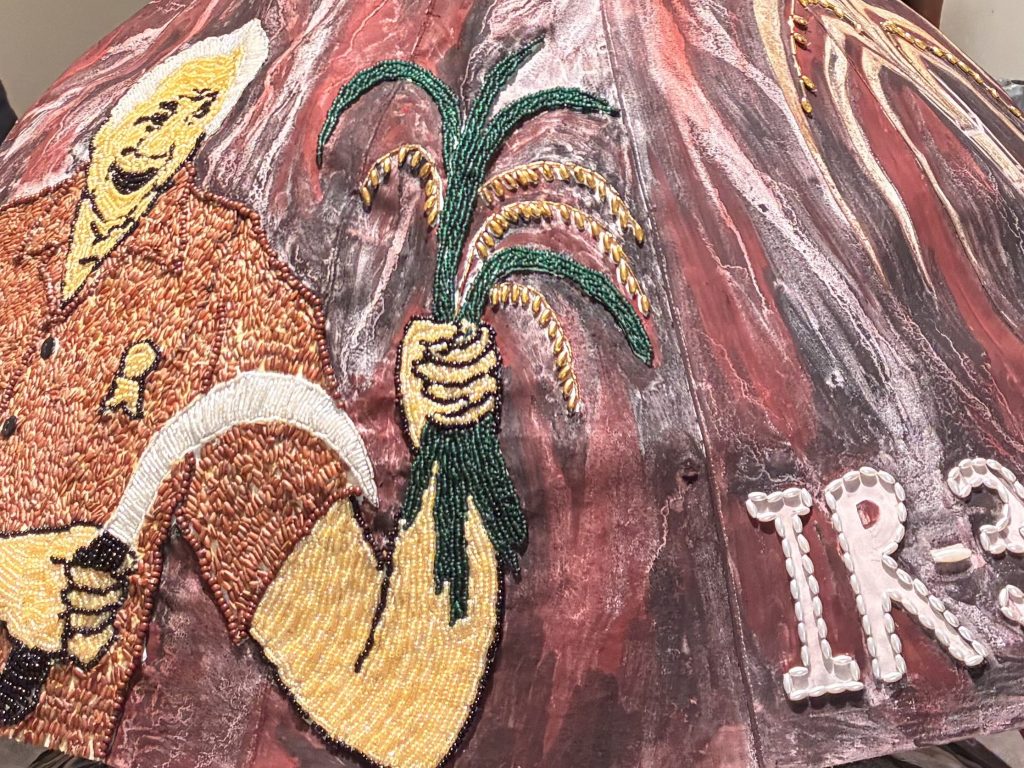
Batur lava rock, rock powder, mud, charcoal, indigo, red iron oxide, marble powder on canvas, rice, beads, iron water pipe installation and terracotta
200 x 200 x 250 cm
2026
– –
Photo by Ipeh Nur, Yipei Lee
Inspired by Bali’s geological landscape, which resembles a rice bowl formed by the creation of the Batur caldera, I created a series of upside-down bowls (bokor) arranged in three sections, echoing the roof structure of a temple (Pura). The work connects this form to water as a source of life and spirituality, flowing from upstream to downstream.
The overturned bowl, traditionally used to hold water and rice, becomes a metaphor for overflow and disaster; a vessel that can no longer contain what it once sustained. In upstream areas, water remains relatively abundant, and communities continue to maintain their irrigation systems. Further downstream, particularly in urban areas, river water levels have begun to decline, while many rice fields have been lost to large-scale land conversion and dense settlement, increasing dependence on groundwater. I view this change as an outcome of the history of the Green Revolution. A paradigm shift occurred, moving from sustainability toward a commodity-focused approach and large-scale development practices.
As water is increasingly treated as a resource rather than as something sacred, its cultural and spiritual significance begins to diminish.
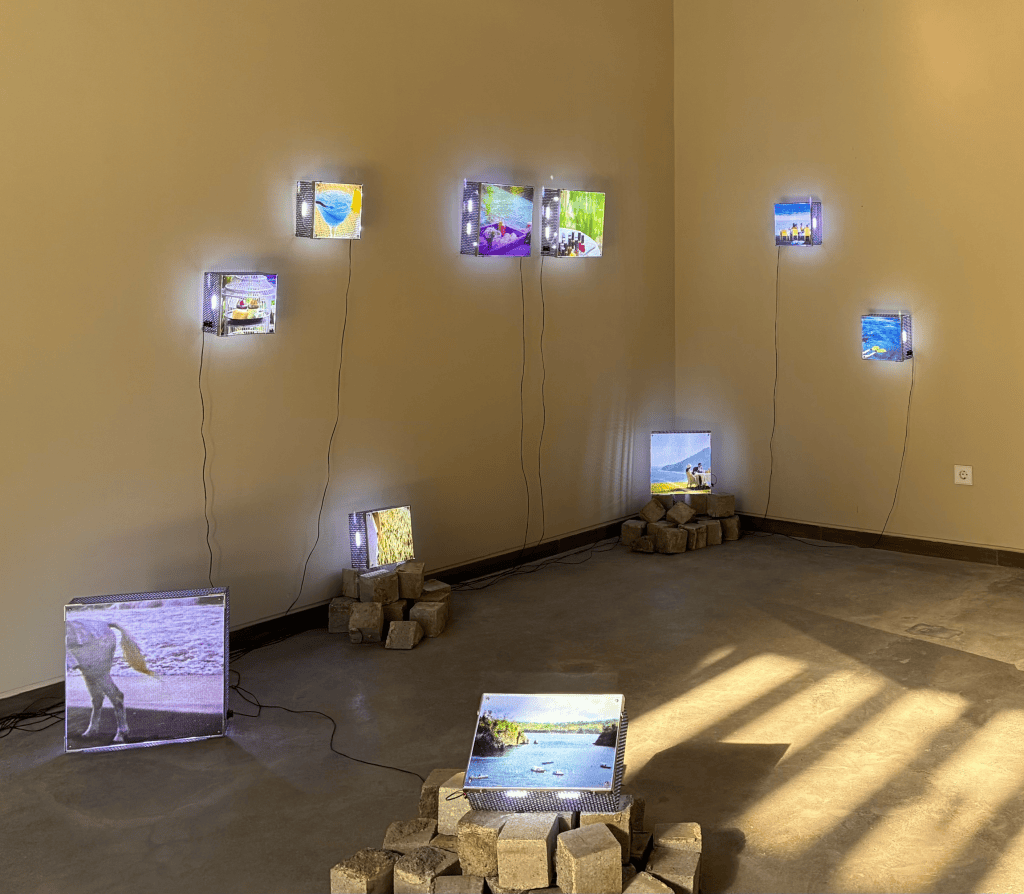
Arif Furqan
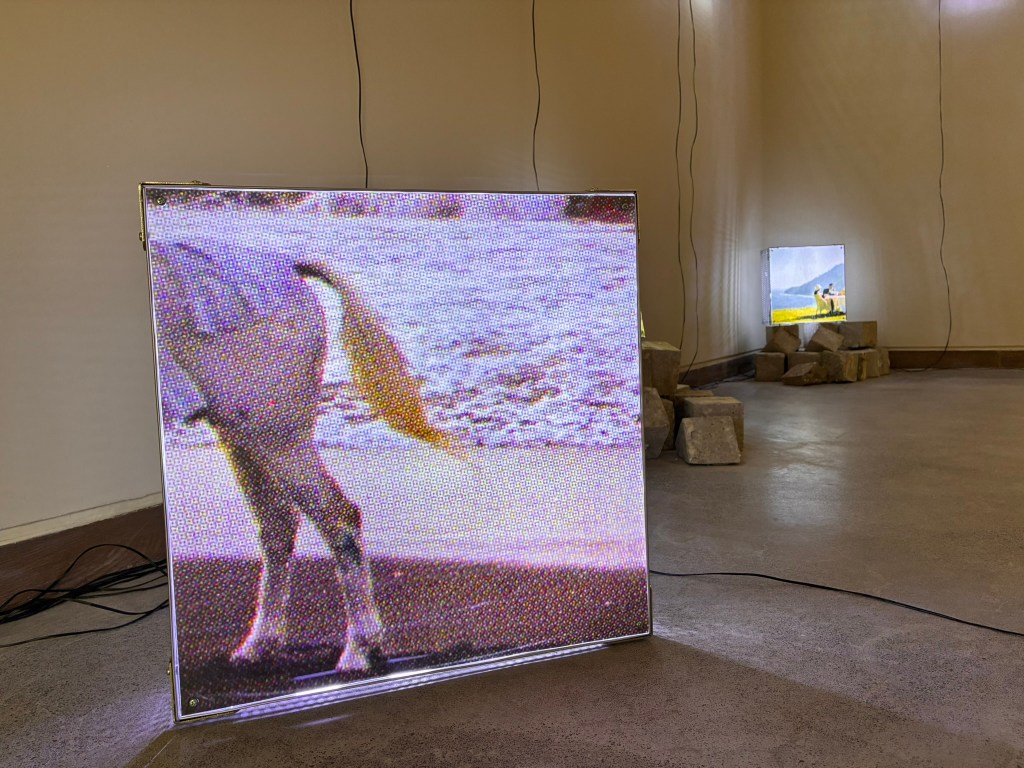
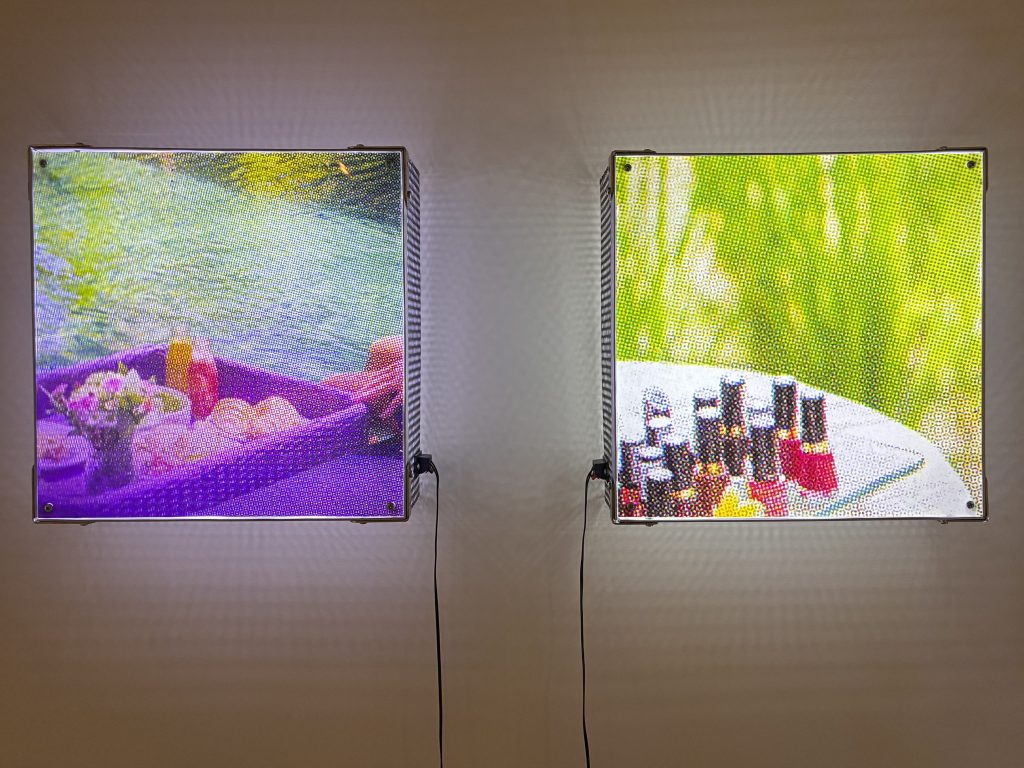
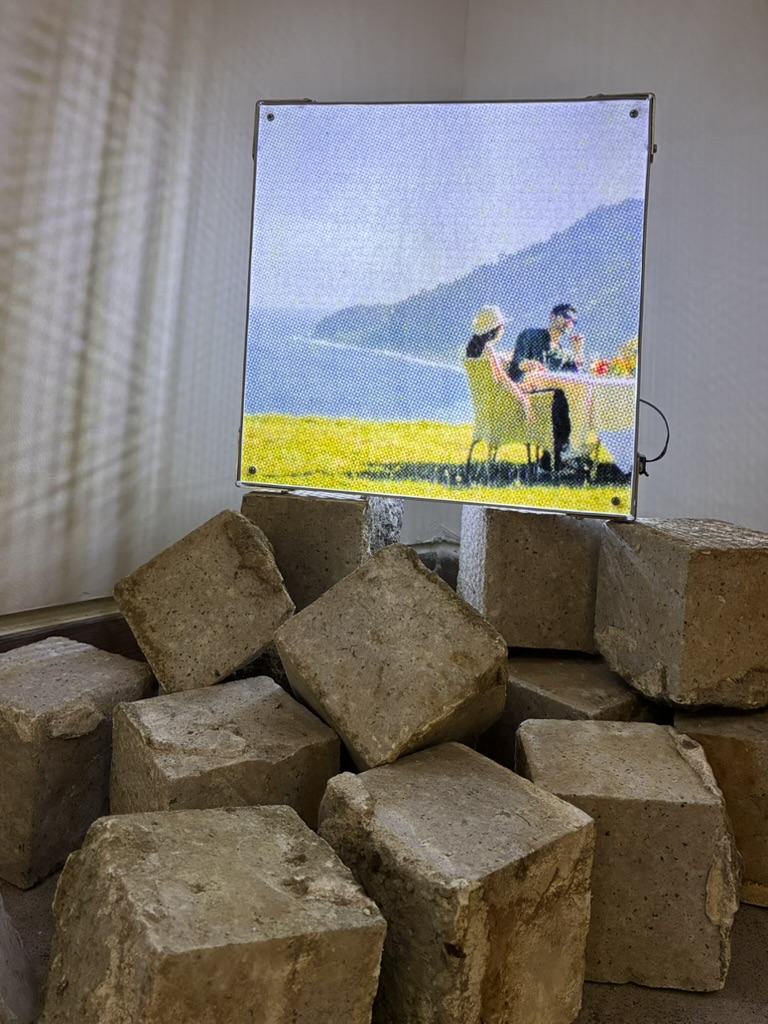
Fragments of Commodity
Digital print, light box, aluminum and steel
Various dimensions
(40 x 40 cm, 30 x 30 cm, 20 x 20 cm)
2026
– –
Photo by Yipei Lee
By utilizing images from printed tourism brochures that promote Bali as an idyllic destination, this project examines the visual construction of the landscape and the tension between its idealized representation and lived reality. Water is no longer encountered primarily through its philosophical, ecological, social, and agricultural functions, but through its capacity to produce the visual aesthetics of a desirable landscape. Through framing, cropping, and the freezing of the photographic image, the landscape is constructed as an unchanging mooi indie backdrop—always beautiful, abundant, and serene. Meanwhile, the conflicts surrounding land and its resources remain outside the frame: competing demands for water, overdevelopment, changing land use, and ecological degradation.
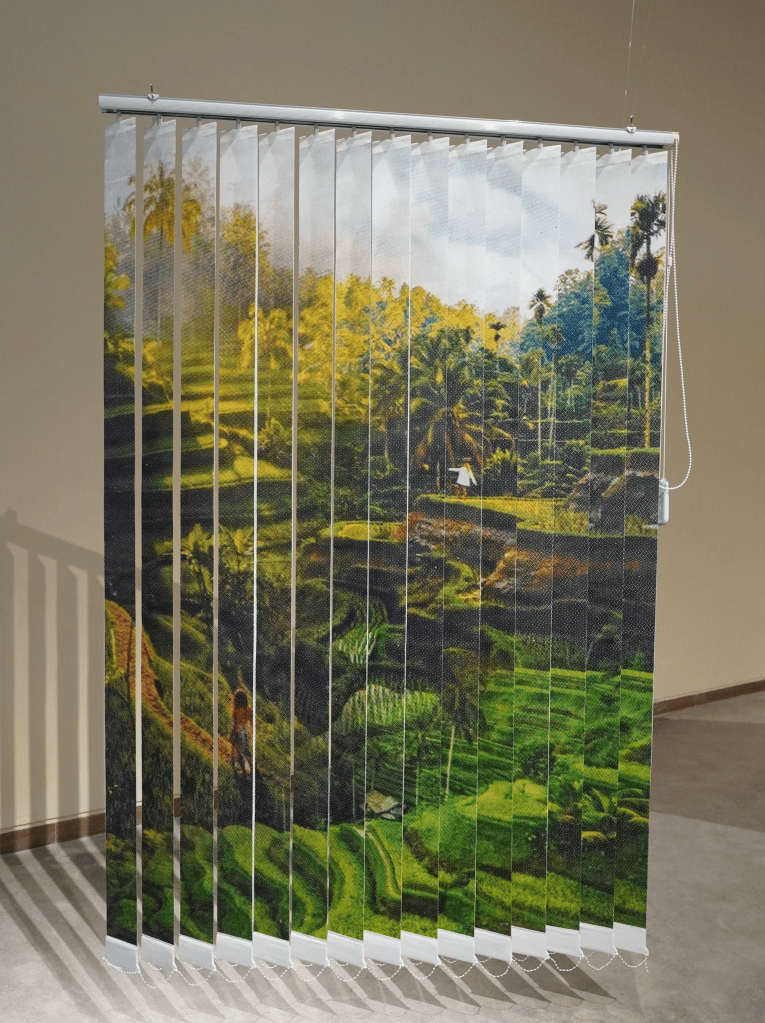
Arif Furqan
A Certain View
Dye-sublimation print on fabric, aluminum, ready-made object
120 x 170 cm, 2026
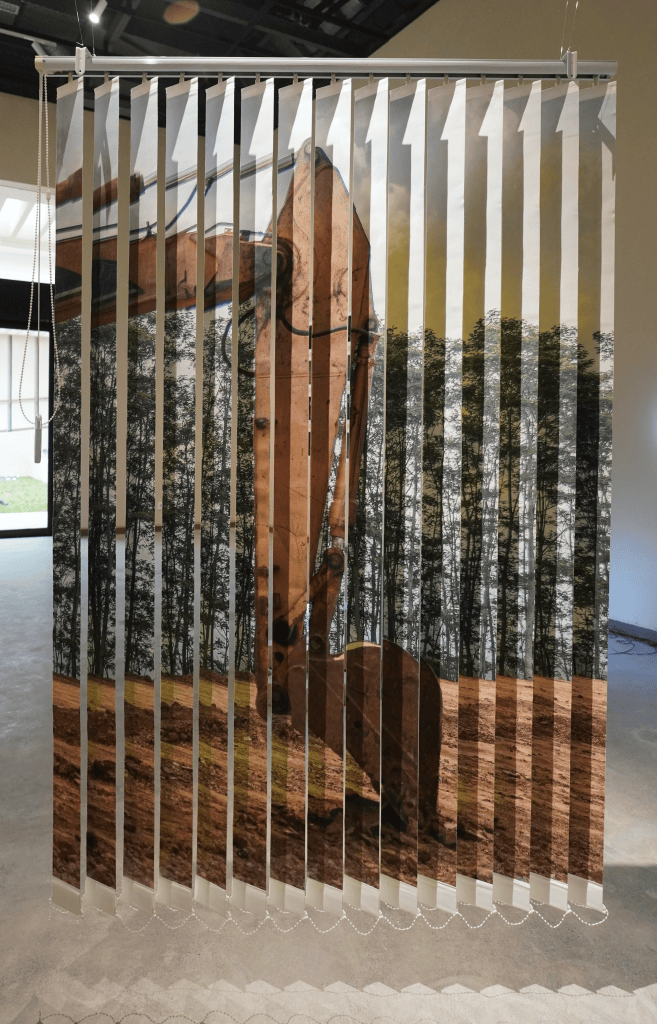
This work reconstructs the window as a device for framing and producing a desired view of the landscape. Within the architecture of tourism, the window does not simply offer a view; it selectively determines what can be seen, transforming the surrounding landscape into an aesthetic experience designed for leisure and consumption. A beautiful view becomes part of the value of the room, while the pressing conflicts beyond the frame—land transformation, water extraction, overdevelopment, and ecological pressure—remain concealed. What appears to be an open view is therefore also a constructed boundary: one that determines not only what is visible, but also what remains excluded from the experience of the landscape.
Landscape is not simply what we see, but how it is framed, selected, and constructed through a certain visual grammar—made into an image, an experience, and ultimately a commodity that obscures the ongoing conflicts. (Arif Furqan)
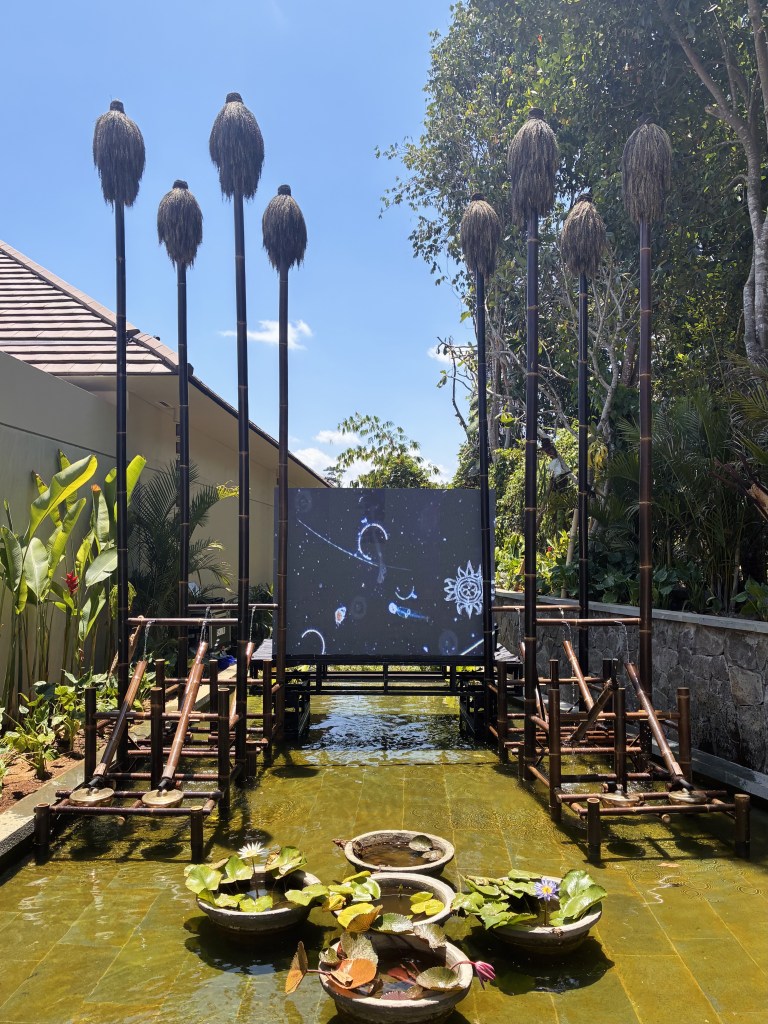
Indah Arsyad|AWATARA, Bamboo, Gamelan, water, and LED Screen, 4 x 3 x 3.8 m, 2026
Through research into environmental pollution, mythology, and technology, AWATARA serves as a bridge between contemporary scientific understanding and ancestral knowledge. Field research was conducted through dialogue and interaction with farmers, Pekaseh (leaders of the Subak irrigation system), Mangku (Balinese Hindu priests), ritual dancers, puppeteers, and other local practitioners.
Alongside this ethnographic engagement, scientific research was conducted through laboratory analysis of water samples collected from the Java Sea, including microscopic visualization of phytoplankton presented as part of the artwork. Phytoplankton are responsible for producing approximately 50% of the oxygen on Earth and thus play a fundamental role in sustaining life. The research also involved monitoring environmental pollution through Internet of Things (IoT) technology.
This monitoring included measurements of water pH and ambient temperature at the site of the polluted Pakerisan River, a watercourse originating from the springs of Lake Batur in Kintamani, Bangli. The Pakerisan River and its source at Lake Batur are regarded, both cosmologically and hydrologically, as one of the highest and spiritually significant sources of water in the region. These measurements were undertaken to develop a more precise understanding of the present condition of the natural environment.
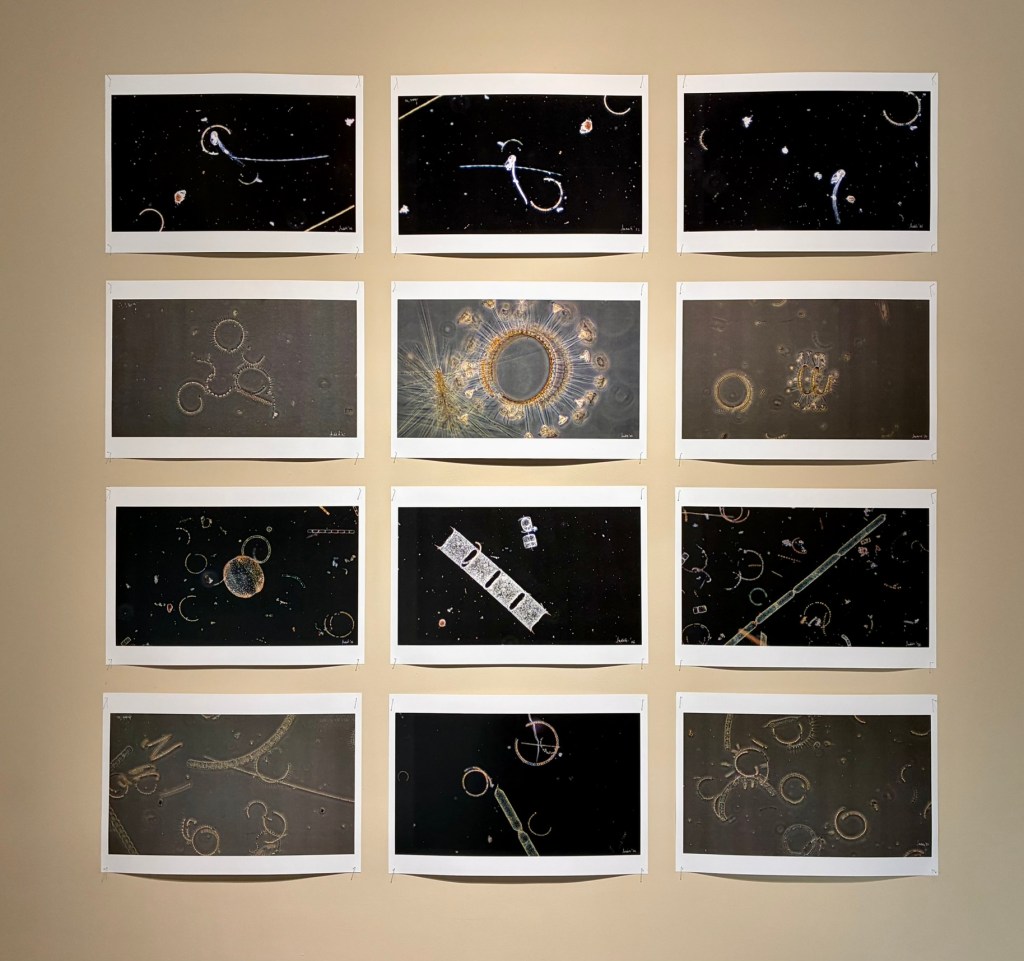
Indah Arsyad|The way of water series #1 – #12, Photographic print on paper ©Indah Arsyad, 30 x 50 cm, 2026
Scientific research included microscopic analysis of phytoplankton from the Java Sea and IoT-based monitoring of water pH and ambient temperature in the polluted Pakerisan River, which originates from the springs of Lake Batur in Kintamani, Bangli. Phytoplankton contribute approximately 50% of global oxygen production and are essential to life on Earth. This spiritually and hydrologically significant water system provides a context for exploring the relationships between environmental change, spiritual traditions, and local ecological knowledge.
Note: Microscopic images of phytoplankton from Java Sea water samples, examined and analyzed at the National Research Center for Oceanography, under Indonesia’s National Research and Innovation Agency (BRIN).
Viewing and listening more through link and artist website|©Indah Arsyad, 2026
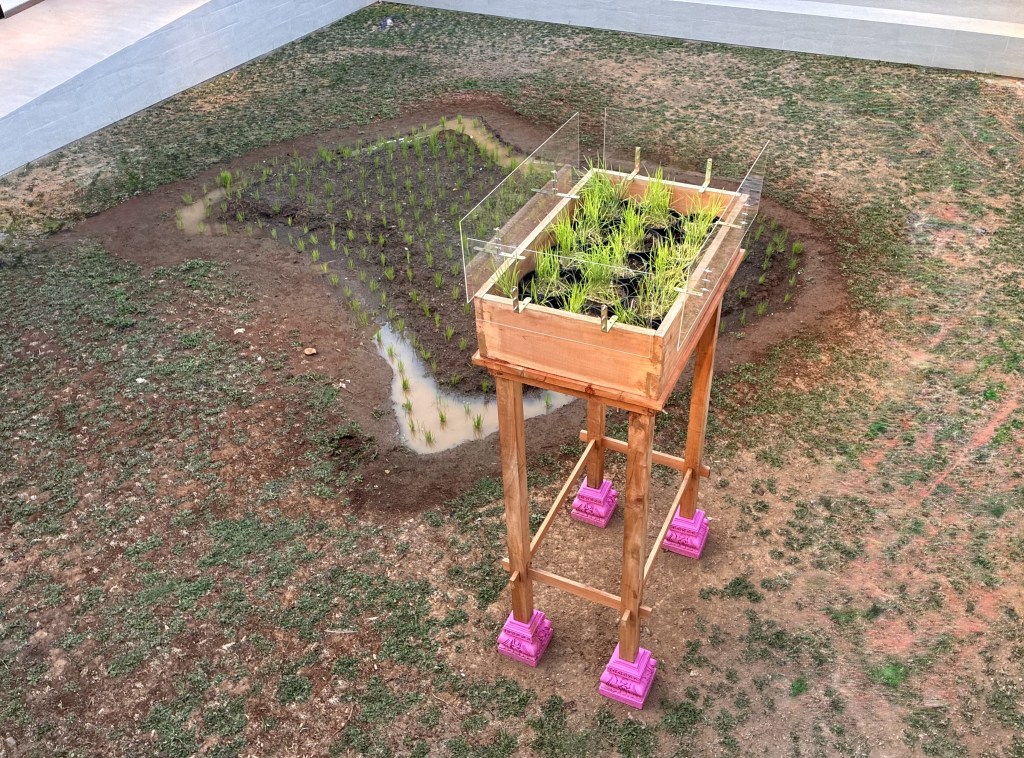
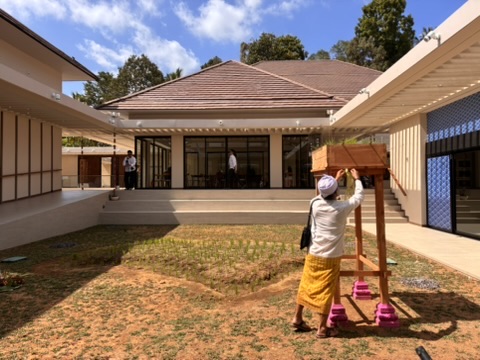
Satya Bhuana
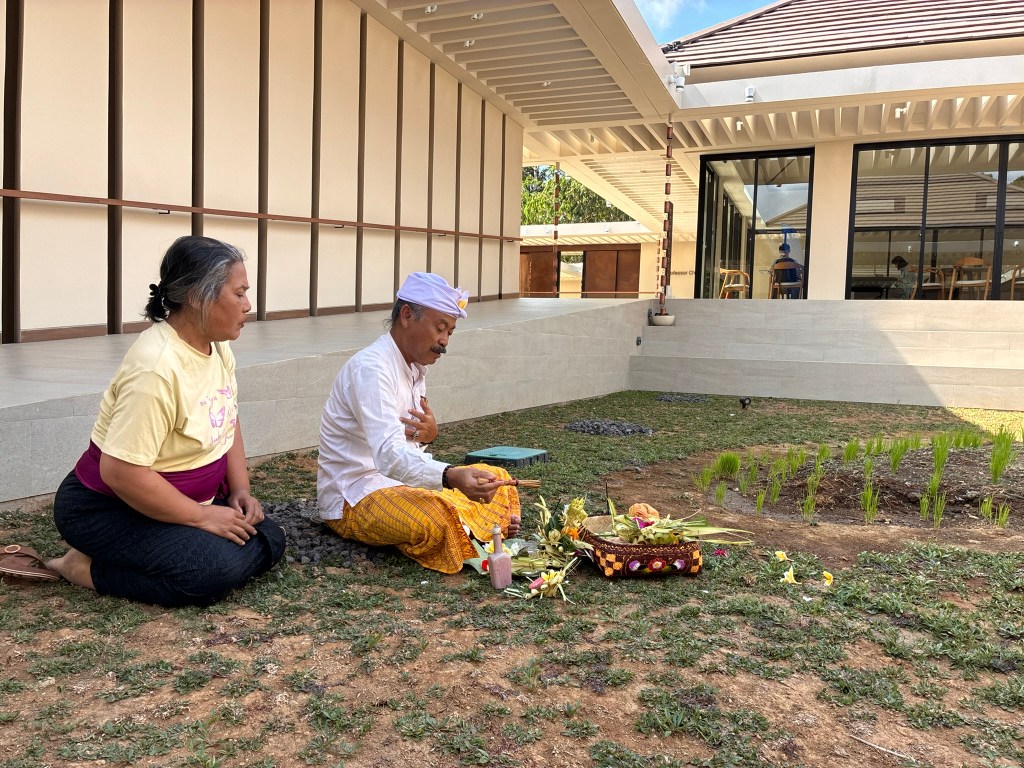
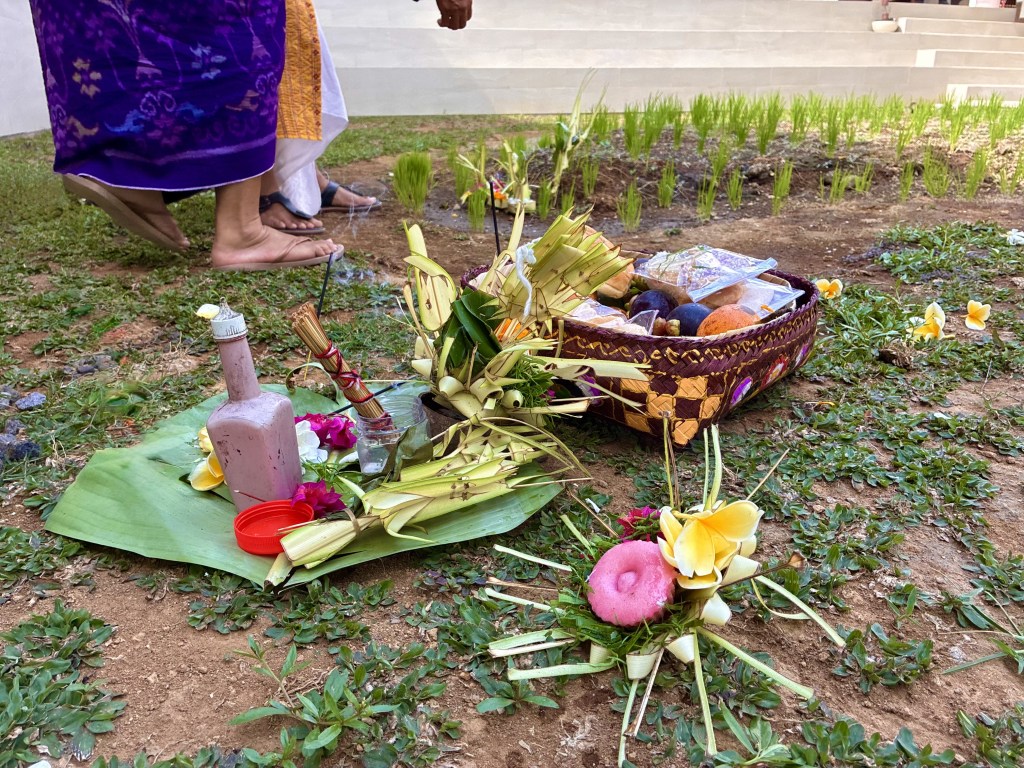
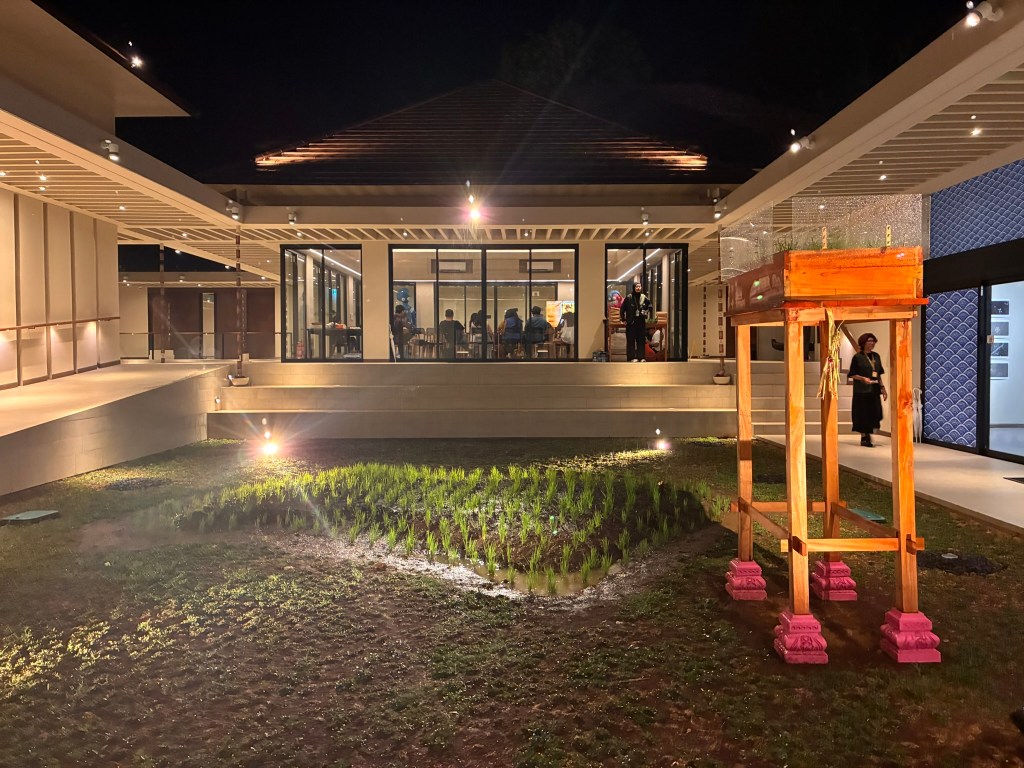
Bali 2073
Rice plants, soil, wood, fiber glass, and concrete
Variable dimensions
Ritual performance
2026
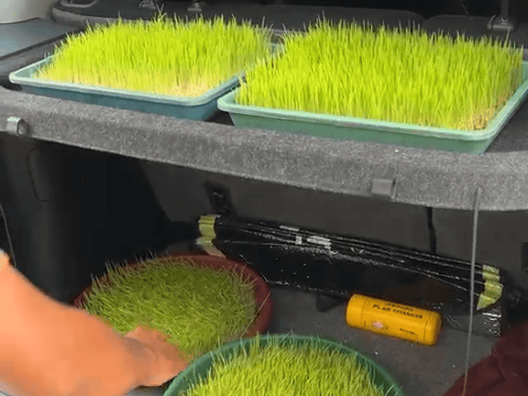
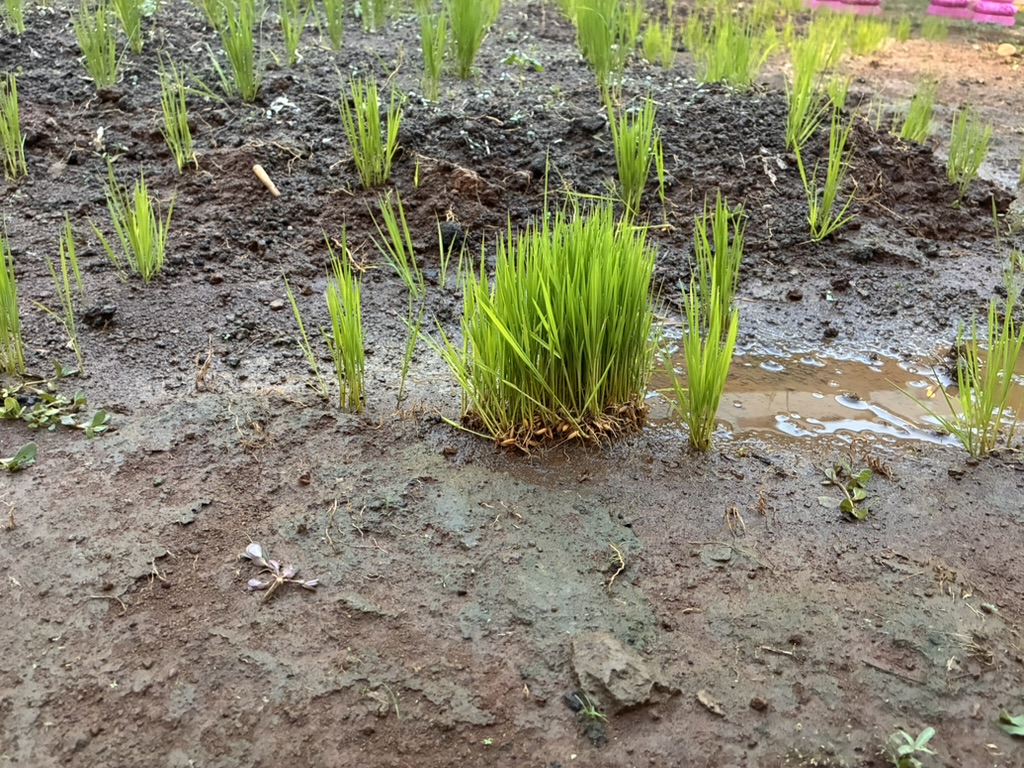
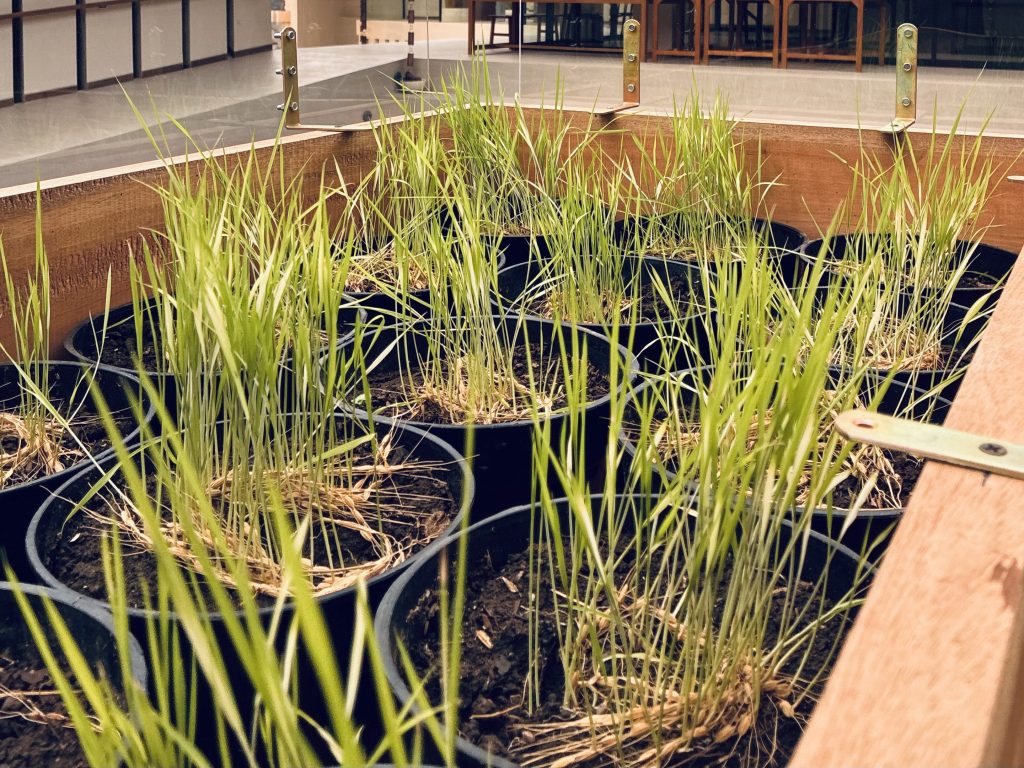
| Date | Rice Growth Stage | Ritual Activities |
|---|---|---|
| 10 October 2026 | Rice Planting Begins | Offering the Banten Panewasa ceremony |
| 22 October 2026 | Rice Plants at 12 Days Old | Offering the Banten Bubur Masuyuk ceremony |
| 24 November 2026 | Rice Plants at 2 Months Old | Offering the Banten Biukukung ceremony |
| 23 December 2026 – 3 January 2027 | Beginning of Harvest | Offering the Banten Pejati ceremony |
For more artist and curator CV,
please visit:
E-katalog – Fluid Kinship – Watershed (EN)
General Information
Indonesia Chapter
Session 1: Watershed (22 October, 2026 – 3 January, 2027)
Venue: Satyanara, Ubud, Bali
Curators:
Yipei Lee & Mella Jaarsma
Participating artists:
Arif Furqan. Indah Arsyad. Ipeh Nur. Made Griyawan. Satya Bhuana.
Researchers:
Angharad Davies (UK), Nikita Fernandes (India), Yipei Lee (Taiwan), Heather Noble (UK), Martina Leone (Italy), Sharo Liang (Taiwan)
Special Thanks:
Pak I Wayan Warsa, Pak Norbertus Sigit Setyo Nugroho, Pak Anton Taryono, Pak Mehendra, Ibu Ivy, Ibu Diah Novita, Ibu Ni Luh Santi Indrayani, Ibu Tugek Putri, Ibu Mie Cornoedus, Ms. Jill Zheng, Ms. Jin-Man Pei
Presented by:
SUAVEART
Supported by:
Yayasan Satya Djaya Raya, Satyanara, Department of Cultural Affairs, Taipei City Government, National Culture and Arts Foundation, and Ministry of Culture Taiwan

