
Angharad Davies is an architectural historian who holds undergraduate and postgraduate degrees from the University of Warwick and The Courtauld Institute of Art. Throughout her academic training, she has focused on environmental architecture and has more recently expanded her research to Iranian architecture and its relationship with the surroundings. As a freelance researcher, she collaborated with St Elvan’s Church Heritage to develop the exhibition Here Be Dragons (2025), showcasing a Meiping vase and an okimono dragon from the British Museum collection. She is currently working with the heritage site on a new project investigating a local twelfth-century parish church, exploring the possibility of reassessing its date of construction.
With experience in the art field ranging from museum and gallery work to auction houses, Angharad has worked in numerous art-based settings. Over the past seven years, she has been able to gain first-hand experience in archives and cataloguing teams. The opportunity to study architectural history alongside objects and art has enabled her to fully unravel the deeper connections between our inhabited spaces and surroundings.
‘Immortality’s spring does not have
the splendour and luster of the Zinda Rüd.
For Khizr, the water of life –
for us, the water of the Zinda Rüd.’
A ghazal from Sāʾib Tabrizi (1592-1677)1
Introduction
Placed in the centre of Iran lies the Safavid metropolitan city of Isfahan.2 Constructed under the rule of Shah Abbas I from 1598, the city soon became a centre for trade, a crossroads between the rest of Asia and the entrance of Europe. With its ability to provide access to both the Caspian Sea and the Persian Gulf, it was a popular route for international travel. As a result of its international prowess, the city itself provided a variety of amenities, inviting visitors and wary travels. One such example is Isfahan’s urban centre, the Maidān-e Naqsh-e Jahān (1598-1629) [Fig.1] with its bazaar and sites of entertainment.3 Despite the maidān’s beauty, theatricality and size, it is the river that rents the city in half that provides Isfahan with its natural beauty, creating an ever-changing spectacle. It travels through the city, both visibly and discretely.
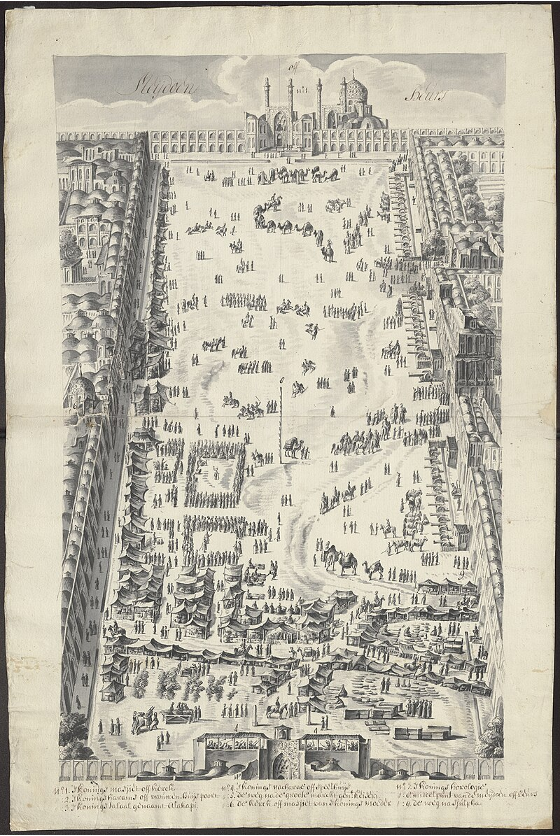
[Fig. 1] Unknown architect(s), Maidān-e Naghsh-e Jahān, 1598-1629, Isfahan. Sketch by Gerald Hofsted van Essen, ‘Meijdoen’, 1703.
The Zayandehrud is essential for the survival of Isfahan [Fig. 2], both before its inception as a city and during recent times. It navigates the city providing water for people, travels beyond Isfahan providing agricultural support and is the largest natural marvel of the city, playing host for festivities and relaxation. The river is supported in these tasks through the infrastructure developed and expanded when Isfahan became a city, with the introduction of new bridges and damming systems, mādīs (canals) and cisterns4.The infrastructure of the city is made to accommodate and manipulate the flow of the Zayandehrud; it has been constructed to capture and highlight its beauty.
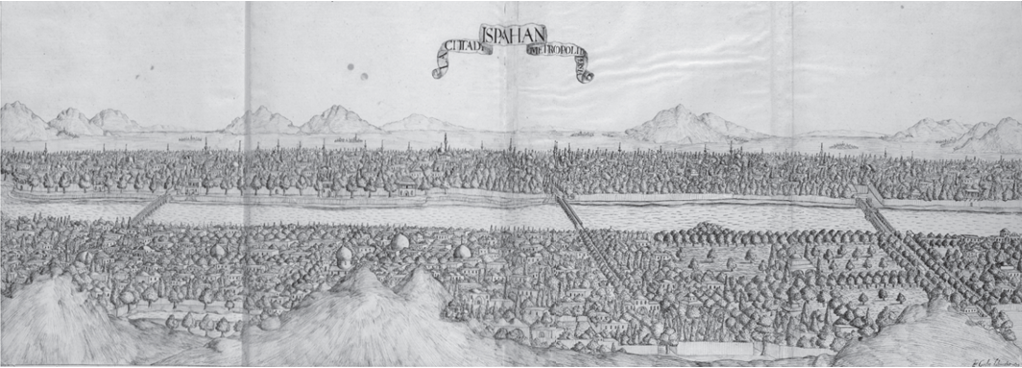
[Fig. 2] Guillaume-Joseph Grélot, City of Ispahan, Metropolis of Persia, 1674, Print. Ambrosio Bembo, Viaggio e giornale per parte dell’Asia di quattro anni incirca fatto da ma Ambrosio Bembo Nobile Veneto, ca. 1676.
The River of Life
With its horizontal division, Isfahan is shaped by the Zayandehrud. The city itself is surrounded by arid land, with the river giving the city a life source. For centuries before even the inception of Isfahan as a Safavid capital in 1598, the villages that once lay parallel, Jayy and Yahūdiyyah [Fig. 3], needed the flow of the Zayandehrud. Nevertheless, it was a natural obstacle. Bridges were constructed to meld the land together, bridges like Marnan and Shahrestan Bridges [Figs. 4 and 5], both of which offered their foundations to Safavid builders when morphing the city. The significance of the river only ever increased during the seventeenth century with the expansion of Isfahan even further with the migration of the Armenian population in 1604, expanding south of the Zayandehrud and forming New Julfa.
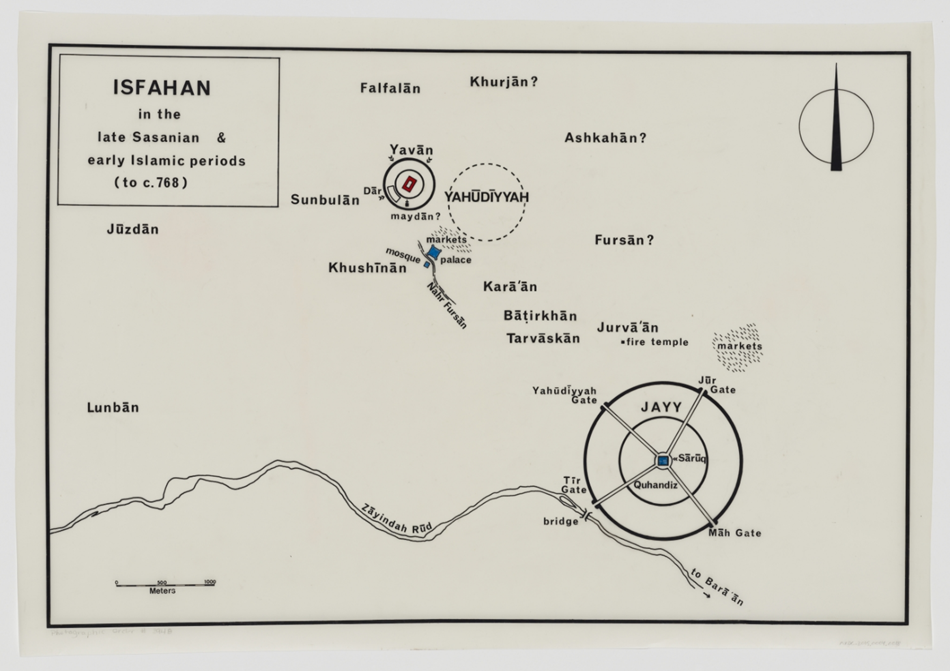
[Fig. 3] Unknown Cartographer, Map of Isfahan area in the late Sasanian and early Islamic periods, showing settlements and walled city of Jayy, ca. 1974-1976, ca. 43.5 x 64 cm. Royal Ontario Museum.
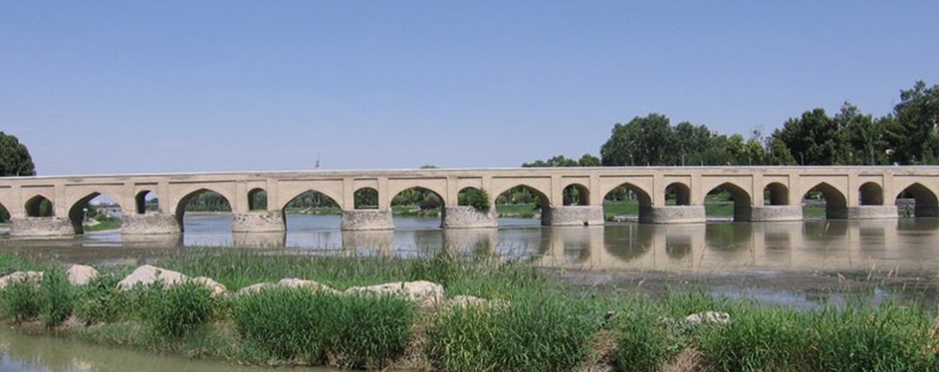
[Fig. 4] Unknown Architect, Marnan Bridge, 1599, Brick, 186 metres long, Isfahan. Accessed from the Visit Iran Webpage on 16 May 2024 [https://www.ivisitiran.com/en/tourist-attraction/about/3413/Marnan-Bridge]
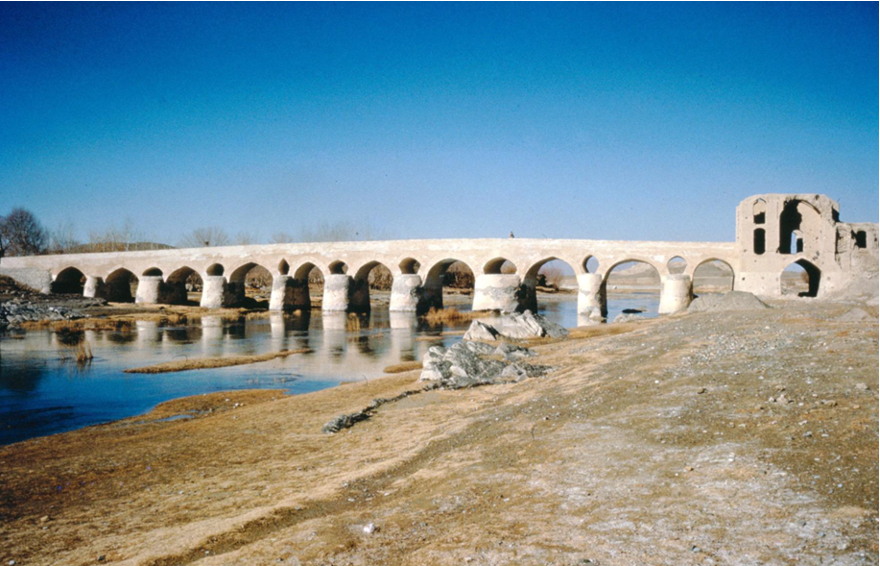
[Fig 5] Unknown Architect, Shahrestan Bridge, Foundations from the Third Century, Brick, Isfahan. Fine Arts Library, Harvard College Library.
The Zayandehurd, venturing down from the Zagros Mountains, was, even to this day, a temperamental river5. During the Summer months, the river practically disappears, exposing the dry bed underneath6 [Fig. 6]. This change in nature provides a new experience for those navigating the river. James Silk Buckingham in his 1829 publication Travels in Assyria, documents this change, describing that he, ‘crossed the bed of the river Zayandehrod, which was entirely dry.’7 With a dry riverbed, noting the five bridges that connect the city, these structures also develop a new personality during these arid months. No longer are the bridges features in the city that are purely for crossing or pleasure, as will be explored in a later section, but can also now be admired, from head on. It is, however, a different matter during the Winter months when the river returns to flow, ‘through the city like a web of veins’8 [Fig. 7]. Due to the nature of the river and its flow, governing it through bridges and mādīs (canals) became a fundamental aspect of the running of the city, important not only to the people occupying its ground, but also to the ruling shah who sought his image, partly, through the control and ordering of this boisterous river.
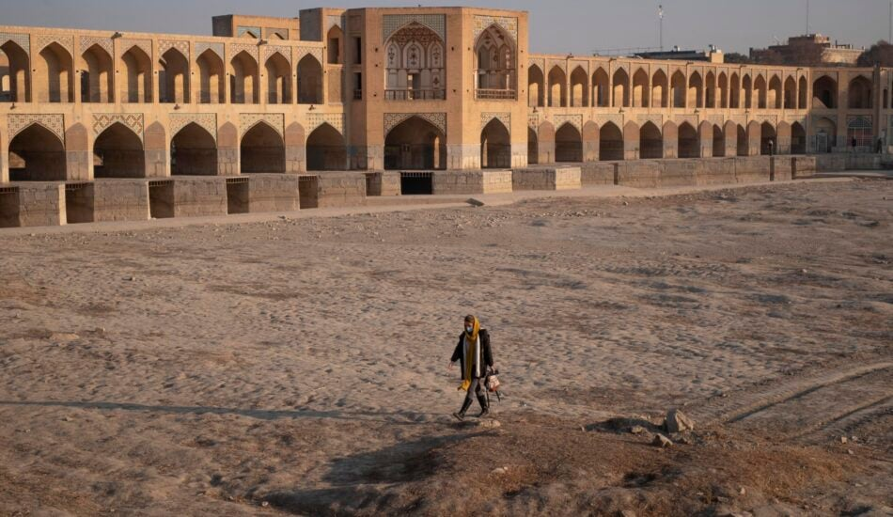
[Fig.6] Morteza Nikoubazi, An Iranian woman walks along a dried-up Zayandehrud riverbed in the city of Isfahan, 2021.
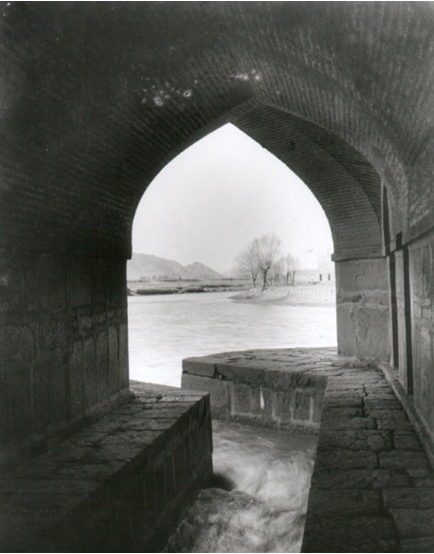
[Fig. 7] Unknown Architect, Khaju Bridge: Detail of supporting pier and vault system, 1650, Stone and Brick, 137 metres long, Isfahan.
Conway Library, The Courtauld Institute of Art.
Fuelling the City
The existence of this river is split into the visible and invisible. Underground mādīs were dug stemming from the river, spreading around the city and providing water for the people of the city [Fig. 8].9 By establishing an underground water network for the city, it lowered the risk of water evaporation, proving vital during the summer months.10 This system was expanded by the Safavids, with the Zayandehrud spreading its valuable elixir of life since around the eleventh century through a mādīs system.11 It is also documented that residents dug mādīs from the Zayandehrud to support their fields, gardens and houses.12 With this internal infrastructure present within the makeup of Isfahan, the seventeenth century saw the introduction of a second smaller group of canals (jadval) that branched from the original mādīs.13 The mādīs were, however, just one aspect of this ‘elaborate hydraulic system’, with water cisterns and the bridges also contributing the distribution of water around the city.14
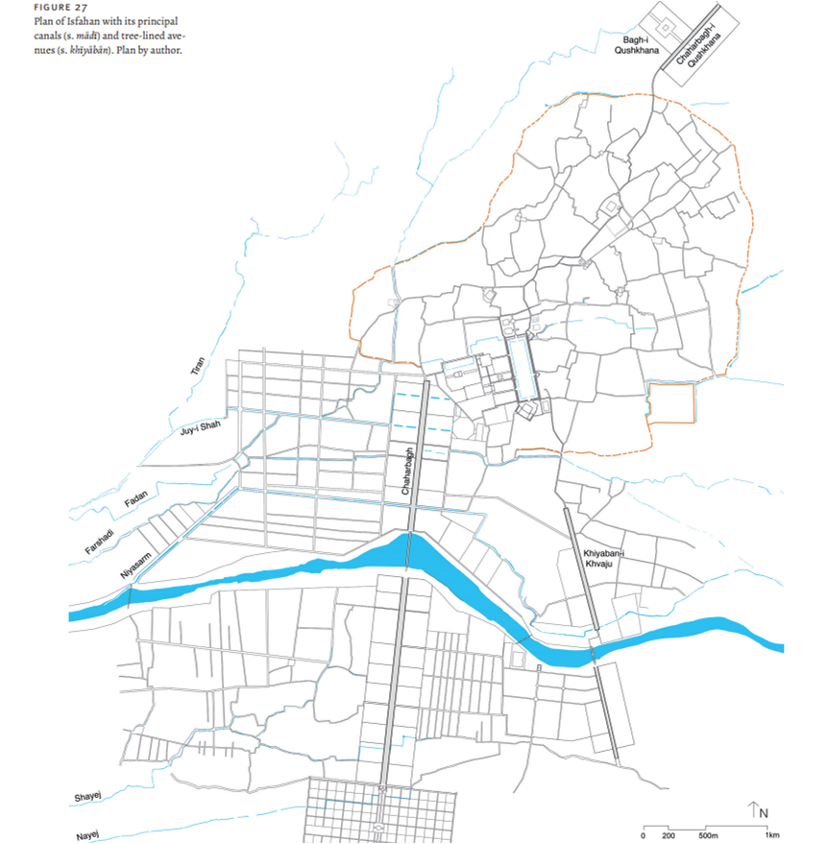
[Fig. 8] Farshid Emami, Plan of Isfahan with its principal canals (s. mādī) and tree-lined avenues (s. khīyābān), 2024. Farshid Emami, Isfahan: Architecture and Urban Experience in Early Modern Iran, 2024 [p. 64]
The bridges running along the river became visible pinnacles of the distribution of this river. Several of the mādīs directly stem back to the bridges. Marnan Bridge is one such example of this, with the Madi-e Niasarm originating from this structure, later branching in three separate directions to fuel the gardens and palaces of the southern suburbs of Isfahan.15 Both the bridges and the mādīs provided a dual purpose. They were not solely used for their distribution of water for drinking, but also for the people’s leisure. Specific mādīs, like Mādī-e Juy Shah which fuelled the royal mansions and gardens, was singularly used for watering gardens.16 As a city renowned for its gardens and natural beauty, these separate mādīs nurtured plants and flowers, as well as creating architectural features within these garden spaces, evidenced with the water channels running through the Chaharbagh [Fig. 9].17 This small addition gave the average ambler a sensorial experience, an overload, from the smell of the flowers to the sound of the water trickling through the garden. It is this fuel of existence that also gives sensorial nourishment.
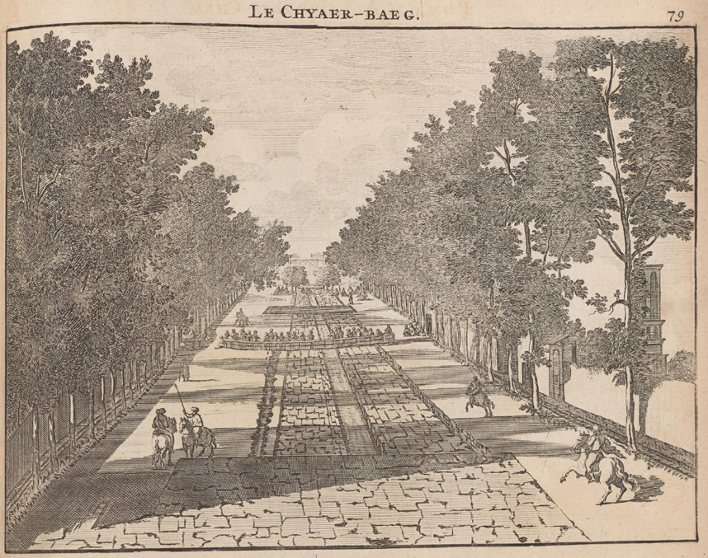
[Fig. 9] Cornelis de Bruyn, Chaharbagh, 1737, Print. Cornelis de Bruyn. Travels into Muscovy, Persia, and Part of the East-Indies, 1737, Plate 79.
Weeping through the eyes of the bridges
In extension to the mādīs, the river was moulded to irrigate the surrounding lands of Isfahan. Engelbert Kaempfer wrote about this system during his travels, documenting that, ‘the river is dammed up long before the city’ with the water used, ‘partly for irrigation of the fields (…) and partly for the wishes of the city.18 With this, structures in Isfahan needed to be established to support the emerging irrigation system. The bridges along the Zayandehrud were not solely used for crossing or admired for their beauty, but, in certain circumstances, for their infrastructure as dammed bridges, like Khaju Bridge (ca. 1650) [Fig. 10].19 Built into the structure of Khaju Bridge, mobile wooden sluices allowed for the river’s damming [Fig. 11].20 This was subsequently split into two levels, allowing for a greater control of the river, as well as providing water for the irrigation of Karāraj, supplied through the Mādī-e Roʾasā.21 The use of dammed bridges was not unknown to Safavid builders. Historically, these structures helped to shape and supply water to flourishing cities, proving to be vital due to the occasionally dry and harsh landscape. Examples of these bridges can be found throughout the Sasanian Empire (224-651 CE), as seen with the Dizful and Kiz Bridges [Figs. 12 and 13 respectively].22
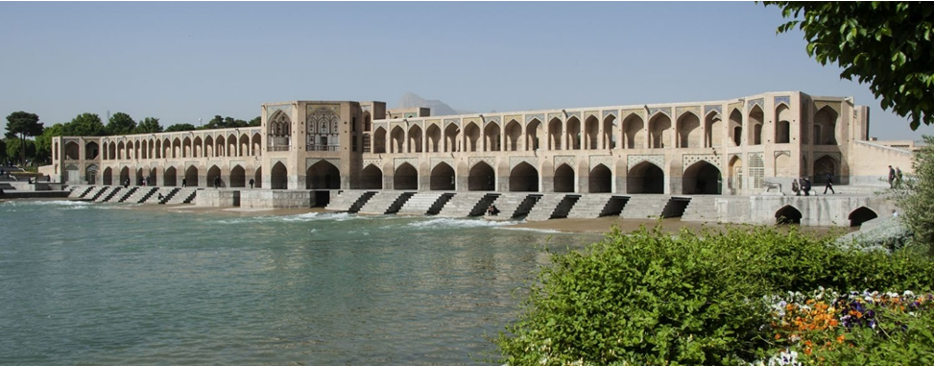
[Fig. 10] Unknown Architect, Khaju Bridge, 1650, Stone and Brick, 137 metres long, Isfahan. Daniel C. Waugh Archive, Aga Khan Documentation Center at MIT.
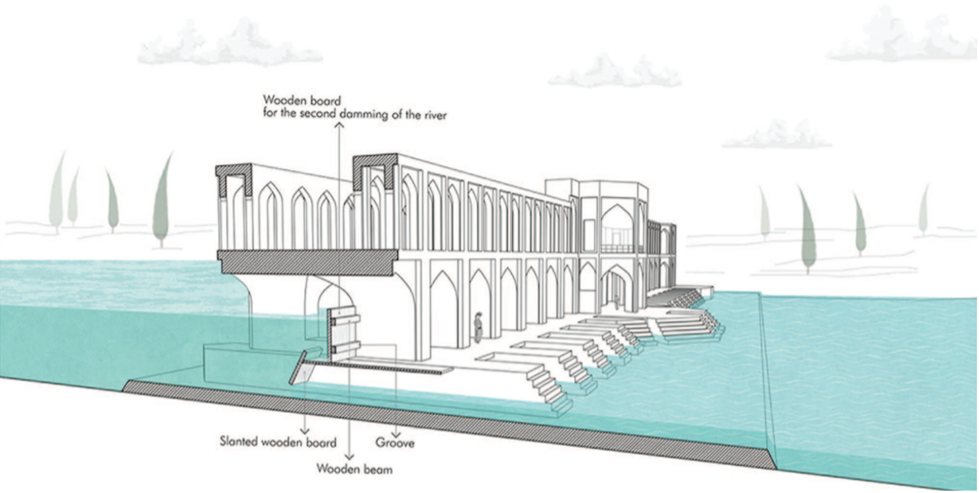
[Fig. 11] Sahar Hosseini and Leila Azizi, Khaju Bridge (representation of an approximate position of the wooden boards installed between the bridge piers and in the base channels to create a dam), 2023, Digital model of the bridge. Sahar Hosseini, “The Invisible Lake of Saʾādat-ābād and the Safavid Architecture of Affect,” 2023 [p. 400].
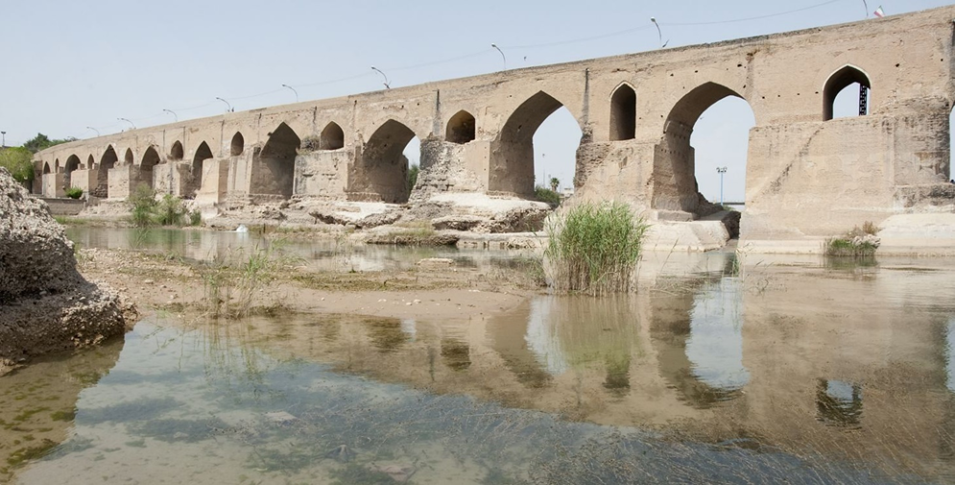
[Fig. 12] Unknown Architect, Old Dezful Bridge, ca. 260 CE, Bricks, 385.5 meters long, Dezful. Daniel C. Waugh Archive, Aga Khan Documentation Center at MIT.
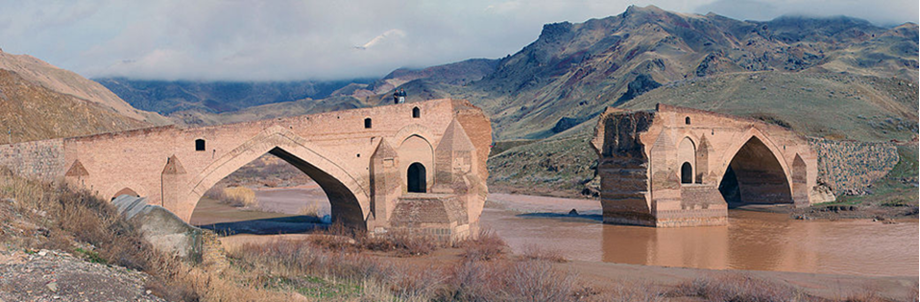
[Fig. 13] Unknown Architect, Kiz Bridge, ca. Eighth Century, Brick, Mianeh.
Outside of the Zayandehrud’s disperse of water, it proved a sign of kingly mastery and control. The construction of Khaju Bridge is an example of this. Just as the Allahverdi Khan Bridge [Fig. 14] demonstrated the power of Shah Abbas I, proving his ability to master the river, develop Isfahan in his eye and to display himself as a present ruler for his people, Khaju Bridge gave the same position to Shah Abbas II.23Throughout Safavid rule, it was crucial that the shah remained accessible to his people, that he could be seen. As a result, these spaces, that can be found across the city from the Maidān-e Naqsh-e Jāhan and the talar of the Ali Qapu Palace [Fig. 15] to the bridges, allowed for sites of theatricality and visibility.24 Khaju Bridge would become a hive for celebrations and merriment during the reign of Shah Abbas II, such as the Cherāghān, a festival part of the Nowruz celebrations.25 Festivities and celebrations were not the only manner in which the presence of the shah and his control could be witnessed. The Zayandehrud itself, through the construction of the bridges, demonstrated his power over the land, where the river would ‘halt on the king’s orders.’26 Khaju Bridge provides the strongest display of evidence demonstrating this. The poet Sāʾib-e Tabrizi (1592-1676) reflects upon the relation between the river and the shah, writing that the river has become a ‘bold youth in golden mail clinched with a belt’, a belt commissioned by Shah Abbas II.27 Valī Qulī Shāmlū’s (d. after 1674) writing also recognises the ‘king’s command’ of the river and the necessity of the bridge during the dry seasons, reflecting its conquest with the bridge’s construction as becoming ‘equal of heaven’s arch.’28 Khaju Bridge is, consequently, used as a marker of the presence of Shah Abbas II.

[Fig. 14] Unknown Architect, Allahverdi Khan Bridge, 1599-1602, Brick, 297.76 metres long, Isfahan.
Daniel C. Waugh Archive, Aga Khan Documentation Center at MIT.
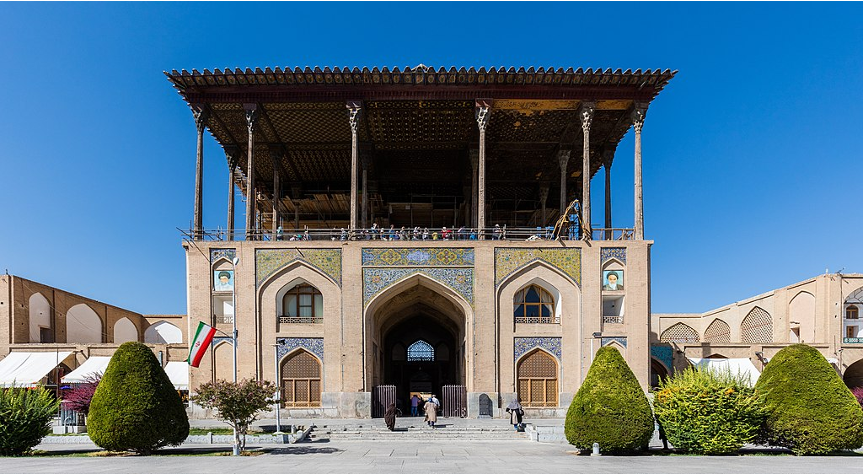
[Fig. 15] Unknown architect. Ali Qapu Palace (with a focus on the talar), 1597, Wood and Brick, Isfahan.
Listening to the Flow of the River
A river can be viewed as a natural obstacle, something that can cause a disjoint in a town or city. Whilst it remained an obstacle for the urban planners of Isfahan, the Zayandehrud is a feature that was chosen to be captured and emphasised. Alongside the bridges, it gives space for relaxation and reflection, it provides a space to stop and encourages it. The banks of the river and the underbelly of the bridges, specifically Khaju and Allahverdi Khan bridges [Figs. 16 and 17], equally foster opportunities for social encounters. Just as in the seventeenth century, people still line the walls of the bridges and their crevasses, enjoying a cooling breeze in the summer as the water faintly brushes past the bricks of the bridge [Fig. 18].29To walk along these five bridges is to experience the river; it is to hear the water interacting with these structures, where you are able to feel the water rush past you from the lower levels, to receive shelter and witness its movement through the land – all of which is framed by an arch [Figs. 19 and 20]. The amenities on both the Allahverdi Khan and Khaju Bridges ensures the loss of time, tempting you to stay in this oasis a little longer. The smell of coffee from the coffeehouses and tobacco mingle in the air, an encounter renowned on Khaju Bridge. These intimate, concealed spaces on the bridges ignites ‘physical immersion’ and ‘mental wandering’.
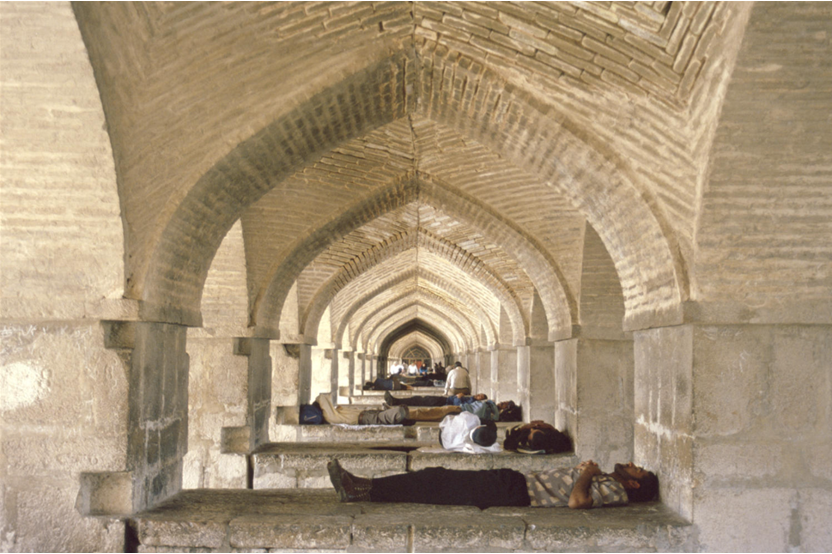
[Fig. 16] Khosrow Bozorgi, Pul-i Khwaju: Interior view through arcade on lower level, 1999, 35 mm slide [Photograph], Isfahan. Aga Khan Visual Archive, Aga Khan Documentation Center, MIT Libraries.
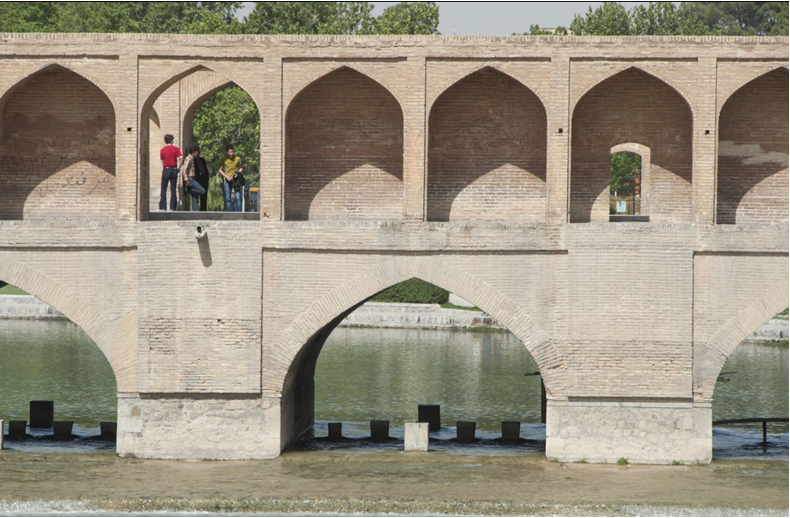
[Fig. 17] Daniel C. Waugh, Pul-i Allahverdi Khan: Downstream view showing pedestrian arcade at centre of bridge, 2010, Digital Photograph, Isfahan. Daniel C. Waugh Archive, Aga Khan Documentation Center at MIT.
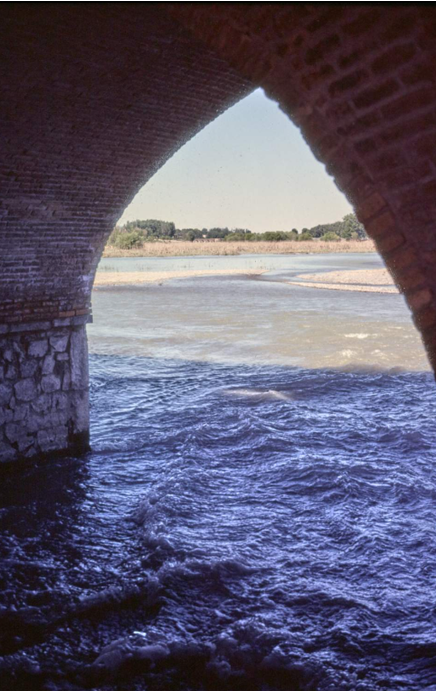
[Fig. 18] Unknown Architect, Allahverdi Khan Bridge: Underside of bridge, view downstream over Zayanda River through arch between piers, 1599-1602, Brick, 297.76 metres long, Isfahan. Royal Ontario Museum and Isfahan Urban History Project, Aga Khan Documentation Center at MIT.
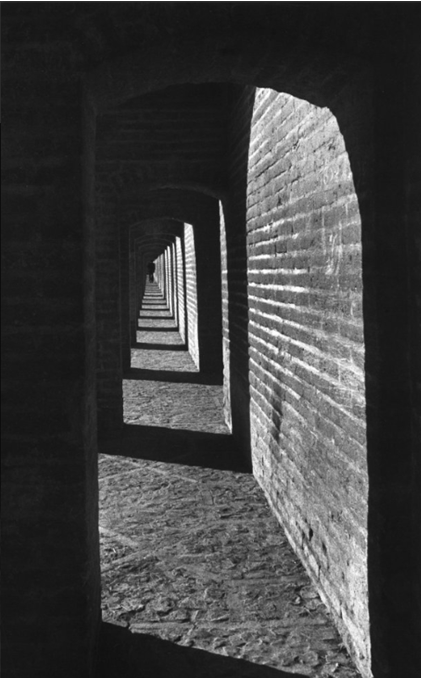
[Fig. 19] Unknown Architect, Allahverdi Khan Bridge: Underside of bridge, view downstream over Zayanda River through arch between piers, 1599-1602, Brick, 297.76 metres long, Isfahan. Royal Ontario Museum and Isfahan Urban History Project, Aga Khan Documentation Center at MIT.
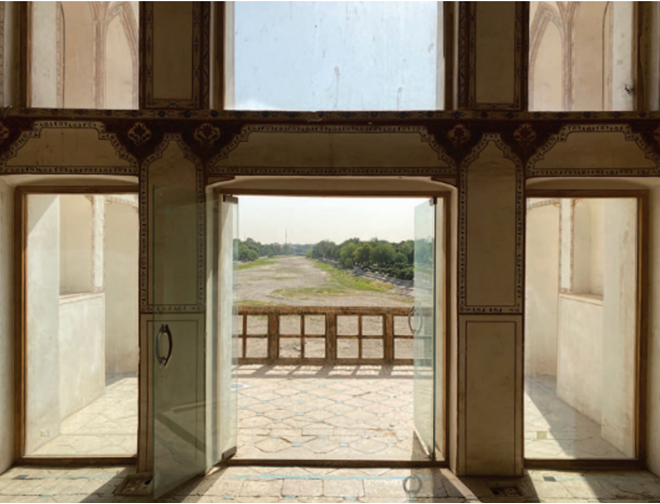
[Fig. 20] Unknown Architect, Allahverdi Khan Bridge: Underside of bridge, view downstream over Zayanda River through arch between piers, 1599-1602, Brick, 297.76 metres long, Isfahan. Royal Ontario Museum and Isfahan Urban History Project, Aga Khan Documentation Center at MIT.
This intimacy with the river can be altered. Festivities often sought the Zayandehrud as backdrop. Nowruz and Ab-rizan celebrations were hosted, first, on the Allahverdi Khan Bridge, and later, Khaju Bridge.30 These festivities have been immortalized through the writing of contemporary poets. The Cherāghān (1069/1659) has become synonymous with Khaju Bridge and poetic expression.31 Both Vahīd Qazvīnī and Sāʾib Tabrīzī poetically documented this event, capturing the sensorial overload. In both pieces, smell dominates with Vahīd Qazvīnī documenting the perfume of aloe-wood and camphor-scented candles coupled with the delicate smell of rose petals scattered underfoot.32 Sāʾib Tabrīzī’s poetry captures the soundscape of the evening, personifying the air whilst capturing the scent of the immediate space.33 In this celebratory instance, the river is a backdrop, with its sound and smell drowned out by the extravagance on Khaju Bridge.
Conclusion
Encountering the river through the bridge presents you with a clear image of Isfahan, a city that is capable of man-made excellence whilst acknowledging the power of the natural. Isabella L. Bird describes Isfahan as a “city of waters”.34 This implies not only what we happen see, the Zayandehrud itself, but also the invisible running of water under the city, factoring also the intimate, individualistic relationship each person has to the river and their ability to connect to its flow through the structures the Safavids imbedded into the city. Despite its practical application, the river is ultimately interacted with through the senses. Every aspect of the Zayandehrud beckons to be encountered, with or without the presence of the bridges. At each point in its journey across central Iran it develops a new method of communication, altering as the landscape changes.35 In this sense, the city has become the autobiography of the people that moulded it to the shape of the river.36
- It is also important to mention here the title of the essay itself. Lifted from a poem by Nawras Damawandi, it captured the beauty of Isfahan through his eyes.
The full text is as follows:
I saw Isfahan to be a silhouette of beauty [savād-i husn],
I drew its picture [tasvīr] through shahrashub.
I painted a picture from fresh imagination [khiyāl-i tāza],
I arranged a spread for the mirth of speech.’
Paul E. Losensky, “ ‘The Equal of Heaven’s Vault’: The Design, Ceremony, and Poetry of the ‘asanābāad Bridge,” in Writers and Rulers: Perspectives on their Relationship from Abbasid to Safavid Times, ed by B. Grundler and L. Marlow (Wiesbaden: Reichert, 2004): 205. ↩︎ - The Safavids Dynasty was an empire that ruled over modern-day and Iran and surrounding land (including some of modern-day Iraq, Afghanistan and Georgia) between 1501 and 1736. With its neighbours, the Mughals and Ottomans, they created what has since been coined ‘The Gunpowder Empires’. Over these years, the capital moved from Tabriz in the west of Iran (1501-1555) to Qazvin (1555-1598) and eventually to Isfahan from 1598. There is much information about the Safavids generally in circulation, such as Andrew J. Newman’s Safavid Iran: Rebirth of a Persian Empire, and Sussan Babaie’s Slaves of the Shah: New Elites of Safavid Iran that offer both an overview of the empire and the people who lived in it. ↩︎
- The Maidān-e Naqsh-e Jahān is orientated on a four-point axis – in the south, the Masjed-e Shah; in the west, the Ali Qapu Palace; the Grand Bazaar is situated in the north and the Masjed-e Shaykh Lutfallah to the east. ↩︎
- The Zayandehrud contains five bridges: the Shahrestan (Sasanian foundations, renovation in the tenth and eleventh centuries), Marnan (1599), Allahverdi Khan (1599-1602), Khaju (1650) and Chubi Bridges (1657-58). The article, however, predominantly focuses on both the Allahverdi Khan and Khaju Bridges due to their amenities, structure and relationship to the river. ↩︎
- Stephen P. Blake, Half the World: The Social Architecture of Safavid Isfahan, 1590-1722 (California: Mazda Publishers, 1999), 31. ↩︎
- Blake, 31. ↩︎
- James Silk Buckingham, Travels in Assyria, Media, Persia (London: H. Colburn, 1829): 206. ↩︎
- Farshid Emami, Isfahan: Architecture and Urban Experience in Early Modern Iran (Pennsylvania: Pennsylvania State University Press, 2024), 63. ↩︎
- Isfahan was composed upon five of these mādīs: mādī-e Niasarm, mādī-e Farshadi, mādī-e Fadan, mādī-e JuyShah, and mādī-e Tiran-va-Anangaran. ↩︎
- Omid Omrani, “Isfahan Multi-Node Metropolis: Conflicts and Opportunities on Urban Nodes and Intersections.” Doctoral Thesis (Universitat Politècnica de Catalunya, 2022): 96. ↩︎
- Somaiyeh Falahat, Cities and Metaphors: Beyond Imaginaries of Islamic Urban Space (London: Routledge, 2018): 100. ↩︎
- Blake, 34. ↩︎
- Somaiyeh Falahat, Cities and Metaphors: Beyond Imaginaries of Islamic Urban Space (London: Routledge, 2018): 100. ↩︎
- Emami, 63. ↩︎
- Blake, 34. ↩︎
- Omrani, 98. ↩︎
- An example of this is seen through the water feature in the Chaharbagh that runs through the central spine of the garden. ↩︎
- Heinz Luschey, “The Pul-I Khwājū in Isfahan: A Combination of Bridge, Dam and Water Art,” Iran 23 (1985): 148. ↩︎
- It is important to recognise here that studies into the infrastructure of the bridges and their application to the running of the city has been little studied, with NAME providing a seminal article about Khaju Bridge and its damming abilities. ↩︎
- Michael Hensel, Defne Sunguroglu Hensel, Mehran Gharleghi and Salmaan Craig, “Towards an architectural history of performance,” Architectural Design 82, 3 (2012), 33. ↩︎
- Sahar Hosseini, “The Invisible Lake of Saʾādat-ābād and the Safavid Architecture of Affect,” Journal of the Society of Architectural Historians 82, 4 (2023): 399-400 and 407. ↩︎
- Luschey, 147. ↩︎
- It has been documented that Shah Abbas I could be seen relaxing and partying on the Allahverdi Khan Bridge during the Nowruz celebrations of 1609. ↩︎
- Babak Rahimi, Theatre State and the Formation of Early Modern Public Sphere in Iran: Studies on Safavid Muharram Rituals (Leiden: Brill, 2011): 235. ↩︎
- Cherāghān is also commonly written as ‘The Festival of Lights’. Emami, 146. ↩︎
- Hosseini, 401. ↩︎
- Losensky, 205. ↩︎
- The full text is as follows:
By the king’s command, the skilled maste rerected a bridge over the Zinda River in Isfahan,
so that the floods of springtime pour over its sluices into the stream of the Milky Way.
Recently they built a bridge over the river. They bound together the fascicles of the earth.
By the command of the king of the seven climes, the bridge became the equal of heaven’s arch.
Valī Qulī Shāmlū. Losensky, 208. ↩︎ - It is important to note here that the design of the bridges engages with this activity. ↩︎
- As a celebration ‘common among Persian Kings’ as well as being a ‘Persian custom’ according to Iskandar Beg, it was revived by Shah Abbas I and even attended by him with his court in 1619 from the lower-level chambers of the Allahverdi Khan Bridge. Emami, 146. ↩︎
- Cherāghān is also commonly written as ‘The Festival of Lights’. Emami, 146. ↩︎
- Losensky, 202. ↩︎
- The full text is as follows:
The strings of clouds – the air holds a lute in its lap.
The red flowers – the earth is flushed like a drunkard’s face.
The scent of flowers has so trickled the air’s nose that it sneezed and scattered the thoughts of the clouds.
Sāʾib Tabrīzī. Losensky, 206. ↩︎ - Isabella L. Bird, Journeys in Persia and Kurdistan: including a summer in the Upper Karun region and a visit to the Nestorian Rayahs; with portrait, maps and illustrations, (London: Murray, 1891): 269. ↩︎
- R. Murray Schafer describes in his book The Turning of the World: Toward a Theory of Soundscape Design that each river has its own sound, each speaks its own language. The same concept can be applied to the journey of water along the Zayandehrud. ↩︎
- Robert McCarter and Juhani Pallasmaa, Understanding Architecture, (London: Phaidon, 2012): 364. ↩︎

