In my younger years, when I was still naive and eager to discover the world, I often travelled south on my own, immersing myself in the many gatherings and events of the Southeast Asian art scene. I was around twenty-five at the time, and frequently encountered the man many referred to as the region’s “patriarch”—Valentine Willie—in Manila Philippines and Yogyakarta Indonesia.
Born in Sabah, Malaysia, Valentine Willie was initially trained and practiced as a lawyer. Yet his lifelong passion for art began during his university years in the United Kingdom in the 1970s. What started as collecting artworks gradually evolved into curating exhibitions of Malaysian artists in Kuala Lumpur in the early 1990s, establishing him as a key figure in the development of contemporary Malaysian art.
He curated early exhibitions for artists such as Bayu Utomo Radjikin and Awang Damit Ahmad, both of whom would later become significant figures in Malaysian art history. His exhibitions at Galeri Petronas, including Paintings by Pioneer Malaysian Artists (1994) and Second Generation Artists (1995), further heightened public awareness of Malaysia’s artistic and cultural heritage.
In 1996, Willie left the legal profession and co-founded Valentine Willie Fine Art (VWFA). Based in Kuala Lumpur, the gallery quickly expanded with branches in Singapore, Yogyakarta, and Manila, becoming one of the most influential platforms for contemporary art in Southeast Asia until its closure in 2013.
When I first met Willie, he was at the height of his career. Whether one was a senior artist, collector, or emerging cultural practitioner, VWFA was almost a mandatory stop for anyone entering the Southeast Asian art world.
He possessed an exceptional ability to recognize emerging talent while also understanding the importance of established artists within broader cultural narratives. Exhibition openings at VWFA were always generously catered with food and drinks, but what truly drew people together was the opportunity to speak with Willie himself. People would queue for a chance to exchange ideas with him, knowing that even a brief conversation could offer encouragement, inspiration, or an entirely new perspective.
I often found myself standing nearby, chatting with other artists while observing this figure surrounded by admirers. I deeply admired him. His unwavering passion for culture and the arts, his egalitarian spirit across race and gender, and his generosity and openness beyond national borders were unlike anything I had encountered growing up in Taiwan.
Following the establishment of VWFA, Willie dedicated himself to raising the international profile of Malaysian and Southeast Asian contemporary art. He actively participated in art fairs around the world and, in 2002, led VWFA to become the only Southeast Asian gallery to participate in ARCO Madrid.
Beyond gallery management, he remained deeply committed to fostering regional artistic dialogue through curatorial practice. In 1996, he curated Wong Hoycheong’s solo exhibition Of Migrants and Rubber Trees at The Creative Centre, National Art Gallery in Kuala Lumpur. He later curated Imagining the Contemporary Body: Selected Works of Art from the Philippines, Singapore and Malaysia at Galeri Petronas, reflecting his longstanding commitment to promoting cross-border artistic exchange throughout Southeast Asia.
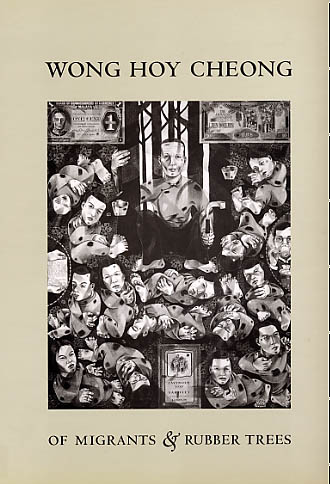
Wong Hoy Cheong: Of Migrants & Rubber Trees.
Kuala Lumpur, Singapore: Five Arts Centre, Valentine Willie Fine Art, 1996.
In 2015, Willie made another significant decision: he stepped away from the commercial art world.
He became a founding figure of ILHAM Gallery, a non-profit art institution in Kuala Lumpur, serving as its Creative Director until 2020. Shifting his focus away from the market, he devoted increasing attention to art historical research, documentation, and archival initiatives.
In an interview with 4A Papers, he remarked:
I think ILHAM Gallery is writing our art history because there is so little written about it. Another condition I set when founding the gallery was that every exhibition must be accompanied by a catalogue. At least then we have a starting point, and we can begin accumulating documentation that future art historians can build upon.
Perhaps these words best encapsulate his life’s work. He was not merely a gallerist, nor simply a curator. He was a builder of cultural infrastructure for Southeast Asian art—supporting artists, exhibitions, archives, publications, and platforms for international exchange.
In April 2026, the VWFA Digital Archive was officially launched, systematically preserving more than three decades of exhibitions, artist collaborations, and cultural exchanges initiated by Willie. The archive documents not only the history of a gallery, but also a vital chapter in the development of contemporary art in Southeast Asia.
***
For many, Valentine Willie was a guiding light for Southeast Asian art.
Although he is no longer with us, the spirit he embodied and the connections he fostered continue to live on throughout the region’s artistic landscape. Perhaps, as the saying goes, those who have brought light to so many lives are destined to become stars themselves. Tonight, somewhere above us, a new star shines brightly among the constellations.
May he rest in peace. ✨
Image courtesy of Valentine Willie’s Instagram.
(Among the many glimpses of his daily life, he was often seen smiling, happily surrounded by dogs.)

