✦ The Literati System: Art Is Not a Skill, but a Way of Life
Over the past half year, while compiling the works of a deceased octogenarian scholar-artist, I gradually came to understand: artists who received a complete traditional education and devoted their lives to Chinese painting often integrated poetry, calligraphy, painting, and seal carving (collectively known as Shi Shū Huà Yìn 詩書畫印) into their spirit and character, evolving them into a philosophy of life.
Within this framework, one can discern: Qi (Tools and Materials): brush, ink, paper, inkstone; kiln fire; meticulous brushwork. Fa (Composition and Principles): the Three Distances technique; negative space; rhythm; layering. Dao (Philosophy of Life): the view of nature; the literati spirit; vitality and rhythm; the unity of heaven and human.
In the world and worldview of literati, observing, experiencing, and leaving traces (through painting, poetry, seal carving, etc.) constitute a daily ritualistic practice—a symbiosis of self and thought. Viewed from afar, it appears to be a logic of objects and mediums; up close, it reveals how literati inscribe time, spirit, and governing principles into the fluid breath of ink.
When the core questions—Why do I paint? How do I perceive the world? How do I situate myself among nature and all beings?—are held tightly by the literati, landscapes are never merely mountains and rivers. Without poetic sensibility, you see scenery; with it, you see the cosmos and the state of the mind.
✦ Practice: From Regular Script Back to the Strokes of Seal Script
I grew up training for competitions in phonetics and character formation, so I became accustomed to regular script. We can quickly identify the pronunciation and writing of ancient characters, but truly understanding their meaning is something that develops gradually with experience as we mature. Initially, reading and identifying the poetic inscriptions and colophons within landscape paintings proved challenging. This isn’t merely viewing images; it involves immersing oneself in the poet’s world through their verses, transporting us back to their time and circumstances. You’ll discover they were expressing heartfelt emotions and documenting the beauty before them.
Inscriptions serve as the artist’s signature, a mark left on the work. They may include the artist’s name or pseudonym (e.g., Shitao, Bada Shanren, Meidao Ren), the date (e.g., Spring of the Year of Bingyin , Spring Day of the Year of Xinsi), the location (e.g., Autumn Visit to Sun Moon Lake, Written at Yellowstone Park), or a narrative (Overlooking the Lion Mountain by the Sea, a Record of Scenic Triumph).
Seals, however, represent a completed language of identity. The visual elements of Intaglio carving and Relief carving, name seals, leisure seals, and collection seals render the reading system of literati works more intricate and complete. In bygone eras, beyond mastering calligraphy, seals served as another distinct, meticulously crafted philosophical element—a means to preserve one’s unique character and prevent replication by others
Over recent months I’ve noticed the scripts used in seals are often Regular, Running, Clerical, and Seal script. Some are simple enough to recognize at a glance; other times they are so complex I have to consult dictionaries, ancient copybooks, or epigraphic rubbings to determine whether the artist is borrowing a style, deforming it, or inventing their own.
Seal script is a different way of thinking. It is like the primordial beast before language became a tool.
Seal script is an imagery-based symbol—a human attempt to capture reality through signs. (This is the core of my practice: how to perceive the authenticity of the past.) In its development, “木” (wood) resembles a tree, “山” (mountain) evokes the peak, “月” (moon) mirrors a crescent, “魚” (fish) suggests the motion of swimming. It is not a depiction of objects, but a mimetic response to the structure of the cosmos; it is the ancient people’s written response to existence through symbols.
There is no strict reading order between literati painting, calligraphy, or seal carving. Yet the ability to understand an artist’s worldview through all of them, calligraphy, painting, seal carving, poetry, is a profound joy for us as viewers.
The evolution of Chinese scripts across dynasties has always been something modern people should linger on and contemplate.
✦ Step by Step: Reading, Stamping, Carving
As I began to understand how to read the characters in seal carving, I also slowly grasped the logic behind them. (Currently, I remain at this stage, practicing transforming this understanding into long-term memory.) Beyond compiling the oeuvre of a single literati artist, I started opening new pathways: studying the works of other literati, trying to synthesize them—from one artist to another; from singular scripts to multifaceted styles; from the meaning of the image to the reconstruction of atmospheric scenes.
When the ancients integrated seal script into seal making, an entirely new realm unfolded. It felt like falling down another rabbit hole.
Only through this long process did I realize seal catalogues, seals themselves, and the act of carving are not mere craftsmanship—they are layers of knowledge unfolding. Literati must dedicate themselves to mastering knowledge, controlling hand strength, rhythmic chisel strokes, and sensing the nature of stone to achieve harmony.
When I look at paintings, it is a cultivation of brush, ink, paper, and inkstone; but when I read seal carving, I see the convergence of human, object, and nature. The Seal catalogues guide the viewer into the context of carving. The moment the chisel meets stone is not merely technical execution, but a dialogue with the material and a process of harmonizing with time.
✦ Seal Text and Aesthetic Realm: Humanity’s Coexistence and Harmony with Nature
Seal carving traces its origins to oracle bone script, bronze inscriptions, and the engraved texts found on ritual vessels. The earliest seals were primarily used for administrative, ceremonial, and divination purposes, such as the jade seals and bronze inscriptions of the Shang and Zhou dynasties. Their functions centered on verifying identity, authorizing documents, and conducting sacrificial rites for blessings. Stylistically, it evolved through two major phases: the “Wei, Jin, and Northern and Southern Dynasties” period, marked by the refinement of literati sensibilities and increasing individuality, and the “Song, Yuan, Ming, and Qing Dynasties” era, which witnessed the artistic maturation of seal carving.
Different literati developed their own stylistic systems, while young artists today continue to explore various approaches to balance and practice.

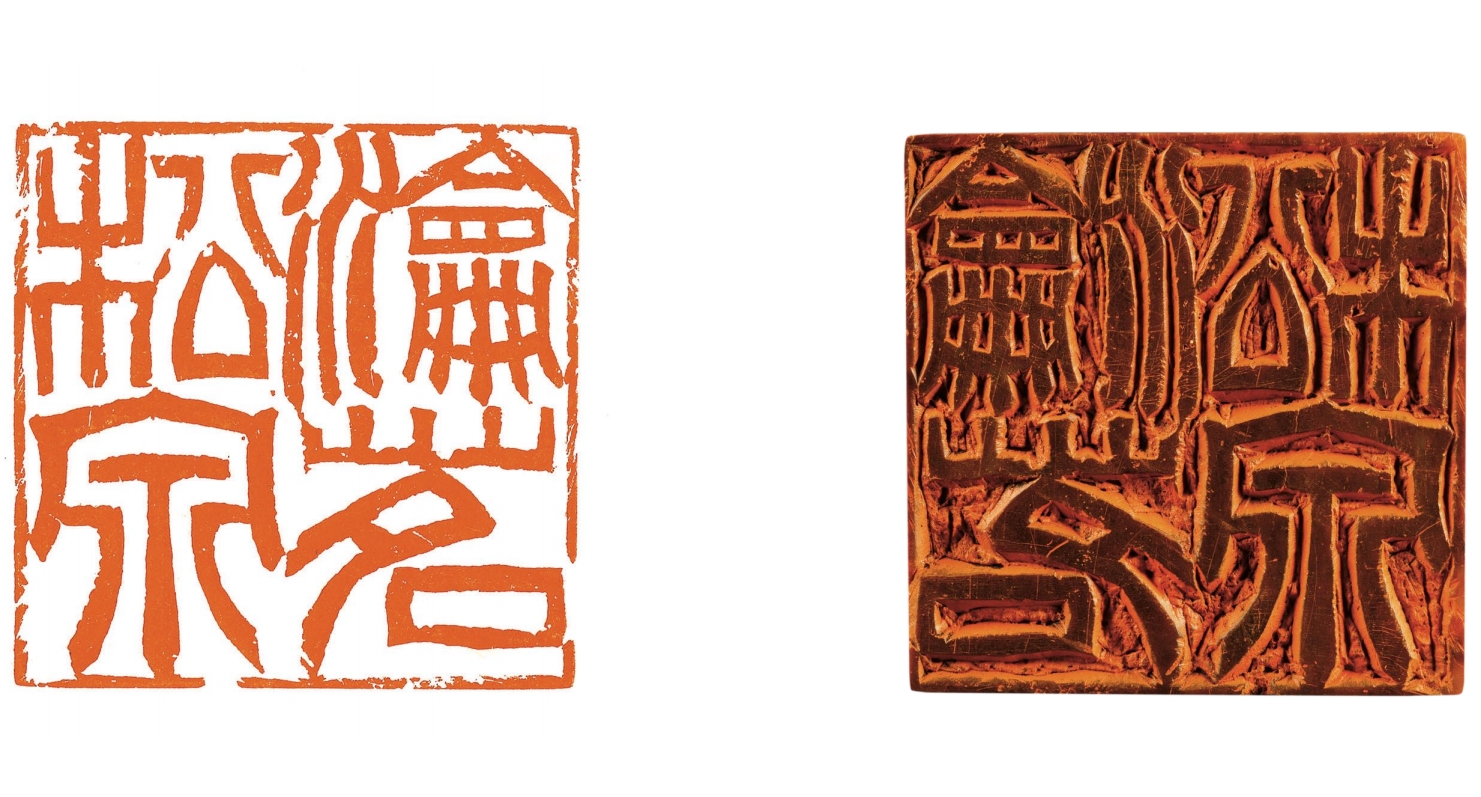
Peng Xiaoxian (born 1989, Dongming, Shandong) completed both his undergraduate and master’s degrees in Calligraphy at the Central Academy of Fine Arts, and is currently pursuing a PhD in Ancient Art History at the School of Humanities, CAFA. His book Zao Du (鑿度) includes 65 seal works: 32 tin seals and 33 stone seals. The collection encompasses physical seals, seal castings, rubbing impressions, as well as inscriptions on the edges, essays, and photographs of exhibition spaces, comprehensively presenting the artist’s reflections and practice regarding seal inscriptions.
Within the catalogue, the content of the inscriptions follows a central theme of “mountains and forests,” gradually interweaving with time and space. Tradition typically seals carving employs stone or wood as materials, with seals typically measuring around 3 x 3 centimeters. Peng’s works, however, treat tin as his signature medium. He conducts deep research into the forming, casting, and carving of tin, so that the characters demonstrate not only aesthetic form but also the unique texture of metal and the artist’s individual sensibility.
Tin seals such as Boiling Tea Among Pines and Springs 《瀹茗松泉》, Flower-bearing Wind 《花信風》, A Single Snow at the Eastern Fence 《東欄一株雪》, Facing the Southern Mountains, Beyond the Northern Marsh 《面南嶺 以北皋》, and Deep Valleys, Lofty Forests 《深谷窈窕 高林扶疏》—not only evoke poetic imagery in their visible areas but also reveal the artist’s physical labor and intellectual wanderings through the interplay of material, texture, and chisel marks.


At the same time, Peng’s stone seal works extend the logic of his carved marks. He selects stone slabs measuring approximately 10 x 10 centimeters to unleash visual and sensory expression. During stone engraving, it requires the stone to be securely anchored while one hand holds the chisel and the other wields the hammer. Through precise striking and angle control, the chisel edge achieves exact alignment with the stone surface. The formation of strokes unfolds gradually through the interplay of striking and pausing, refining and mastering.

For me, the layout of the seal text is also a point of fascination in how one sees. Ownership, setting, function, character, aesthetics, and spirit, all can manifest within the brevity of just two to eight characters: less is more, and profound meaning resides in conciseness.
In the work Seeking Autumn at Tanzhe 《潭柘尋秋》, the seal script characters are relatively delicate and slender. The size and height arrangement of characters like水 (water), 木 (wood), and 禾 (grain) create a subtle contrast with the regular script notes on the border inscription. In By the Water’s Edge 《在水一方》, the seal text leaves appropriate blank spaces, allowing the force of stroke and carving to stand forward. This precise negotiation between character and void, brush and blade, is rare in seal carving, and quietly moving.


✦ Keeping Pace with Time: The Philosophical Practice of Seal Carving
Viewed alone, metal, stone, and other materials are cold and unyielding. Yet in the hands of literati artists, they become vessels that carry thought and emotion.
In seal engraving, guiding the blade into stone, tin, or metal requires patience, focus, and inner stillness. Through daily practice, artists learn to observe the structure of characters, grasp the rhythm of knife-work, and understand the qualities of each material. In doing so, they infuse their own spirit and a sense of natural resonance into the work. The ancient saying “Carve without stopping, and you can engrave metal and stone” (鍥而不捨,金石可鏤) reflects this path of cultivation: technique, temperament, and time accumulate and settle within every piece.
Time is both teacher and companion. Only through continual practice can we gradually perceive the essence and truth of things. Where blade meets stone, and mind meets nature, seal engraving becomes more than a craft—it becomes a profound meditation on life, time, and existence.
After spending some time absorbing and reflecting on these works, I find that appreciating seal engraving and script no longer feels as opaque as before. I may still be far from fully embodying the physical practice behind each carved stroke, but I’ve grown more curious about exhibitions on seal engraving. I hope that by visiting more shows and learning more about artists’ creative processes, I can gradually fill this gap, allowing my observations to align more closely with the true spirit and intricate details of seal carving.
Text by Yipei Lee.
Special thanks to Yawen Lu.
All image courtesy of Artist.
 細着藝術 SUAVEART