Short Intro of CURATOR
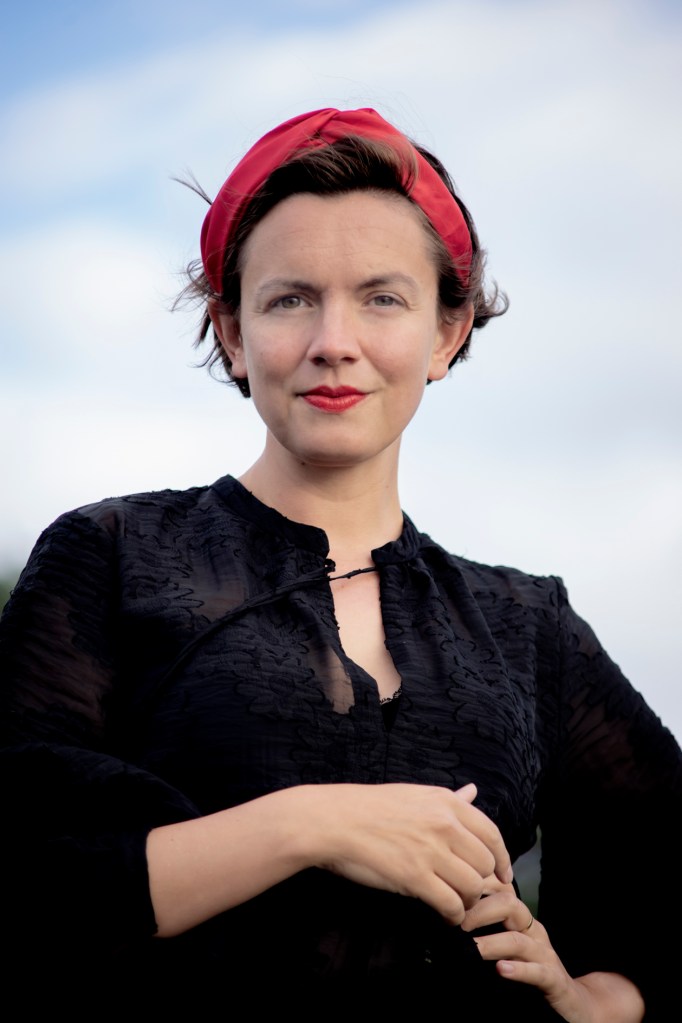
Dr. Bronwyn Bailey-Charteris navigates the currents between art, research, and climate urgency as an Australian and Swedish curator whose book The Hydrocene: Eco-Aesthetics in the Age of Water was published by Routledge in 2024.
Previously, she was curator at Stockholm’s Index Foundation and head of Accelerator’s Art+Research programme, and serves as Curator for the Climate Aware Creative Practices Network across Australia. Recent exhibitions include Bianca Hester’s project Lithic Bodies at UNSW Galleries and Clifton Hill School of Arts (2024) in Sydney and Relational Ecologies at the Australian Centre for Contemporary Art (2025) Melbourne.
Curatorial Expertise & Interests
Bailey-Charteris develops what she calls hydro-artistic approaches that embrace contamination and the productive messiness of boundaries dissolving, working in spaces where climate meets aesthetics to terraform community and planetary care, revealing hidden connections between human and more-than-human worlds.
Currently, she based in the Blue Mountains on Dharug and Gundungurra Country, she is a Post-Doctoral Fellow and Senior Research Associate at ARC Centre of Excellence for Automated Decision-Making and Society (ADM+S) and UNSW investigating how the four elements are transformed through digital technologies.
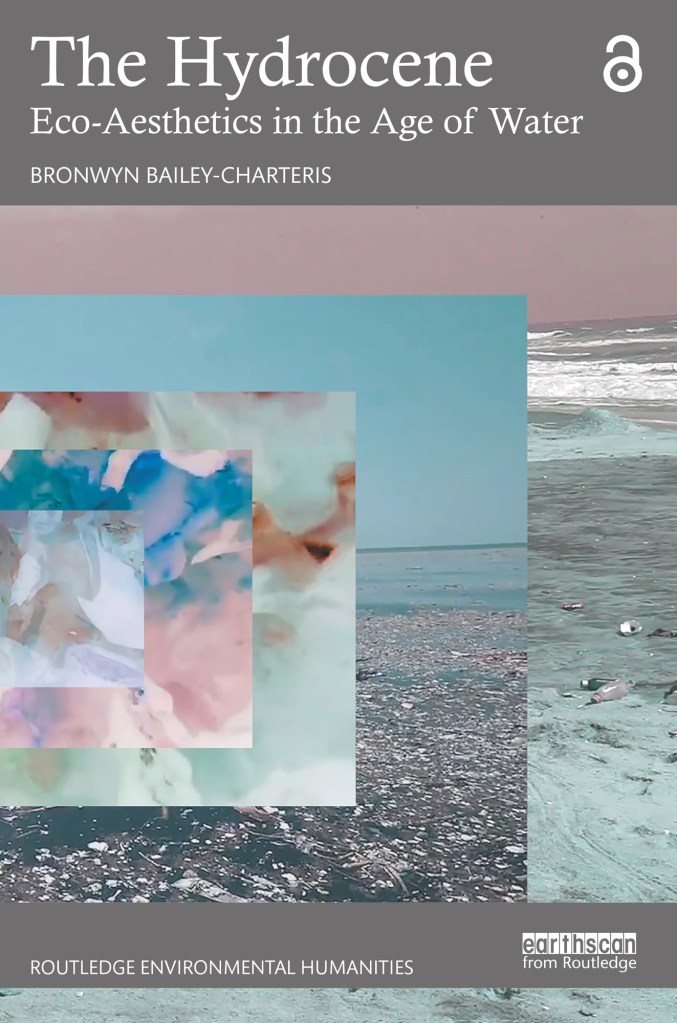
This book challenges conventional notions of the Anthropocene and champions the Hydrocene: the Age of Water. It presents the Hydrocene as a disruptive, conceptual epoch and curatorial theory, emphasising water’s pivotal role in the climate crisis and contemporary art.
The Hydrocene is a wet ontological shift in eco-aesthetics which redefines our approach to water, transcending anthropocentric, neo-colonial and environmentally destructive ways of relating to water. As the most fundamental of elements, water has become increasingly politicised, threatened and challenged by the climate crisis. In response, The Hydrocene articulates and embodies the distinctive ways contemporary artists relate and engage with water, offering valuable lessons towards climate action. Through five compelling case studies across swamp, river, ocean, fog and ice, this book binds feminist environmental humanities theories with the practices of eco-visionary artists.
Focusing on Nordic and Oceanic water-based artworks, it demonstrates how art can disrupt established human–water dynamics. By engaging hydrofeminist, care-based and planetary thinking, The Hydrocene learns from the knowledge and agency of water itself within the tide of art going into the blue.
The Hydrocene urgently highlights the transformative power of eco-visionary artists in reshaping human–water relations. At the confluence of contemporary art, curatorial theory, climate concerns and environmental humanities, this book is essential reading for researchers, curators, artists, students and those seeking to reconsider their connection with water and advocate for climate justice amid the ongoing natural-cultural water crisis.
【From Coffee to Curating: A Day with a Curator】
My curatorial process begins not with ideas but with immersion—literal and metaphorical soaking. I see work, I visit galleries, I walk in the bush, I dive into archives, I swim in the ocean pool. The Hydrocene reminds me that thinking and feeling are never separate from the material world we’re embedded in and that water is the figure who leads me there.
Water becomes both co-conspirator and hydro-methodology. I try to work in the space where climate urgency meets eco-aesthetics—curating doesn’t just represent ecological crisis but attempts to embody it through terraforming community and planetary care.
Each curatorial project emerges like a tributary system. Multiple streams of research, artist conversations and material investigations converge towards these hydro-artistic approaches. I’m trying to embrace contamination and the productive messiness of boundaries dissolving. This approach has been refined through years of international curatorial practice, working across different cultural contexts and learning how place and community shape the possibilities for aqueous encounters.
For example, recently I’ve been working closely with artist Bianca Hester on Lithic Bodies at UNSW Galleries and Clifton School of Arts, these dual exhibitions and extensive public programs emerged from conversations about geological time and mineral extraction with the artist, whilst entwining my focus on aqueous relationships into the folds of Hester’s work. In the context of Lithic Bodies I was drawn to consider my own bodily ‘stoneness’, enacting a sense of living as conglomerate of forest, stone, air in dynamic relation to planetary processes. A stoney guest on Dharawal land.
Water found me in the Blue Mountains where I grew up—not just through the beautiful creeks and world famous waterfalls, but through the mist that rises from the valleys, the way sandstone holds and releases moisture, the particular quality of mountain rain. Later, when I lived and worked in Sweden as a curator, I encountered entirely different water grammars—the way Stockholm’s winter ice creates temporary geographies, and in summer the archipelago becomes home to thousand beaches. My water grammar shifted in Sweden.
I try to decouple from an understanding of water as singular sites or zones such as oceans and rivers to instead encompass the entire planetary hydrosphere—the atmospheric cycles, the groundwater systems, the moisture in soil and bodies. It includes the toxic dimensions: contaminated watersheds, microplastics in precipitation, the chemical traces that circulate through all water bodies.
The Hydrocene emerged from recognising that we’re not just in a climate crisis—we’re being constituted by it. Climate change operates as a threat multiplier that exacerbates existing forms of oppression: communities already marginalised by colonialism, racism, and economic inequality bear the heaviest burden of environmental degradation. Water becomes a site where environmental violence intersects with social violence—from the poisoning of Indigenous water sources to the gendered impacts of water scarcity.
Water is the ultimate (hydro)feminist element: fluid, boundary-crossing, life-giving, and utterly essential yet systematically undervalued. Its very fluidity challenges the fixed hierarchies that structure both patriarchal and colonial power, offering methodologies for more responsive, adaptive forms of relation.
Climate-aware practice for me isn’t just about material choices—it’s about slowing down, working collaboratively, and staying with the harsh realities of intersectional climate violence rather than turning away. My practice has shifted towards writing, long-term relationships, and patient collaboration as forms of care that resist the extractive fast pace of traditional curatorial cycles.
Working with the Climate Aware Creative Practices Network taught me that the most climate-focused practice is often the slowest one—building relationships over years, returning to the same communities, listening more than speaking. This means fewer exhibitions but deeper engagement, prioritising local collaboration over international travel, choosing writing and workshops over spectacular displays.
The climate crisis demands that we face its intersectional violence directly—how environmental collapse disproportionately impacts Indigenous communities, women, and the global south. My curatorial practice tries to hold space for these difficult truths rather than aestheticising them. Sometimes the most climate-aware choice is to not make an exhibition at all, but to write, to teach, to support others’ work, to acknowledge the severity of our situation and that our cultural responses must reckon with these realities.
This approach has opened unexpected pathways towards more intimate, embodied forms of curation that centre care and embodiment over spectacle.
Water teaches a different kind of spatial grammar—one based on gradients rather than boundaries, accumulation rather than separation. Water teaches a different kind of spatial grammar—one based on gradients rather than boundaries, accumulation rather than separation. Like feminist practice itself, water refuses containment—seeping through cracks, finding alternate routes, and persisting despite attempts to control or redirect its flow.
I experienced this powerfully when curating Rosana Antolí’s solo exhibition at Madrid’s Cybele Palace. The exhibition wound through the baroque corridors in a tentacular circuit and a minimalist glowing blue environment bound the galleries, performances, video, paintings and sculptural elements together. The continuous, hypnotic soundtrack created an immersive milieu where visitors moved through the space as if navigating ocean currents. In the exhibition Antoli and I understood the jellyfish and the ocean as part of a total hydrosphere, this meant considering contamination alongside purity, toxicity alongside nourishment.
The most fertile collaborations happen in the spaces between disciplines—where scientific data becomes embodied knowledge, where artistic intuition illuminates research blind spots. I’m learning to become a polyglot, attempting to speak multiple languages at once: the flowing vocabulary of watersheds, the speculative grammar of art, the urgent rhetoric of climate and crisis, and increasingly, the influences of digital saturation, AI and techno-ecologies.
My current work at the ARC Centre of Excellence for Automated Decision-Making and Society (ADM+S) exemplifies this integration. Working with Professor Deborah Lupton, we’re examining how earth, air, fire and water are digitised and datafied through the latest digital technologies, including automated decision-making and AI. Our study uses creative and arts-based methods with stakeholders to provide insights into practices related to monitoring and management of soil, bushfires, air and water, whilst communicating research findings to the public. A crucial example is the complex relationship between AI and water systems—whilst AI technologies support water research through monitoring and predictive modelling, the same systems require enormous amounts of water for cooling data centres, creating a contradiction where the tools meant to address water challenges simultaneously intensify water consumption, often in regions already facing water stress.
My curatorial practice works to make complex ecological relationships tangible through aesthetic encounter, whilst always asking who has power and who doesn’t. The challenge is holding multiple accountabilities—to art and artists, to audiences, and to the communities most affected by these relationships.
Theory becomes action when it moves through bodies and communities. My approach focuses on creating embodied encounters that honour different ways of knowing whilst foregrounding questions of environmental justice and whose voices are centred in conversations about climate change.
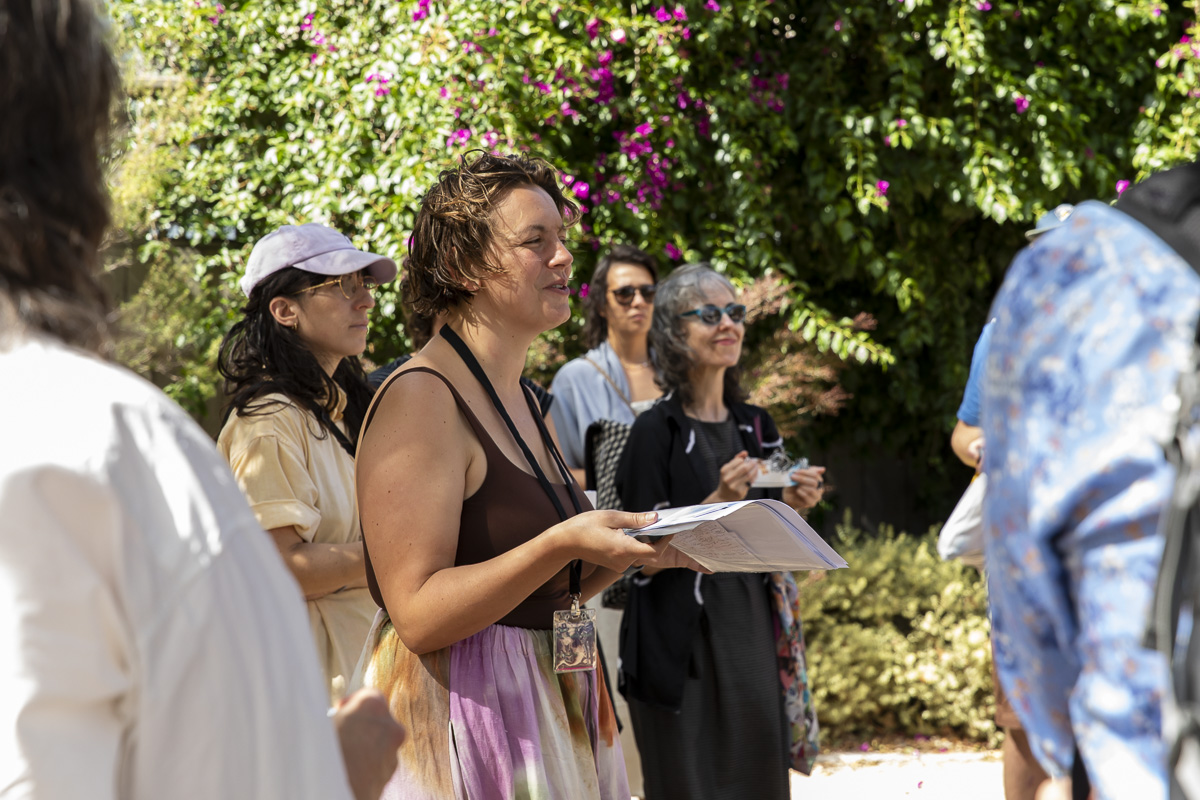
“Curating Relational Ecologies alongside Tristen Harwood and Tara McDowell exemplified this collaborative approach to climate-aware practice. The intensive brought together the nation-wide Climate Aware Creative Practices Network for a program of workshops, panel discussions, and performances at ACCA, questioning how we study and teach climate-aware creative practices with a special focus on Indigenous land justice. Tristen led a yarning circle model with guest presenters Lauren Burrow, Laniyuk, Micaela Sahhar and Brooke Wandin to facilitate shared knowledge building around land-back and ecologically legible art practices, The program extended into collaborative actions: Jakarta-based artist duo Tita Salina and Irwan Ahmett led an hour-long walking procession around the Birrarung, whilst other sessions included dancerly and writerly forecasting practices around weather instability with Jo Pollitt, tarot reading as ‘affective cartography’ with Annie Murney and workshops with local succulents with Clare Milledge and Clare McCracken. The intensive emphasised what climate-aware artists do best: sharing, reworking and collaborating across precarious institutions while bringing deep curiosity and awareness of materials and processes—an experiment in collaboratively generating and modelling climate aware creative methodologies.
As part of the program I led a watershop, Currents & Vessels, with my trusted collaborator Lleah Smith. We began at the gallery with participants choosing vessels from our laboratory—sea shells, sponges, umbrellas—and filling them with collected rainwater. Together, we walked as a body of water to Grant Street Reserve, carrying our precarious vessels, embracing leaks and spills as part of the process. We posed questions like “What vessels are needed now?” and “How can we float together?” Participants combined their waters with others, creating new vessels together, before we ended by releasing the water back into the hydrosphere. This methodology—moving between historical image, embodied practice, and collective action—creates accessible entry points into complex climate realities whilst trying not to lose sight of the political dimensions. The precarity of walking whilst holding water becomes a metaphor for our planetary condition, but it’s experienced through the body rather than explained through text.
My curatorial practice and academic research merge as confluent streams. Exhibitions become laboratories for testing theoretical propositions; academic conferences become opportunities for performative interventions. For me, the most generative thinking happens in these hybrid spaces in collaboration with dynamic folks.
The Hydrocene concept emerged directly from curatorial encounters—from watching how water moved through exhibition spaces, how audiences responded to different material configurations, how artists worked with aqueous media. For me, theory is always embedded in material engagement.
Working within ADM+S has intensified this integration. My collaboration with the wonderful Professor Deborah Lupton demonstrates how curatorial theory and methods can serve as rigorous research tools within academic contexts, while academic frameworks provide conceptual depth that strengthens curatorial work.
Curating has become my way of metabolising the overwhelming reality of ecological crisis whilst grappling with how environmental violence intersects with other forms of oppression. It’s how I process my own climate anxiety while creating spaces for collective processing that acknowledge the unequal impacts of extreme environmental change.
Increasingly I’m drawn away from traditional exhibition-making towards more embodied curatorial models. My academic work has opened up possibilities for curatorial practice that extends beyond gallery walls—through pedagogy, writing, workshops and collaborations that create intimate spaces for collective learning.
Writing, particularly, has become a curatorial medium in itself. The process of researching and writing The Hydrocene was deeply curatorial—gathering different voices, materials, and methodologies, creating connections between seemingly disparate elements. Now, through our Four Elements research, I’m exploring how publications and workshops can function as curatorial spaces that reach audiences who might never enter traditional art institutions.
The collaboration with Professor Deborah Lupton is very exciting, it’s pushing me towards understanding how artificial intelligence is reshaping our relationships not just to water, but to earth, air, and fire as well, whilst always asking who benefits and who is harmed by these immense technological transformations. Our current study is revealing how each element brings different temporal rhythms, different scales, different forms of agency that challenge how we think about AI and digital ecologies.
We’re conducting interviews with artists engaged in exploring the societal and environmental impacts of AI, which is generating new methodologies for making visible the complex relationships between technological systems and ecological processes. One critical dimension we’re exploring is how AI’s seemingly immaterial operations are deeply material—from the cobalt mines in the Congo that supply AI chip components to the nuclear reactors being built to power data centers on Indigenous territories, AI’s infrastructure creates cascading environmental and social impacts that remain largely invisible to users.
Above all I’m increasingly drawn to slow moving, longer-term projects that unfold over seasons and years rather than months. I want to centre the voices of artists and the leadership of First Nations communities. I want to develop pedagogical and research approaches that honour water’s temporal rhythms rather than strict academic calendars. We have a lot of work to do.
【Additional exhibition photos】


Relational Ecologies Intensive|ACCA|Feb, 2025
Courtesy of Bronwyn Bailey-Charteris

Interviewer: Jin-man Pei
Editor: Yipei Lee
Special thanks: Dr. Bronwyn Bailey-Charteris
Photo credit: Lou, Mouw and Lucy Foster
From Coffee to Curating: A Day with a Curator is a series of dialogues with curators who are deeply engaged in the art of curation, knowledge exchange, and cultural storytelling. Through this column, we’re pulling curators out from behind the scenes and into the spotlight. In these fun, candid interviews, we invite you into their world—from early morning coffee rituals to late-night brainstorming sessions. Discover the sparks of inspiration, unexpected creative turns, and everyday hustle that shape the exhibitions we see and feel. It’s about the people behind the practice, and the passions that keep them going.
 細着藝術 SUAVEART