The word diaspora is of Greek origin—diaspeirein with dia meaning ‘across’ and speirein ‘scatter’. In its very essence, a diaspora embodies geographic movement that becomes a sign of elsewhereness. Encapsulating traces of its invisible trajectories, a diaspora is at the same time a gestalt where otherness completes the picture of its identity.
Coming from ‘the elsewhere’ in this project, I was as if a drop of ink diffusing into water, approaching the gestalt of Herianto Sulindro, and the greater sphere of Zurich where the Kho family have settled and lived their lives carrying the cultural memories within. I look to ‘space’ as a conceptual anchor through my working process, not only because space plays a vital role in architecture and urban planning such as in Herianto’s works, but also because space is ‘a network of relationships’ that holds the past, present and future where the invisible trajectories can unfold, and manifest through artistic practices in present context.


The public sphere became my natural starting point of research and interaction, as there’s a clear temporal dimension from carefully preserved records of urban planning in its beginning to its physical form in current sites. With Herianto’s report on the Bahnhofstrasse project pre-read in mind, I went to one of the world’s most expensive shopping streets. Having absorbed his insights shaped my experience of Bahnhofstrasse—luxury shops faded into background while the crisscross overhead wiring reflected the city’s developed complexity which marked the street the critical hub of public transport. Though the architect’s personal style was hardly visible, it may just be the exact point of dissolving himself in the consideration of the fluidity of space and its environmental energies. I see Herianto as an initiator who re-energised the ‘freifläche/open space’, where humans were part of a holistic system.
The thought of Space being Lived emerged as I started getting to work. I intended to create a dialogue between the Bahnhofstrasse-in-plan that Herianto was crucially involved in and my words inspired by the experience of walking in its present built environment. The visual poetry of ‘Lived Space (public)’ embeds the scope of time by integrating the found image from the Bahnhofstrasse’s development project in the 70s and the meandering poetic text which mimicks the shape of the tram that snakes through the very freifläche/open space that Herianto planned in order to reduce car emission. The colours of orange and green from his blueprint radiate and ripple across the rest of the text arranged on different planes from the flat surface, creating architectural and textural dimensions. The semiotic interaction of found image, colour, and graphic arrangement converges upon the word ‘life’, as life is literally given in the act of space being read.
After laying out the first piece on ‘freifläche’ in the outer, I (re)turned to the inner living space—the residence of then home to the Kho. Being immersed in this house-hold, I imagined myself a new addition in the continuity of memories. “Language is”, as German philosopher Andreas Weber theorises, “the ability to ‘touch’ other, to relate to things, processes, emotions, individuals, and through this to turn them into something different”. From exploring subtle traces left unintendedly in the house, words started to come together into lines, and lines gradually a poem.
As the poem born in and about the lived space, I sought to enmesh words with space further by liberating the poem from the flat reading surface, and weaving it to the staircase that transformed poetry into a kinetic reading experience.I found oil paint and a Chinese calligraphy brush in the attic, and started to handwrite the poem. The brush hair that smelled turpentine remained its softness, leaving a nuanced oriental trace in the curves of the letters. Handwriting my poem was a critical ritual for the work in progress when the motion of writing consolidated into a material form that was about to embrace the space. Another typographic play was cut-out words made of images referencing the Kho family, such as the phrase ‘the smell of Kho’ which was made of images from the family cook book, and the word ‘space’ from the blueprint of the Höngg project.
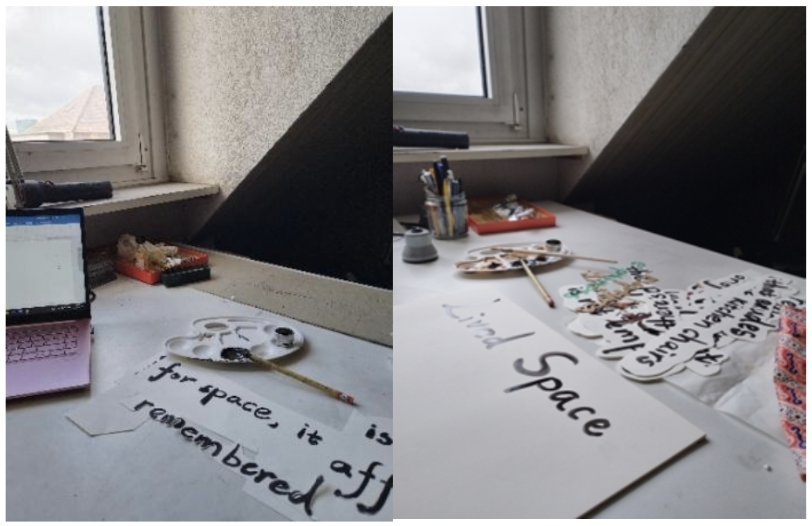
Stairs connect spaces and become a tactile poetic form with dimensions for ‘Lived Space (home)’. As visitors ascend, they encounter the poem step by step—the physicality and kineticity play an essential role in conceptualising space – poetic or domestic – as to be experienced, to be lived.
References:
Ireland, Timothy. (2024). From Life to Architecture, to Life. Springer.
Weber, Andreas. (2016). Biopoetics: Towards an Existential Ecology. Springer.
The Schubertstrasse Experience
The timely chimes of the church bell and the caws of crows were the integral part of my experience living in Schubertstrasse. The bell announced its European presence, while the crows sung the song of efforts Swiss people made to embrace nature in their living environment. Schubertstrasse was a quiet and peaceful neighbourhood, and Limmat River was just within walking distance. A stroll along the river, or a visit to Schindlergut Community Park that overlooked the river was my favourite refreshing activity.
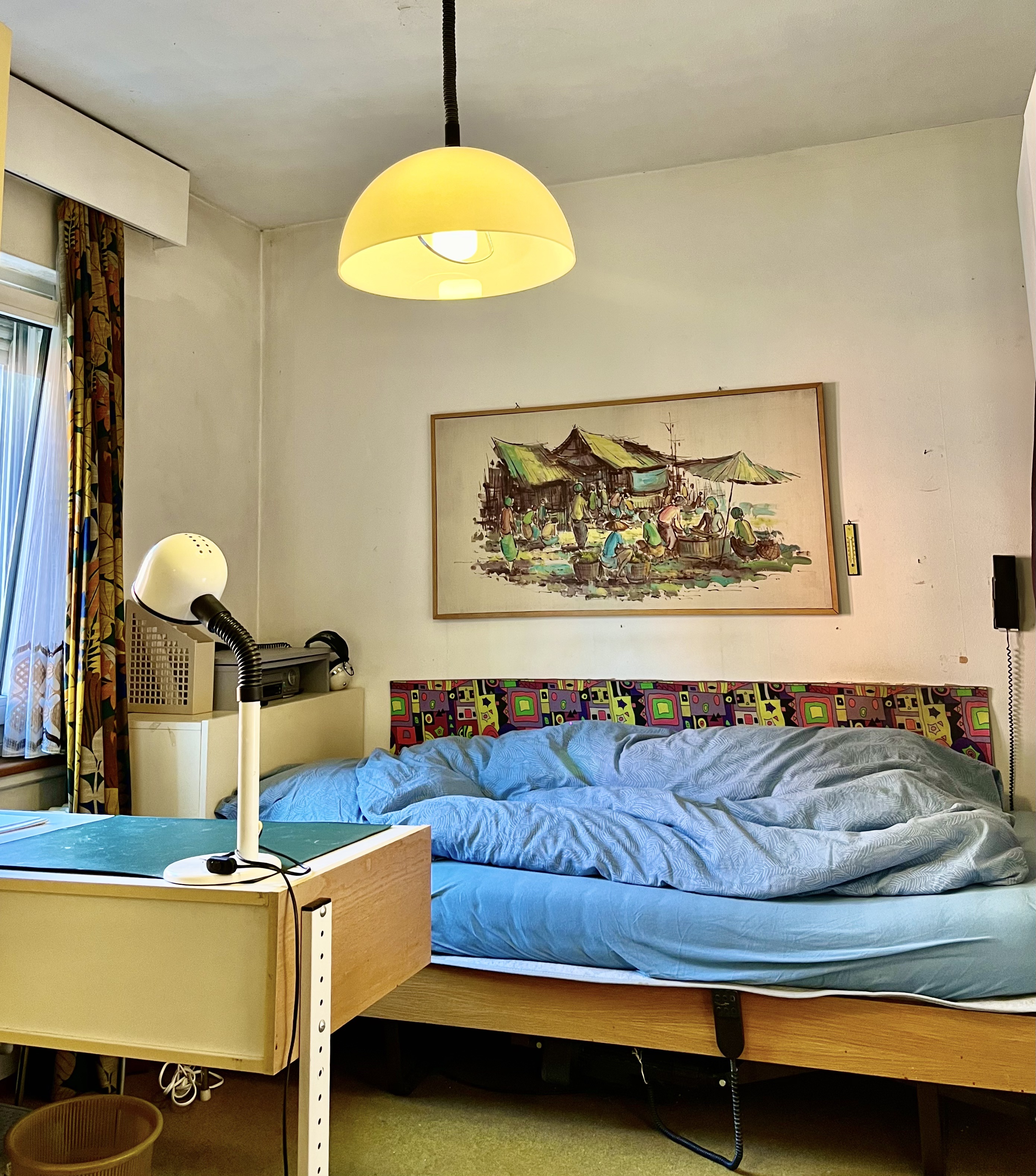
The room I stayed in was what used to be Herianto’s. It was the semiotics of his mind and interests, with drawers dedicated to glasses, glass cases and drawing supplies, a closet full of photography equipment, and another, curiously, dental supplies and health products. Among these neat tools, there at the same time emerged a sculpture of Indonesian-inspired creature, and neckties with Batik patterns and Chinese calligraphy. Working in the room, I channelled these two flows of energy—the structural and architectural stream with the cultural flare of diasporic trace.
Sprawling from the room to the entire house, more and more rich signs of life came to sight. I was particularly drawn to unintended marks left in the house – paint marks on the closet, dent on the carpet, ruptures on the kitchen chairs, the juxtaposition of cultures harmoniously existing within – like the bamboo fan with the Chinese character ‘囍 blessing’ safely kept in the cabinet underneath sculptures of Indonesian god and goddess. As the new dweller in the space of Schubertstrasse enfolded the past, present and future, I felt fortunate to experience its memory-scape and weave it into my poetry.
Text by Jill Zheng
Photo Courtesy of Artist and SUAVEART
 細着藝術 SUAVEART