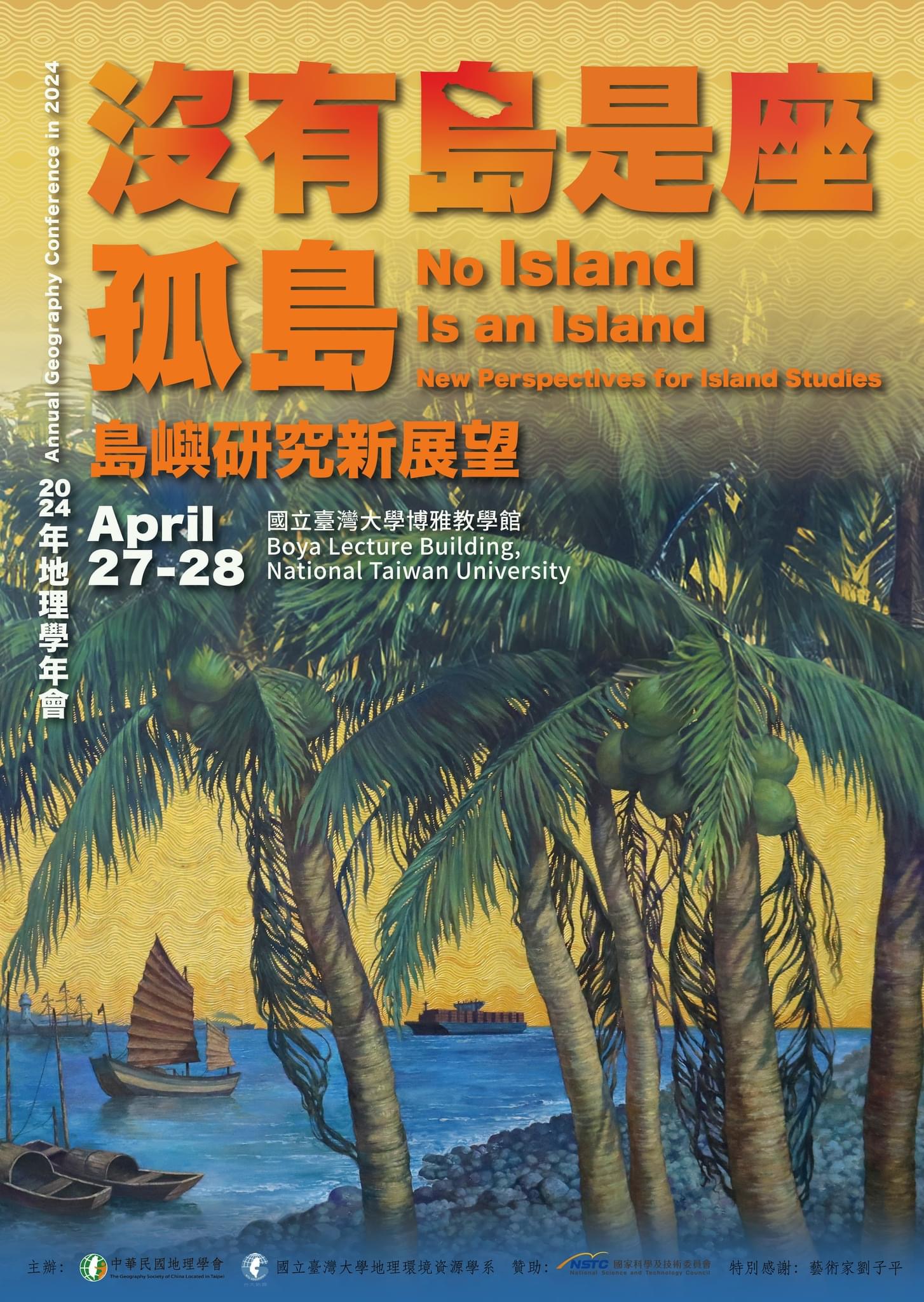
It’s thrilled to announce that Yipei Lee, the founder and curator of SUAVEART presented “Cogitating on Islands: The Translating of Humanistic Spirit and Contemporary Art Practice” under the topic “Island Exhibition and Performing Islands” in the Theme of “No Island Is an Island” at Annual Geography Conference on 27 April, 2024.
The presented artistic case is internet artist residency “Flaneur in the Insular Cities: Island Ecology” co-curated with Jalan Besar Salon. The participating artists are Ivan Juarez from Mexico City, Elizabeth Gabriel Lee from Singapore, and x:x (Yuxiu Xiong & Yuxuan Xue) from Chengdu. While the commentaries were written by Cheong Kin Man and Yipei Lee.
Theme: No Island Is an Island: New Perspectives for Island Studies
The British poet John Donne (1572-1631) famously wrote the line “No man is an island.” Donne was born during the 17th century, part of the Age of Exploration, a time when knowledge of people and customs from across the world flooded in like waves from the sea. In this environment, Donne came to realize that everyone and everything in the world are connected. He concludes this poem in a slightly darker tone: when you hear the bell toll in the village, there is no need to find out who has passed. Why? Because within this network of interconnected people, when someone passes, part of you also fades away. “For whom the bell tolls, it tolls for thee!”
Looking back from today, Donne did not hold a favorable opinion of islands. Compared to continents, he believed islands are self-isolated and sequestered from the outside world. His position is not difficult to understand. In Western academic thought, islands are associated with the word “insularity,” implying myopia, narrowness and seclusion. Islands thus are in clear contrast with continents, which symbolize openness, diversity and tolerance.
The Enlightenment era thinker Francis Bacon, who wrote of an “island of truth,” once said that if a person can treat strangers with a kindness, it means that they are a “citizen of the world,” possessing a heart not an island, but a continent.
Contemporary island studies aims to break through these stereotypes. Whether in natural sciences, humanities or social sciences, islands have always been important not only as indispensable sources of inspiration, but also as “laboratories” for testing new ideas. Islands are central to well-known events and intellectual production of recent history: Daniel Defoe’s Robinson Crusoe and Darwin’s collections from the Galápagos Islands; the transformation of evolutionary biology brought about by Edward O. Wilson and Robert MacArthur’s island biogeography; U.S. nuclear testing at Bikini Atoll during the Cold War and portrayals of Earth as an island in Cold War environmental discourse. While inheriting this rich academic genealogy, contemporary island studies also attempts to place islands at the center of its analytical vision. Islands are no longer merely a source of inspiration for continental thought or a laboratory to answer questions; because islands possess diversity, hybridity and resilience that does not fit into the categories of continental thinking, they serve as an answer in the face of climate change, loss of ecological and cultural diversity, geopolitical conflict and restructuring, intensifying neoliberalism and exacerbated uneven development.
Perhaps the bell toll is getting louder for the future of human beings, other species and the sustainability of the earth’s ecology, but this toll does not necessarily herald an irreversible end. Instead, it could be a wake-up call, reminding us that we all live on islands of varying scales (after all, the Earth can be understood as an island). Cherishing the diversity and hybridity of islands and demonstrating that no island is isolated from interscalar and comparative perspectives are the main efforts of contemporary island studies. This is also the spirit of the invitation that this annual geography conference sends from the island of Taiwan to the world.
主題:沒有島是座孤島:島嶼研究新展望
「沒有人是一座島嶼」(no man is an island)是英國詩人多恩(JohnDonne, 1572-1631)的著名詩句。生長在 17 世紀的他,正值地理大發現的年代,大量關於世界各地之風土民情的知識如海濤般襲來。他逐漸體會到,世界上的人事物均是彼此相連。在該詩的末尾,多恩以略為暗黑的筆法,總結他的發現。他說,當你聽到村落裡響起了喪鐘,用不著遣人探詢是誰離開了人世。為什麼?因為在這人與人共構成的網絡中,某人的逝去也意味著你的一部分也隨之消逝。“For whom the bell tolls, it tolls for thee!”
從今日的角度,當多恩寫下這首詩時,他對島嶼並無好感。他認為,相較於大陸,島嶼是自我隔離的,與外界斷絕聯繫的。這也不難理解。在西方學術思潮中,島嶼常與 insularity 一詞連結在一起,意味著某種目光如豆、心胸狹窄、閉關自守的島嶼根性(insularity),與象徵開放、多元、包容的「大陸」,形成明顯對照。勾勒真理之島(island of truth)的啟蒙時代大師培根(Francis Bacon)便曾表示,如果一個人可以親切的態度對待陌生人,這就意味著他是「世界的公民」,他的心靈不是一座島嶼,而是一片大陸。當代的島嶼研究便是要破除前述刻板印象。事實上,不論是自然科學,還是人文社會科學,島嶼的身影一直都在,不僅提供不可或缺的靈感來源,更是測試這些靈感的「實驗室」。從迪福(Daniel Defoe)的《魯賓遜漂流記》至達爾文於加拉貝戈島的採集,從威爾森(E. O. Wilson)與麥克阿瑟(Robert H.MacArthur)以島嶼生物學改寫演化生物學的知識地景,至美國於冷戰年代在比基尼環礁的核子試爆,以及冷戰環境論述中如同島嶼的地球,均是廣為人知的例子。當代的島嶼研究在繼承如此豐富之學術系譜的同時,也試著把島嶼放在分析視野的中心。島嶼不再是大陸思維的靈感來源或提供答案的實驗室而已;因其大陸思維無法輕易歸類的多樣性、混雜性與韌性,面對氣候變遷、生態及文化多樣性之喪失、地緣政治之重組與衝突、新自由主義的升級與深化、變本加厲的不勻發展,島嶼本身就是答案。
在這個意義上,或許在人類及其他物種的未來、地球生態的永續等面向上,喪鐘已經越來越響亮了,但這喪鐘不見得預示無可挽回的終結。相反的,它可能是一個喚醒的鐘聲,提醒我們其實都活在不同尺度的島嶼之上(畢竟,地球也可理解為是座島嶼)。珍視島嶼的多元與混雜,以跨尺度與比較的視野彰顯沒有一座島嶼是座孤島,是當代島嶼研究的主要主題,也是本屆地理學年會希望從臺灣島向世界發出的邀請函。
Abstract
The motivation of this research is to explore the concrete and intangible context of the islands which is relatively regarded as the concept opposite to continental through the process of contemporary art practice. What is the definition of the island in human cognition? Whether it is a geographical or spiritual island that shapes the ideology and values of individuals in the current society, how does this island communicate, interact or connect with another subject if it becomes the subject? Whether it is the natural landscape or the human landscape, is there always alternative to reflect the similarity and diversity among the islands.
My research methodology is to collect the mankind’s perspectives from the islands and in the mainland through travelling, fieldwork interviews, curatorial practices such as workshops, podcast, physical and online residency programmes, and publications, etc. I attempt to deconstruct the above questions into multiple steps, which will lead to thoughts and dialogues. Primarly I have the acumulatives of keywords, definitions, and writings from peers, and are not limited to the language that we use in daily conversations. Gradually it is developed into a textual basis for next dialogues that will continue to reflect with ideas, realities and challenges among the islands.
Within the practices, I have mainly found that when the island as a core idea cogitates with other cultures, the interactions become closer, more subtle and more real, but the uncertainty increases at the same time.“Cogitating on Islands” is like alternative philosophy and methodology, there is a freedom to look at the facts without limiting the judgement to the frameworks of nationality, race, gender, etc. Instead, there are more dialogues and narratives, which allow us to shape the opportunities for innovation and solutions to future climate change.
Keywords: Cogitating on Islands, Insular keyword, Diversity, Narratives
摘要
研究動機是想透過當代藝術的實踐過程,探索島嶼這個相對於被視為與大陸相反概念的具體和無形的人文精神脈絡。究竟島嶼在人類認知中的定義為何?無論是地理性或精神性的島嶼形塑了當前社會個體意識形態與價值觀,若這座島成為主體時,該如何與另一個主體溝通、互動或產生連結。不論是自然景觀或人文景觀,是否有機會真實地反應出島嶼之間彼此的相似性和多樣性。
我的研究方法則是透過旅行、田調訪談、相關策展概念的策劃,如工作坊、Podcast、實體與線上駐村、出版等方式,採集來自島國和在大陸地區人們的觀點,試圖將上述提問解構為多個步驟,進而觸發思想與對話,初期有關鍵字、定義、個人與他者的書寫等累積,且不限於我們平日對話所使用的語言,逐步發展成未來計畫的文本基礎,繼續碰撞關於島嶼的思想、現況與挑戰。
在個人的實踐當中主要發現到,當島嶼作為核心思維與其他地域文化碰撞時,該時空下的互動性更為密切、細膩與真實,然而不確定性會大幅提高。島嶼像另類的哲學和方法論,存在觀看事實的自由度,不侷限在國土、種族、性別等框架的評斷。反而是頻繁地對話和知識系統交換則有機會碰撞出應對未來氣候變遷的創新與解方。
關鍵詞:思索在島、島嶼關鍵字、多樣性、書寫
Read full article on:
Agenda 2024
 細着藝術 SUAVEART